
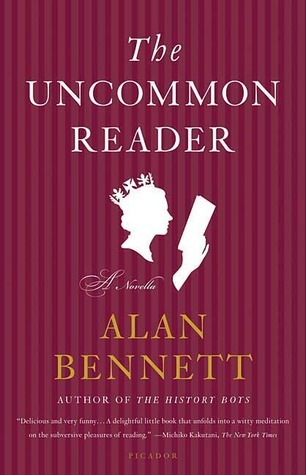
More on this book
Community


Kindle Notes & Highlights


‘What does Your Majesty like?’ The Queen hesitated, because to tell the truth she wasn’t sure. She’d never taken much interest in reading. She read, of course, as one did, but liking books was something she left to other people. It was a hobby and it was in the nature of her job that she didn’t have hobbies. Jogging, growing roses, chess or rock climbing, cake decoration, model aeroplanes. No. Hobbies involved preferences and preferences had to be avoided; preferences excluded people. One had no preferences. Her job was to take an interest, not to be interested herself. And besides, reading
...more
The next morning she had a little sniffle and, having no engagements, stayed in bed saying she felt she might be getting flu. This was uncharacteristic and also not true; it was actually so that she could get on with her book. ‘The Queen has a slight cold’ was what the nation was told, but what it was not told and what the Queen herself did not know was that this was only the first of a series of accommodations, some of them far-reaching, that her reading was going to involve.
Queen gave Norman her Nancy Mitford to return, telling him that there was apparently a sequel and she wanted to read that, too, plus anything else besides he thought she might fancy. This commission caused him some anxiety. Well-read up to a point, he was largely self-taught, his reading tending to be determined by whether an author was gay or not. Fairly wide remit though this was, it did narrow things down a bit, particularly when choosing a book for someone else, and the more so when that someone else happened to be the Queen.
What she was finding also was how one book led to another, doors kept opening wherever she turned and the days weren’t long enough for the reading she wanted to do.
‘Of course,’ said the Queen, ‘but briefing is not reading. In fact it is the antithesis of reading. Briefing is terse, factual and to the point. Reading is untidy, discursive and perpetually inviting. Briefing closes down a subject, reading opens it up.’ ‘I wonder whether I can bring Your Majesty back to the visit to the shoe factory,’ said Sir Kevin. ‘Next time,’ said the Queen shortly. ‘Where did I put my book?’
‘I can understand,’ he said. ‘Your Majesty’s need to pass the time.’ ‘Pass the time?’ said the Queen. ‘Books are not about passing the time. They’re about other lives. Other worlds. Far from wanting time to pass, Sir Kevin, one just wishes one had more of it. If one wanted to pass the time one could go to New Zealand.’
‘I read, I think,’ she said to Norman, ‘because one has a duty to find out what people are like,’ a trite enough remark of which Norman took not much notice, feeling himself under no such obligation and reading purely for pleasure, not enlightenment, though part of the pleasure was the enlightenment, he could see that. But duty did not come into it. To someone with the background of the Queen, though, pleasure had always taken second place to duty. If she could feel she had a duty to read then she could set about it with a clear conscience, with the pleasure, if pleasure there was, incidental.
...more
Books did not defer. All readers were equal, and this took her back to the beginning of her life. As a girl, one of her greatest thrills had been on VE night when she and her sister had slipped out of the gates and mingled unrecognised with the crowds. There was something of that, she felt, to reading. It was anonymous; it was shared; it was common. And she who had led a life apart now found that she craved it. Here in these pages and between these covers she could go unrecognised.
her long-standing lines of inquiry – length of service, distance travelled, place of origin – and had embarked on a new conversational gambit, namely, ‘What are you reading at the moment?’ To this very few of Her Majesty’s loyal subjects had a ready answer (though one did try: ‘The Bible?’). Hence the awkward pauses which the Queen tended to fill by saying, ‘I’m reading . . . ,’ sometimes even fishing in her handbag and giving them a glimpse of the lucky volume. Unsurprisingly the audiences got longer and more ragged, with a growing number of her loving subjects going away regretting that they
...more
‘I don’t see,’ said the Queen, ‘why there is any need for a press release at all. Why should the public care what I am reading? The Queen reads. That is all they need to know. “So what?” I imagine the general response.’ ‘To read is to withdraw. To make oneself unavailable. One would feel easier about it,’ said Sir Kevin, ‘if the pursuit itself were less . . . selfish.’ ‘Selfish?’ ‘Perhaps I should say solipsistic.’ ‘Perhaps you should.’ Sir Kevin plunged on. ‘Were we able to harness your reading to some larger purpose – the literacy of the nation as a whole, for instance, the improvement of
...more
Nor initially did she discuss her reading with anyone, least of all in public, knowing that such a late-flowering enthusiasm, however worthwhile, might expose her to ridicule. It would be the same, she thought, if she had developed a passion for God, or dahlias. At her age, people thought, why bother? To her, though, nothing could have been more serious, and she felt about reading what some writers felt about writing: that it was impossible not to do it and that at this late stage of her life she had been chosen to read as others were chosen to write. To begin with, it’s true, she read with
...more
That the Queen could readily switch from showbiz autobiography to the last days of a suicidal poet might seem both incongruous and wanting in perception. But, certainly in her early days, to her all books were the same and, as with her subjects, she felt a duty to approach them without prejudice. For her, there was no such thing as an improving book. Books were uncharted country and, to begin with at any rate, she made no distinction between them. With time came discrimination, but apart from the occasional word from Norman, nobody told her what to read, and what not. Lauren Bacall, Winifred
...more
It was this sense of making up for lost time that made her read with such rapidity and in the process now making more frequent (and more confident) comments of her own, bringing to what was in effect literary criticism the same forthrightness with which she tackled other departments of her life. She was not a gentle reader and often wished authors were around so that she could take them to task.
It was exciting to be with writers she had come to think of as her friends and whom she longed to know. But now when she was aching to declare her fellow-feeling with those whose books she had read and admired, she found she had nothing to say. She, who had seldom in her life been intimidated by anyone, now found herself tongue-tied and awkward. ‘I adored your book’ would have said it all, but fifty years of composure and self-possession plus half a century of understatement stood in the way. Hard put for conversation, she found herself falling back on some of her stock stand-bys. It wasn’t
...more
Authors, she soon decided, were probably best met with in the pages of their novels, and as much creatures of the reader’s imagination as the characters in their books. Nor did they seem to think one had done them a kindness by reading their writings. Rather they had done one the kindness by writing them.
Having lightly dug an oak sapling into the reclaimed earth of a bleak urban farm above the Medway, she rested on the ceremonial spade and recited by heart Philip Larkin’s poem ‘The Trees’, with its final verse: Yet still the unresting castles thresh In fullgrown thickness every May. Last year is dead, they seem to say, Begin afresh, afresh, afresh. And as that clear and unmistakeable voice carried over the shabby wind-bitten grass, it seemed it was not just the huddled municipal party she was addressing but herself, too. It was her life she was calling upon, the new beginning hers.
‘One recipe for happiness is to have no sense of entitlement.’ To this she added a star and noted at the bottom of the page: ‘This is not a lesson I have ever been in a position to learn.’ ‘I was giving the CH once, I think it was to Anthony Powell, and we were discussing bad behaviour. Notably well-behaved himself and even conventional, he remarked that being a writer didn’t excuse one from being a human being. Whereas (one didn’t say this) being Queen does. I have to seem like a human being all the time, but I seldom have to be one. I have people to do that for me.’
The equerry, with whom she’d never shared such confidences before and who ought to have been flattered, simply felt awkward and embarrassed. This was a truly human side to the monarch of which he’d never been previously aware and which (unlike its counterfeit versions) he did not altogether welcome. And whereas the Queen herself thought that such feelings probably arose out of her reading books, the young man felt it might be that she was beginning to show her age. Thus it was that the dawn of sensibility was mistaken for the onset of senility. Immune to embarrassment herself, as she was to
...more
Though the Queen was always discreet about writing in her notebooks, her equerry was not reassured. He had once or twice caught her at it and thought that this, too, pointed to potential derangement. What had Her Majesty to note down? She never used to do it, and like any change of behaviour in the elderly it was readily put down to decay. ‘Probably Alzheimer’s,’ said another of the young men. ‘You have to write things down for them, don’t you?’ and this, taken together with Her Majesty’s growing indifference to appearances, made her attendants fear the worst.
‘Reading, ma’am.’ ‘I beg your pardon.’ ‘Your Majesty has started reading.’ ‘No, Sir Claude. One had always read. Only these days one is reading more.’
‘I see no harm in reading in itself, ma’am.’ ‘One is relieved to hear it.’ ‘It’s when it’s carried to extremes. There’s the mischief.’ ‘Are you suggesting one rations one’s reading?’ ‘Your Majesty has led such an exemplary life and that it should be reading that has taken Your Majesty’s fancy is almost by the way. Had you invested in any pursuit with similar fervour, eyebrows must have been raised.’ ‘They might. But then one has spent one’s life not raising eyebrows. One feels sometimes that that is not much of a boast.’
‘Has Your Majesty ever considered writing?’ ‘No,’ said the Queen, though this was a lie. ‘Where would one find the time?’ ‘Ma’am has found time for reading.’ This was a rebuke and the Queen did not take kindly to rebukes, but for the moment she overlooked it. ‘What should one write?’ ‘Your Majesty has had an interesting life.’ ‘Yes,’ said the Queen. ‘One has.’ The truth was Sir Claude had no notion of what the Queen should write or whether she should write at all, and he had only suggested writing in order to get her off reading and because in his experience writing seldom got done. It was a
...more
The boy finished, the audience applauded, and clapping too, she leaned over towards another of the party as if sharing her appreciation. But what she wanted to say was that, old as she was, renowned as she was, no one knew her voice. And in the car taking them back she suddenly said: ‘I have no voice.’
And it occurred to her (as next day she wrote down) that reading was, among other things, a muscle and one that she had seemingly developed. She could read the novel with ease and great pleasure, laughing at remarks, they were hardly jokes, that she had not even noticed before. And through it all she could hear the voice of Ivy Compton-Burnett, unsentimental, severe and wise. She could hear her voice as clearly as earlier in the evening she had heard the voice of Mozart. She closed the book. And once again she said out loud: ‘I have no voice.’ And somewhere in West London where these things
...more
In the darkness it came to the Queen that, dead, she would exist only in the memories of people. She who had never been subject to anyone would now be on a par with everybody else. Reading could not change that – though writing might. Had she been asked if reading had enriched her life she would have had to say yes, undoubtedly, though adding with equal certainty that it had at the same time drained her life of all purpose. Once she had been a self-assured single-minded woman knowing where her duty lay and intent on doing it for as long as she was able. Now all too often she was in two minds.
...more
She found, though, that when she had written something down, even if it was just an entry in her notebook, she was happy as once she would have been happy after doing some reading. And it came to her again that she did not want simply to be a reader. A reader was next door to being a spectator, whereas when she was writing she was doing, and doing was her duty.
‘Is there anything specific that Your Majesty is looking for?’ said the librarian after he had brought her yet another pile of material. ‘No,’ said the Queen. ‘One is just trying to remember what it was like. Though what “it” is one isn’t sure either.’ ‘Well if Your Majesty does remember, then I hope you will tell me. Or better still, ma’am, write it down. Your Majesty is a living archive.’ Though she felt he could have expressed this more tactfully, she knew what he meant and reflected, too, that here was someone else who was urging her to write. It was almost becoming a duty, and she had
...more
