
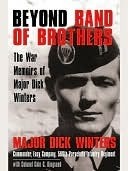
More on this book
Community


Kindle Notes & Highlights

by
Dick Winters
Read between
December 9 - December 21, 2022

The dark memories do not recede; you live with them and they become a part of you. Each man must conquer fear in himself.
To find a quiet peace is the dream of every soldier. For some it takes longer than others. In my own experience I have discovered that it is far easier to find quiet than to find peace. True peace must come from within oneself.
I learned a valuable lesson that nothing is ever guaranteed. However, you adjust; you get used to the little things and hope for the best.
Today I realize what the Barnes family did was help me develop the most fundamental element in good leadership—lead by example, live by setting a good example.
An officer should never put himself in a position where he takes anything from the men. Never abuse them by act or omission. As a commander, a leader must be prepared to give everything, including himself, to the people he leads.
On the verge of a major deployment, it was important to hold on to something from home.
A leader gains an advantage in combat if he is able to appraise the terrain and the situation quickly and correctly.
Once the battle began, discipline and training overcame our individual and collective fears.
In both training and combat, a leader senses who his killers are. I merely put them in a position where I could utilize their talents most effectively. Many other soldiers thought they were killers and wanted to prove it. In reality, however, your killers are few and far between.
This core of warriors survived, at least until the fates finally abandoned them, because they developed animal-like instincts of self-preservation.
Another thing I noted about being overseas and away from home was that I found myself not giving a damn about trivial things.
What I needed instead was to get out and run, or walk, or sing, or do something to alter my frame of mind. It usually resulted in a run.
Soldiers draw comfort being in close proximity to their fellow soldiers.
After watching men fight and die with increasing regularity, I no longer found anything to say that was worth saying. In truth, I noticed myself becoming increasingly distant. And if I had nothing worthwhile to say, why write?
As the weather further deteriorated, physical exhaustion combined with mental fatigue to produce an unusually high number of casualties now classified as combat exhaustion or battle fatigue. In Normandy I had witnessed lots of stress; some in Holland; but much more at Bastogne due to the cold, lack of sleep, and constant artillery bombardment. I’m not sure that anybody who lived through Bastogne hasn’t carried with him, in some hidden ways, the scars of fatigue. Perhaps, that is a factor that keeps 101st paratroopers bonded so unusually close.
Physical exhaustion leads to mental exhaustion, which in turn, causes men to lose discipline. Loss of self-discipline then produces combat fatigue. Self-discipline keeps a soldier doing his job. Without it, he loses his pride and he loses the importance of self-respect in the eyes of his fellow soldiers. It is pride that keeps a soldier going and keeps him in the fight.
One last observation on combat fatigue: When you see a man break, he usually slams his helmet down and messes up his hair. I don’t know if it’s conscious or unconscious, but a soldier goes to his head and massages his head, shakes it, and then he’s gone. You can talk to him all you want, but he cannot hear you. When he reaches that point, the best thing for everybody is just to let him take a walk.
War had become old to Sergeant Joe Toye, and he was good at it. The lives of his squad depended on his ability to master his craft. In a sense, Toye and his platoon sergeant Bill Guarnere had become what Ernie Pyle termed “senior partners in the institution of killing” and caring for their men.
Just as soon as the last round falls, as a leader you must begin circulating among the men. “Is everybody okay? Let’s get up. Let’s move. Keep your eyes open for an attack.” Get the men’s attention. And moving among your men—the very fact that they see you and they are talking to you—they know that you are there and it makes all the difference in the world to realize that they are not in this by themselves. Even if a soldier remains fixed on his own feelings and his own fear, and if his leader is moving among the men, the soldier realizes that his leader is sharing the same hardship he himself
...more
Every military operation, no matter how large or how small, has two components: a scheme of maneuver and a plan for fire support.
considered it far too dangerous to place an unproven officer in command of a combat patrol when veteran noncoms were available.
I certainly didn’t feel like writing anymore. I couldn’t explain why, but the only emotion that I could arouse were feelings of anger and after staying mad all day and half the night, I was just plain tired. Mad at what? Just about everything, for just about everything was done wrong or it wasn’t done perfectly. Since nothing but perfection was acceptable, I stayed mad. What struck me most was how damn tired I became by the end of each day and how difficult it was to concentrate.
Combat required that my thoughts and feelings remain hard, cold, indifferent, and effective. As to any tender thoughts I might have possessed before the war, I had left them behind in the marshalling area in England.
Did I feel guilty about this? Did my conscience bother me about taking over this beautiful home? No! We had been living in foxholes in Normandy; we had been in the mud at Holland; and we had suffered in the freezing cold at Bastogne. Just a few days earlier I had seen a concentration camp not 100 miles from here. These people were the reason for all this suffering. I felt no sympathy for their problems. I did not feel that I owed them an explanation.
When I realized that the war was over, I felt like a retired fire horse. It’s over, I thought. I’m finished. I did not know what to do with myself, nor did I have much time to think about it. While Americans celebrated the end of the European war in Times Square, the war was sure as hell not over for me.
There are times that the army comes up with some rules and orders that defy common sense and are meant to be disobeyed.
That’s what I really enjoyed, just drifting around and thinking of nothing in particular.
Writing to DeEtta Almon, I summarized the war from my personal perspective, but I found it impossible to convey my innermost thoughts to someone who had not experienced combat. I had grown frigid mentally and couldn’t think of anything to write.
The attention is flattering, but nobody really knows me. The neighbors, the people whom I have known most of my life, now see a different part of me as a result of the television series. Still, it is impossible to convey the horrors of war to someone who has not experienced the crucible of combat. It is not their fault; like most veterans, I have only recently spoken about the war. World War II was, and remains, an intensely personal experience.
Combat fatigue, the desire to flee, is stopped by small-unit morale.”
“If we were afraid of anything, it was that we wouldn’t measure up. We wanted to be heroes: not to the American public or in books, but to each other.”
“It has been a long war; it’s been a hard war. You have fought bravely, proudly for your country. You are a special group of men connected by a bond that only exists in combat. You’ve shared the incommunicable experience of war and have been tested under extreme adversity. You’ve shared foxholes and held each other in dire moments. You’ve seen death and have suffered together. You’ve lived in an environment totally incomprehensible to those who do not know war. I am proud and deeply honored to have served with every one of you. You all deserve long and happy lives in peace. I bid each of you
...more
Each situation is different and each requires a leader to be flexible in adapting his or her particular leadership style to the specific circumstances required to accomplish any mission. It’s a matter of adjusting to the individual, and you do this every day. You don’t have just one way of treating people. You adjust yourself to whom you are talking.
a leader should strive to be an individual of flawless character, technical competence, and moral courage.
Character provides a leader with a moral compass that focuses his efforts on the values we cherish: courage, honesty, selflessness, and respect for our fellow man. Character also allows you to make decisions quickly and correctly.
Those entrusted to lead must study their profession to become totally proficient in tactics and technology.
Second, don’t waste time attempting to define leadership. No need to go to the dictionary. The Infantry School at Fort Benning, Georgia, has defined leadership in just two words via its motto: “Follow Me!” Never ask your team to do something you wouldn’t do yourself.
You cannot make sound decisions unless you are at the point of attack. Leaders should always position themselves where the critical decisions must be made.
Successful leaders must be highly visible, if for no other reason than to share the hardships of their men.
Physical fitness is another prerequisite for success. I freely admit that I was blessed with a sound physical constitution, but whenever possible, I took opportunity to improve my physical stamina.
A fourth key to Easy Company’s success, as well as 2d Battalion’s, centered on the development and the nourishment of teamwork.
Having selected the right men for the right job, I then delegated the authority to my subordinates and allowed them to use their initiative to execute the mission. There is no need to tell someone how to do his job if you have properly trained your team.
I would also urge leaders to remain humble. If you don’t worry about who gets the credit, you get a lot more done.
Next, I would encourage leaders to take a moment of self-reflection before rushing into an important decision. Many leaders don’t take the time to consider carefully their decisions or the implications of their actions.
The opportunity for self-analysis allows you to find your own self-consciousness, which in turn tells you if you are getting off track.
Lastly, “Hang Tough!” Never, ever, give up regardless of the adversity. If you are a leader, a fellow who other fellows look to, you have got to keep going.
medals on his chest to stand out. It is what each man carries in his chest that makes him different. It is the confidence, pride, and character that make the World War II generation stand out in any crowd.
War brings out the worst and the best in people. Wars do not make men great, but they do bring out the greatness in good men. War is romantic only to those who are far away from the sounds and turmoil of battle. For those of us who served in Easy Company and for those who served their country in other theaters, we came back as better men and women as a result of being in combat, and most would do it again if called upon. But each of us hoped that if we had learned anything from the experience, it is that war is unreal and we earnestly hoped that it would never happen again.
Strive to be a leader of character, competence, and courage. Lead from the front. Say, “Follow me!” and then lead the way. Stay in top physical shape—physical stamina is the root of mental toughness. Develop your team. If you know your people, are fair in setting realistic goals and expectations, and lead by example, you will develop teamwork. Delegate responsibility to your subordinates and let them do their jobs. You can’t do a good job if you don’t have a chance to use your imagination or your creativity. Anticipate problems and prepare to overcome obstacles. Don’t wait until you get to the
...more
Remain humble. Don’t worry about who receives the credit. Never let power or authority go to your head. Take a moment of self-reflection. Look at yourself in the mirror every night and ask yourself if you did your best. True satisfaction comes from getting the job done. The key to a successful leader is to earn respect—not because of rank or position, but because you are a leader of character. Hang Tough!—Never, ever, give up.
