
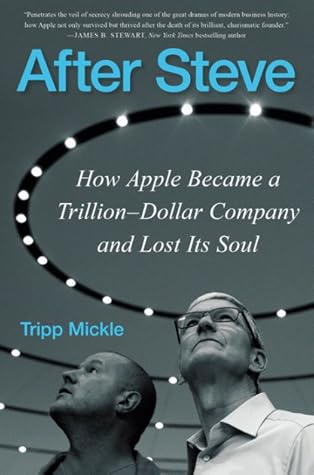
More on this book
Community


Kindle Notes & Highlights

by
Tripp Mickle
Read between
June 30 - July 13, 2022

His gift was not the creation of new products. Instead, he had invented countless ways to maximize margins, squeezing some suppliers and persuading others to build factories the size of cities to churn out more units.
Disney had structured his company much as Jobs structured Apple. It had been flat, staff members hadn’t had titles, and everyone had been called by their first name. “If you’re important to the company,” Disney said, “you’ll know it.” The philosophy
As they updated colleagues on their areas of responsibilities, such as hardware and software, a few felt a listlessness take root. Whereas Jobs had made instant, instinctive decisions, relying on his gut as much as his brain, Cook moved slowly and preferred analysis.
“He was one of those kids that you don’t get to know very well,” said Eddie Page, the school’s band director. His chemistry teacher, Ken Brett, called him an intellectual who was “soft spoken, easy to get along with, never slack on his homework.” For several years, his classmates named him “Most Studious.”
The community was unofficially a Sundown town, a term used across the South for towns where race-based restrictions discouraged Black people from being out after dark. When night fell in Robertsdale, Black residents retreated to their homes in the neighboring towns of Loxley and Silver Hill. In 1969, the local school began busing Black students from those areas into Robertsdale. Some locals resisted integration. The family of one of the first Black students to integrate the high school opened their mailbox to find a pipe bomb inside.
Former classmates, neighbors, and friends took exception to the way Cook had used his prominent position to portray his hometown in a negative light. Deepening their frustration was their collective conviction that the episode the New York Times described had never happened.
Cook watched the energy drain out of his upbeat boss. Later, Petsch summoned Cook back to his office. He told Cook that he was planning to retire as head of Compaq’s operations in a year. He wanted Cook to take his job. Though they had worked together for only eight months, Petsch owned Compaq stock and wanted its share price to increase. As a shareholder, he thought that keeping Cook at the company would ensure that its stock price would rise.
There was a new way of doing things: Design came first.
Ive was amazed. In most places that decision would have taken months. Jobs had made it in a half hour. The iMac’s success transformed both
Jobs was skilled at finding creative partners. Apple had sprouted out of his partnership with Steve Wozniak. His relationship with Ive over the next few years would become central to his second act at Apple.
questioned the stainless-steel case and molded body, and challenged Ive’s vision for engraving Apple’s logo on its rear rather than on its front.
He had a generous spirit and endeared himself to colleagues by arranging the delivery of flowers or champagne to their hotel rooms during family vacations. A by-product of that kindness and generosity was greater loyalty across a company that worked to bring his designs to life.
If a cost-conscious supplier chose to use low-priced, reground plastic, Ive could detect with a glance that they had violated Apple’s requirement to use virgin material.
Inside a company of nerdy engineers, they embodied art school cool. They dressed casually in T-shirts, hoodies, and designer jeans. They drove expensive cars, among the priciest being Ive’s Aston Martin DB9, which had cost about $250,000. They obsessed over their hobbies: De Iuliis perpetually searched for the world’s best coffee; Julian Hönig, an avid surfer, shaped his own boards; and Eugene Whang created a record label, Public Release, and DJ’d under his nickname, Eug, at clubs. They
Over the years, they had discussed how to measure success and agreed that it would not be dictated by share price or sales volume.
Under those metrics, rival Microsoft became successful only to eventually stagnate. Instead, they decided it would come down to their subjective opinion: Were they proud of what they designed and built?
The Honda Accord could be seen before dawn, humming down the dark emptiness of the 101 freeway past the dim shadows of low-slung office buildings and shopping centers. Though Apple had given Tim Cook a base salary of $400,000 and a $500,000 signing bonus, he didn’t put a lot of value on what car he drove. It was just four wheels that got him to the gym and the office and back to his Palo Alto apartment at the end of the day.
He whipped staff forward through interrogation with a precision that reshaped the workplace. Intense, detailed, and exhausting, there was little margin for error. He seemed to absorb and retain all the information his underlings provided and learned the business faster than anyone had expected. Jobs had asked O’Sullivan to spend four months with Cook to teach him Apple’s operations; Cook mastered them in four or five days. He peeled away at issues with question after question. Silence followed. His Socratic style created a tense atmosphere that caused staff to squirm.
Apple’s operations team had reduced the number of days of inventory by two-thirds since Jobs’s return.
The more inventory turned, the less money a company spent on spoiling parts. The operations team detailed how it had increased its turn rate to more than twenty-five times a year, up from eight times, making it second in the industry only to Dell.
Within a few years, Apple built computers to order and held almost no inventory on its books. The operations team’s pursuit of that goal included painting a yellow line down the middle of factory floors. Components on one side of the yellow line remained on a supplier’s books until Apple moved them across the line to be assembled into a new computer. That reduced Apple’s costs because, under generally accepted accounting principles, the company wasn’t in possession of the inventory, even though it sat in its own warehouse, until the parts moved down an assembly line. The concept, which was
...more
the Lance Armstrong quote “I don’t like to lose. I just despise
At Apple’s request, Foxconn built a supply chain to make 1,500 units a day, but Jobs decided to change the computer’s target market from high-end professional customers to general consumers. Cook needed Foxconn to expand its capacity tenfold, and he needed it done fast. Apple’s quarterly results would hinge on the success of the new computer. Cook flew to China with some of Apple’s top engineers to oversee the expansion. He stayed there through Thanksgiving and Christmas, working on the factory floor to identify problems as computers came off the assembly line and escalate issues to Gou when
...more
After nearly finalizing terms with a chip supplier in the mid-2000s, Cook called the supplier and said he’d reconsidered. “I think you mistreated us, and don’t think we’ll negotiate anymore,” he said. He then went silent for days, as the supplier worried it had lost the deal. “What he’s hoping for is that you’ll come back with a huge give in the eleventh hour,” recalled the supplier, who eventually got the deal done. “Smart guys would have to say, ‘Keep the faith.’ It was old-school negotiations.”
Colleagues joked that the only thing in the place was a single set of utensils, a plate, a bowl, and a cup. Rumors spread that there were termites in the place.
Nearly a decade after moving to Palo Alto, one of the nation’s priciest housing markets, Cook finally purchased a relatively modest house, spending $1.97 million for the 2,300-square-foot home. Jobs lived a mile away in a stately home that was more than twice the size.
“This is really bad,” Cook had said. “Someone should go to China.” He had later looked at Khan and asked, “Why are you still here?” Khan had stood up, driven to San Francisco International Airport, and flown to China without a change of clothes.
They urged Jobs to promote him to chief operations officer and ease restrictions on executives serving as directors at other companies. It was not an easy
COOK QUICKLY BROADENED Apple’s attitude toward social causes. Less than a month after Jobs’s death, he introduced a corporate match program for charitable gifts, paving the way to direct contributions by the company to the Anti-Defamation League and others.
IF JONY IVE WAS Jobs’s prodigy of industrial design, Scott Forstall was his prodigy of software design.
He allowed staff to take a month after a software release to work on any project of their choosing. The policy helped birth new products for Apple, including the software design that became the impetus for a streaming video device, the Apple TV.
“They’re probably not going to like me bringing in an outside practitioner, so if I get stopped, I’m just going to dedicate a wing,” said Jobs, whose reputation for being a jerk could overshadow his generosity to friends and colleagues.
After Forstall’s design ideas triumphed, the animosity between the teams deepened because the hardware engineers believed that Forstall had blocked new features, such as a better camera, by discouraging his software engineers from prioritizing them.
Staff at Apple interpreted it as a sign of a new age of management. Jobs had favored rivalries between executives, encouraging people with egos to advance ideas that he could pick from to make great products. He could keep those dueling personalities in check. Whereas he might have torched Forstall and fired a subordinate directly responsible for Maps, Cook used the fiasco to eliminate disharmony on his leadership team and send a signal to the company that he wanted everyone to work together more than they had in the past. Without Jobs there to connect all the different areas of their
...more
When Jobs had returned in 1997, he had put the entire company under a single profit-and-loss statement and created an organization whose senior vice presidents managed the various areas of the business. That so-called functional structure meant that the heads of hardware, software, marketing, operations, finance, and legal reported directly to him. He had then created special project teams to build the iPod and the iPhone. As those products succeeded, the company’s structure flexed to suit Jobs. Software development was split by products, with Forstall leading iOS and Federighi leading MacOS.
...more
In a span of six months, the engineering team had transformed one of Apple’s iPods from a music player into a health product.
At Ive’s direction, they shifted from demonstrating how an app worked to making paper printouts that showed how an app looked. They became more like graphic designers than software savants.
THE KEY TO A PRODUCT’S SUCCESS is purpose. The iPod dominated music because it put a thousand songs into people’s pockets. The iPhone flourished because it combined a music player, phone, and computer into a single device. Not every gadget starts with such transformative goals in mind, but every one that succeeds springs from a well of deep thought and consideration.
And they explored how Swiss watchmakers had made complicated gears to tick off minutes, a craft upended in the 1970s by the arrival of quartz crystals and a battery-powered revolution. They synchronized the history lesson with purchases of some of the world’s finest watches. The orders were routed through a shell company called Avolonte Health, a startup Apple had created in a nearby medical office complex where its engineers were secretly at work on the noninvasive blood glucose–monitoring technology from Rare Light. Such covert businesses were sprinkled around the peninsula, enabling Apple
...more
The design was complicated by the heart sensors. The most accurate heart rate readings come from inside the wrist, where nurses take people’s pulse. But such a design would create a bulky band that would test people’s traditional notions of what a watch should be. The design team agreed that that hardware would need to live on the backside of the watch case.
Apple’s tax team explained that although the United States determines corporate residency by point of incorporation, in Ireland, where Apple Europe was based, it was determined by where the company was managed and controlled. Since Apple’s Irish subsidiary had no employees and was not managed or controlled in Ireland, it wasn’t treated as a tax resident of Ireland.
After they spoke, Roach realized that Apple wasn’t paying taxes in the United States on profits made in Europe because the money flowed to a subsidiary in Ireland, and it wasn’t paying taxes in Ireland on the profits in Europe because its Irish subsidiary was managed from the United States. A circular but clever logic trick was saving it billions of dollars in taxes.
Roach left the meeting and called a few tax experts to assess Apple’s practices. They all reacted with surprise. He and his fellow investigators sensed that they had unearthed something unique. They went back to Apple and its accountant for more information and additional interviews. They soon learned that Apple had three Irish subsidiaries with no tax residency anywhere, which had collected $74 billion in profits over a four-year period. A favorable agreement with the Irish government meant that it was paying less ...
This highlight has been truncated due to consecutive passage length restrictions.
Generally, he said, he believed that U.S. tax laws were unfair because they required companies to pay the same 35 percent tax rate on overseas earnings as they did at home. He considered the rate unreasonable and had been docking Apple’s cash in Ireland rather than bring it home. As the hour-long
APPLE’S OUTPOST in Washington, D.C., was intentionally tiny by corporate standards. Jobs had disdained politics and considered lobbying wasteful. The Senate’s tax investigation stretched the dozen-person team in ways the company had never anticipated.
Blankfein, whose hearing after the 2008 financial crisis had lasted ten hours, told Cook to not let his lawyers dictate his remarks. They want to protect you from legal jeopardy, he said, but that can limit how well you can shield the company from public criticism. He also arranged for Goldman’s and Apple’s communications teams to speak, paving the way to a press briefing before the hearing.
“Is it true you told our staff you are not bringing the $100 billion home unless we reduce our tax rates? Is that accurate?”
The activist’s pressure created a conundrum for Cook. Jobs hadn’t believed in returning cash to shareholders. Scarred by Apple’s near bankruptcy in 1996, he had favored building a treasure chest that could help the company in an economic downturn and give it the firepower to reinvest in the business when needed.
Icahn knew that Apple was holding more than $100 billion overseas to avoid paying U.S. taxes. He suggested that the company borrow against it and use the borrowed money to return cash to investors. Then, when the U.S. tax laws changed, it could return the cash from overseas to the U.S. and pay off the debt.
The camera design took more than nine months and required 561 different models before Ive was satisfied. Apple estimated that fifty-five engineers had spent a combined 2,100 hours on it. The company reused some of the manufacturing techniques in future Apple products, including the laser-etching process for MacBook speakers. Keats did the final assembly by hand and traveled to Germany to have Leica’s engineers ensure that the camera worked.
