
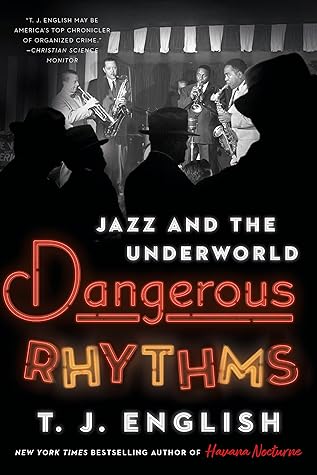
More on this book


Kindle Notes & Highlights

by
T.J. English
Read between
September 10 - September 22, 2024

There is a reason that “Strange Fruit” still stands as the seminal jazz song. Written by Abel Meeropol in 1937 and sung so memorably by Billie Holiday two years later, it beckons from the great beyond, elliptical and haunting. The song is both a ballad and a primal scream, an aching tone poem that carries with it the deep, heart-wrenching emotionalism of the blues, as well as the lucid, steely observationalism of someone who has been a witness to history. In form and content, it is a brutal diagnosis of the human condition in B-flat minor. That this song speaks for jazz at the core of its
...more
“Strange Fruit” finds its power in the perverse metaphoric imagery of “Black bodies swinging in the southern breeze, strange fruit hanging from the poplar trees . . .” Blood on the leaves, blood at the root. It is a song about lynching. And it is a song about America.
It is generally agreed that jazz as a new musical art form began to take shape in the early years of the twentieth century. It is not generally commented upon that jazz, in its origins, was a response to the horror and reality of lynching in America. But consider this: From 1882 to 1912, in the thirty years leading up to the onset of jazz, there were 2,329 instances of lynching of Black people in the United States (according to statistics of the Tuskegee Institute). Many believe this number is low, given that the documentation of lynching was suppressed for generations. During this period, a
...more
The fact that these spectacles were sometimes carried out with the acquiescence of legal authorities—politicians, local lawmen, Christian church leaders—undermined the confidence of Negroes in their own country. Lynching was designed to enforce the view that for Black folks in America, a sense of inferiority and terror was their rightful inheritance.
For the would-be inventors of jazz, this was the contemporary state of affairs. Black folks who sought to make music, to partake in a tradition that had flourished on the plantations and elsewhere for generations, did so with the knowledge that they were creating their sounds within a social context that was malignant and hostile. The instruments were not new. String instruments, various types of horns, the piano, and drums had been around for decades or, in some cases, centuries. But what these early musicians were attempting to do with these instruments was almost beyond calculation.
It is difficult—perhaps even impossible—for people today to grasp the full immensity of what was taking place. The early formations of jazz—the rhythm patterns, melodic phrasings, and occasionally aggressive syncopation—were revolutionary. It has been commented upon that the creation of jazz was an attempt to codify an entirely new language. But it was more than that: Jazz was an attempt to rearrange the molecular structure ...
This highlight has been truncated due to consecutive passage length restrictions.
The music was an affirmation of the human spirit, a declaration of the present tense. As the writer Stanley Crouch wrote, “Nothing says ‘I want to live’ as much as jazz.”
The criminal underworld, which became the domain of organized crime, was designed to be a parallel universe to the upperworld, both in its philosophical imperatives and its methods.
By now it is a familiar story: Successive waves of immigration filled out the ranks of organized crime. At the street level, Irish, Italian, Jewish, and other immigrant groups defined the terms of the underworld, but they did not create the system under which it operated. This was created by the white, Anglo-Saxon, Protestant (WASP) elite—the bank owners, land barons, early industrialists, and manipulators of capital who set the tone for a new century. The dye had been cast, and now the tapestry would be woven.
Jazz was not music that had been carefully fostered in conservatories or academies. It was the music of the people. And the fact that it flourished mostly at night and became associated with vice—bordellos, gambling, drinking, and artful carousing—only added to its charm.
Many gangsters of all ethnicities were drawn to jazz because they loved its energy and its rhythms. They sought to make this music part of their lives by owning the clubs where jazz was played, or by hanging out there, creating an atmosphere that contributed to and became interchangeable with the structural aspects of ragtime, Dixieland, swing, and bebop.
The average Black musician had less to fear from an Italian mafioso inside a club than he did from the average white cracker out on the street. The early twentieth-century musician had less to fear from a gangster than he did from a policeman. For people in the jazz world, the bordello and the honky-tonk were a source of refuge from a society where, among other threats and indignities, lynching was an ongoing nightmare, and had been for generations.
This book is an attempt to chart a narrative course through the history of both jazz and the underworld, focusing on the interactions between the musicians and the mob.
In later decades, rock and roll, rap, and hip-hop surpassed jazz in commercial popularity and cultural relevance, but for seventy years or so, jazz constituted close to 80 percent of record sales and dominated the airwaves through live radio broadcasts. Furthermore, it was the music Americans wanted to hear when they went out for a night on the town.
There was a time when most jazz clubs in cities like New York, Chicago, New Orleans, and Kansas City were “mobbed up.” Throughout the century, this model spread to other cities on the coasts (especially in Los Angeles) and in the Midwest (St. Louis, Detroit, Denver, and others). In the Nevada desert, an entire city was founded on the relationship between jazz and the underworld (Las Vegas), and the model was transported beyond the boundaries of the United States to Havana, Cuba, in an audacious attempt by the mob to go international.
The mobster hired musicians, which was good for the musicians. End of story. But it is not that simple. From the beginning, the relationship was based on a kind of plantation mentality. The musician was an employee for hire, not unlike the waitresses, busboys, and doormen who worked at the club. By its very nature, this was unfair to the musician. Patrons were drawn to a nightclub not because of the hired help, they were there because of the artistic talents of the musicians.
This saga is loaded with illuminating anecdotes and a startling cast of characters. On the musical side: Jelly Roll Morton, Fats Waller, Duke Ellington, Cab Calloway, Louis Prima, and many others. On the underworld side: Al Capone, Owney Madden, Legs Diamond, Mickey Cohen, and Bugsy Siegel, to name a few. The story also includes notorious club owners and talent managers like Morris Levy, Jules Podell, and Joe Glaser, men who walked a line between the two realms.
Armstrong and Sinatra were shining lights in a constellation of planets and stars, circling around larger spheres of power while dodging the occasional asteroid. As jazz unfolded throughout the twentieth century, the participants of this saga communed among celestial bodies, but they also wallowed in what the great pianist Mary Lou Williams referred to as “the muck and the mud” of the jazz business.
I am not writing here as much about jazz the music, as I am jazz the business and cultural phenomenon. Throughout the century, the culture of jazz was infused with all kinds of music and musicians who did not fit a present-day purist’s definition of jazz. This book addresses aspects of the business—the nightclubs, management relationships, dealings with agents and record companies, the relationship between musicians and mobsters as human beings—that became the foundation for all that came later.
It could be argued that this is not a book about jazz at all. It is a book about the American story, and the ways in which jazz became such an important compositional element of the narrative.
You cannot understand America without knowing the history of jazz—or the mob. Taken together, they are part of the country’s origin story, symphonically intertwined, like an orchestral extravaganza by Ellington, with harmonic complexity, rich tonal shadings, dissonance, syncopation, and all the other elements that make a piece of music resonate in the imagination and remain timeless. Through the striving of numerous musicians, club owners, record label executives, and gangsters chronicled in this book, the contrapuntal groove between jazz and the underworld emerges as the heartbeat—and the
...more
The funeral parades were serious musical displays, and many musicians—especially those who were canny showmen as well as brilliant players—emerged as stars. Cornet player Buddy Bolden, most notably, lit up the sky with his virtuosity and became the first great jazz legend in New Orleans. Young Louis Armstrong first saw and heard Buddy Bolden play at Funky Butt Hall, and like so many others, he was enraptured by the spirit of the music in ways that altered the trajectory of his life.
It came from the bordellos. Prostitution had existed in New Orleans almost from the beginning. The cultural tradition of fancy bordellos was brought to the region by the French, who established the convention of a madam, or matron, who presided over the establishment. The best houses had a well-appointed foyer with lace curtains, Oriental carpets, mirrors, and furniture imported from Europe. Here pimps, johns, and ladies of the evening met, drank champagne, and smoked fine cigars while awaiting the main event in a room upstairs or down the hall. New Orleans had dozens of high-class bordellos,
...more
Congo Square was a place of profound cultural expression, and it was also where, on the other days of the week, slave trading took place. Thus, in New Orleans, music and slave commerce were inexorably intertwined; the ground on which the roots of jazz found fertile soil was also a locale of capitalist exploitation and sorrow.
Before he’d ever even touched a cornet, he was drawn to the sound of that instrument and paid careful attention to the great players he heard: Bolden, Bunk Johnson, and especially Joe “King” Oliver, who would one day become a significant mentor to the aspiring young musician.
From this point onward, Armstrong realized there was something he would need if he were to have the long career in jazz about which he dreamed. Protection.
Fans of the music weren’t sure if what they heard one week was related to what they had heard the week before. The music was building upon itself, adding new chord changes, patterns of syncopation, instrumentation (the trumpet hadn’t even entered the picture yet), accents, and shadings on a near daily basis.
For a phenomenon like this to take place, with musicians regularly listening to and influencing one another, a certain locality to exhibit the music and somehow turn it into a viable commercial venture was required. Thus was born a district so notorious that many, to this day, refer to it as the most legendary red light district that ever was.
Not everyone in the city liked the idea of a centralized vice district. The tight sixteen-block radius that comprised Storyville had, in fact, been created as a compromise with reformers, who would have preferred to see prostitution completely outlawed in the city. But the world’s oldest profession was so deeply entrenched in New Orleans, such a significant aspect of the city’s history and culture, that it was an
irrefutable fact of life.
The man who led the charge to stamp out prostitution and other forms of vice was an alderman named Sidney Story. As a compromise, Story was the one who put forth the ordinance in 1897 that led to the creation of a district. He did so reluctantly as a means to, as he put it, “lessen the blight” of vice throughout the city. For his troubles, his detractors forever...
This highlight has been truncated due to consecutive passage length restrictions.
creation of Storyville did not involve constructing new buildings or altering the city landscape in any way. What was new was that, within the district, prostitution was now allowed. The de facto legalization of this previously illegal practice inevitably gave rise to new levels of permissiveness in the area. Gambling parlors and drug dens became commonplace, and the district’s honky-tonks and saloons became the central breeding ground for a new class of criminal hustler in the city.
For such an environment to thrive, organization was required. No one was yet using the term “organized crime,” but everyone understood that for a district such as Storyville to reach its maximum commercial potential, it
needed a potentate, or boss, who could bestow power, secure the necessary city licenses to run a business in the area, and settle disputes. There were few people who had the kind of skills and reputation to serve in this capacity. The ...
This highlight has been truncated due to consecutive passage length restrictions.
These two men, Anderson and Armstrong, born in poverty in separate parts of the city, would come to play an essential role in setting a course for the relationship between jazz and the underworld—not only in New Orleans, but, by extension, all around the United States.
The manner by which Anderson elevated himself to become boss of the city’s underworld was a classic tale. It was a pattern that would play out in many U.S. cities in the early twentieth century. In some ways, it is the story of the mob
itself: how organized crime evolved to become such a force in modern urban America.
The use of the term “mob boss” is believed to have originated in New York City, in the infamous Five Points district, but it was based on a phenomenon that was unfolding in a number of American cities. It all started with what became known on the street as a “mob primary.” An aspiring political leader would stand on a soapbox or overturned milk crate and orate about the events of the day. Eventually, if all went well, he would attract a following that would become the basis for his running as an alderman or other candidate ...
This highlight has been truncated due to consecutive passage length restrictions.
sleep, or all of the above, in exchange for the pledge of a vote. The type of person to most benefit from this sort of handout was usually a rough character—a bum, a homeless person, a thief, or a gangster. Thus, the mob boss, or mobster, became the leader of a less than savory constituency that was, nonetheless, powerful enough to sway local elections. The arrangement worked both ways. By aligning himself with a rising and powerful mob boss, the street hoodlum was now also a mobster. He was “connected,” part of a system in which he now had a vested interest. Ostensibly, he wo...
This highlight has been truncated due to consecutive passage length restrictions.
burglary ring, or any manner of quasi-criminal enterprise popular throughout the underworld. This symbiotic connection between the upperworld of politics and business and the underworld of vice and crime wou...
This highlight has been truncated due to consecutive passage length restrictions.
By 1910, there were more than sixty honky-tonks, dancehalls, or private clubs that showcased live music in the district. The musicians were almost exclusively Black, but the clientele was mixed race. From the beginning, jazz became identified as race-mixing music, an unusual development, perhaps unprecedented, where Blacks and whites came together to celebrate what was an authentically African American form of expression. The clubs were all owned by white men. And the type of men who owned the clubs were often associated with vice—prostitution, gambling, opium and cocaine, unfettered drinking,
...more
The nickname Jelly Roll came from his supposed popularity with women, “Jelly Roll” being a slang term for “vagina.” (The more accurate street translation might be “pussy.”)
Morton’s persona as a hoodlum and pimp was unusual: The story of jazz and the underworld is most often a case of gangsters and mobsters influencing the business of jazz from above as club owners, managers, record label owners, et cetera. Morton’s personal proclivities suggest another aspect: hoodlums who rose from the streets to become practitioners of the music.
Morton understood that to play jazz in the streets, the bordellos, and the clubs was not for sissies. Between the late-night clientele in the district who might be drunk or stoned, and the volatile nature of race mixing in clubs and bordellos where the patrons were white and the performers were Black, the possibilities of “misunderstandings” and/or confrontations were ever present.
To Armstrong, it was a mutually beneficial alliance: “One thing I always admired about those bad men when I was a youngster in New Orleans is that they all liked good music.” Being aficionados of jazz was one thing, but even more significant was the role men like Henry Matranga could play in making it possible for Armstrong to function in an unjust world.
The history of organized crime in America, much like the history of jazz, is part fact and part mythology.
In the case of the history of organized crime, there is a belief among many that it all started with the mafia. Others contend that Irish refugees fleeing the Potato Famine of 1845–55 laid down the template for organized crime. No doubt, waves of immigration—primarily Irish, Italian, and Jewish—shaped the development of mobsterism in late nineteenth- and early twentieth-century America.
But the economic framework on which these dynamics would be exerted, and the philosophical core of U.S. capitalism (which has always involved the use of “influence,” power,
ruthlessness, and violence), was in place long before mass immigration to t...
This highlight has been truncated due to consecutive passage length restrictions.
Honky-tonks, saloons, and dancehalls (in the early twentieth century the term “nightclub” was not yet in fashion) were sometimes financed with money from illegal gambling, extortion, and other criminal activities. That money was also used to pay the musicians who were, through the emerging phenomenon of jazz, an increasingly vital aspect of city life.
