
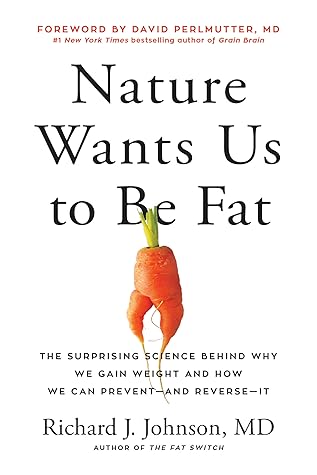
More on this book


Kindle Notes & Highlights

Read between
April 6, 2022 - July 24, 2023

I am talking about not only obesity, but also the diseases that crowd our hospitals today, particularly diabetes, high blood pressure, stroke, and heart disease.
Today, 30 to 40 percent of the US population is obese, and 10 to 12 percent is diabetic.
survival switch, as it turns on a whole series of physical and metabolic changes, as well as behaviors, that protect animals in nature when food is not available.
One of the central discoveries is that obesity is not the cause of these other conditions; rather, obesity and its associated diseases are all driven by the same underlying biological process, the survival switch.
if you have a chronic illness or are older, or if you do not always have good access to food, or if you are in a region at risk for famine, then it is better to have some extra fat on board.
When fat is broken down, it provides not only the energy we need to survive, but also water. This is not because there is water in fat, but rather because burning fat generates water as one of its by-products.
The clever way animals respond to food shortage is by making insulin less effective at moving glucose into muscle and the liver. With less glucose going into these tissues, levels in the blood rise, thereby ensuring sufficient glucose for the brain.
This phenomenon is called insulin resistance.
Insulin resistance is a major survival response in animals that...
This highlight has been truncated due to consecutive passage length restrictions.
In nature, metabolic syndrome is an insurance plan. For humans today, metabolic syndrome is a disorder, a harbinger presaging the development of diabetes, high blood pressure, and heart disease.
People are eating more and exercising less, and this is causing obesity—but not solely because of bad habits. Most people with obesity are resistant to leptin, impairing their ability to control their hunger, and many have reduced metabolism, especially at rest.
This is the same biology that is observed in animals preparing for hibernation. In fact, the biology of animals that are putting on fat has remarkable similarities to that of the majority of humans who are struggling with their weight,
It is not our culture that is making us fat. It is our biology.
Our culture is responding to our biology. Somehow, we have unwittingly activated nature’s survival switch.
This is why we can lose weight temporarily through dieting and exercise, but have trouble keeping it off. With the survival switch activated, it is as if we are continuously preparing for hibernation with no end in sight;
Studies suggest that LDL cholesterol is bad, as it is associated with plaques in our arteries that increase our risk for heart disease. In contrast, HDL cholesterol is considered good, because it may reduce our risk for heart disease. People with metabolic syndrome typically have low concentrations of the good HDL cholesterol, while their levels of bad LDL cholesterol may or may not be elevated. CHAPTER
Most of the fructose that we eat comes not from fruit and honey but from table sugar or from HFCS added to foods; they are the two most common sources of added sugars.
FRUCTOSE TRIGGERS WEIGHT GAIN FOR ANIMALS IN THE WILD
fructose intake could cause every single feature of metabolic syndrome.
The data is clear: excessive intake of fructose stimulates food intake and the development of metabolic syndrome in both animals and humans. Animals may dramatically increase their intake of fruits and honey in the fall not because these foods are an available source of calories; rather, the fructose present in these foods may be important to disengaging the normal regulation of weight and triggering the survival switch.
fructose causes weight gain primarily by stimulating calorie intake. That is, in the absence of increased food intake, weight gain is minimal.
Despite the calorie restriction, the sucrose-fed rats had all developed diabetes, and their livers were filled with fat.
Fructose causes weight gain by encouraging increased food intake, but causes the other features of metabolic syndrome even when food intake remains the same.
Leptin, which you’ll recall is released from fat cells, is what tells our brain we are full.
leptin resistance results in persistent hunger,
Fructose causes leptin resistance, which makes us hungrier, which leads us to eat more and gain weight.
Our taste for sugar encourages us to eat more of it, but we would get fat from sugar even if we could not taste it.
The preference for sugar is dependent on metabolism of fructose in the intestines, while fructose’s ability to cause obesity and insulin resistance stems from its metabolism in the liver.
What is it about the metabolism of fructose that activates the survival switch?
The oxidative stress caused by uric acid also blocks the burning of fatty acids released from stored fat. The net effect is that not only do the mitochondria make less ATP, but also the calories that would have been used to make ATP are now being stored as body fat.
Uric acid causes oxidative stress to the mitochondria, decreasing energy production, impairing fat burning, and stimulating fat production.
When ATP levels fall in the cell, the body treats it as an emergency. It responds by stimulating hunger immediately.
the way fructose works is that it mimics starvation by creating a low-energy state inside our cells, signaling to the body that there is an energy crisis. This is what flips the survival switch to the “on” position.
Mother Nature is smart. Consuming fructose tricks an animal into thinking its energy stores are low, even when it has plenty of untapped energy in the form of fat. This drives the animal to increase its fat stores and triggers a host of other metabolic responses that aid survival in a crisis. It is a brilliant system, as it allows an animal to put on fat before it is in trouble, rather than having to figure out how to survive once no food or water is available.
Eating fruits and honey rich in fructose creates a false sense of starvation that encourages fat production, allowing animals to prepare for hibernation by increasing their stores of energy and water. Likewise, eating salt creates a dehydrated state that helps the animal retain additional water indirectly by increasing its fat stores. Both are ways an animal can stock up on crucial resources as a means to protect itself before it is in a desperate situation.
it is not really the amount of salt that is important in driving blood pressure, but the balance of salt and water.
if we can keep fructose intake low, and drink plenty of water to help prevent our blood salt concentration from getting high, we have a good chance of preventing hypertension without restricting salt too severely.
inflammation becomes self-perpetuating.
inflammation causes the kidneys to retain salt, which results in persistently elevated blood pressure.
While severe inflammation is never a good thing, chronic low-grade inflammation can help our body defend against some infections, as it tends to make it easier for our white blood cells to kill bacteria and parasites.
However, when the switch is in overdrive, this low-grade inflammation ceases to be beneficial.
The decrease in energy production by the mitochondria is compensated for by the stimulation of glycolysis, a more primitive and less efficient method of making energy, which does not require oxygen.
Fructose is cancer cells’ preferred fuel, for it supports tumor growth under these low-oxygen conditions.
Cravings for sugar and alcohol are definitely intertwined.
Since dehydration stimulates the body to make fructose, this suggests that drinking alcohol might be another way to make fructose.
the craving for alcohol is related to the craving for fructose.
But if we find a way to block fructose metabolism, we may be able to cure alcoholism.
Just restricting sugar intake may also help reduce the craving for alcohol, though this has not yet been evaluated.
Alcoholism is a sugar disorder. The sedating effects of alcohol are due to the alcohol itself. However, the craving for alcohol and its ability to cause liver disease both stem from its stimulation of fruct...
This highlight has been truncated due to consecutive passage length restrictions.
fructose intake was associated with
