
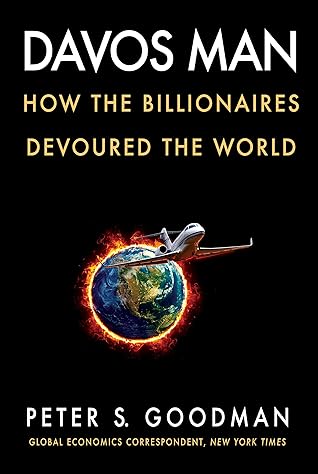
More on this book
Community


Kindle Notes & Highlights


By the end of the year, the collective wealth of billionaires worldwide had increased by $3.9 trillion, even as their philanthropic contributions fell1 to their lowest level in nearly a decade. Over the same year, as many as 500 million people descended into poverty, with their recovery likely to take a decade or more.
The term Davos Man was coined in 2004 by the political scientist Samuel Huntington. He used it to describe those so enriched by globalization and so native to its workings that they were effectively stateless, their interests and wealth flowing across borders, their estates and yachts sprinkled
across continents, their arsenal of lobbyists and accountants straddling jurisdictions, eliminating loyalty to any particular nation.
Davos Man and his hired guns—lobbyists, think tanks, battalions of public relations people, and obsequious journalists who prize access to power
over truth—have resolutely perpetuated this idea, even in the face of overwhelming evidence to the contrary.
“That is the magic of Davos,” a former Forum executive told me. “It is the largest lobbying operation on earth. The most powerful people
gather together behind closed doors, without any accountability, and they write the rules for the rest of the world.”
Davos Man’s monopolization of the fruits of global capitalism is no accident. He has insinuated into our politics and culture what we may call the Cosmic Lie: the alluring yet demonstrably bogus idea that cutting taxes and deregulating markets will not only produce extra
riches for the most affluent, but trickle the benefits down to the lucky masses—something that has, in real life, happened zero times.
We watch shows like Billions and see him sweating through the plot twists, and, along the way, we buy into the implicit notion that he has earned his perch.
