
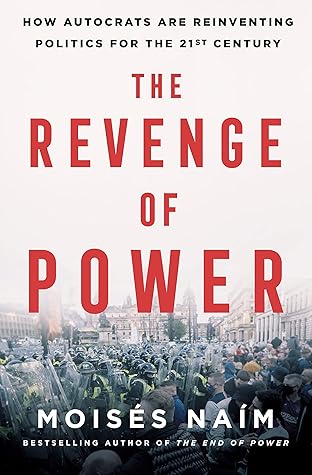
More on this book


Kindle Notes & Highlights

by
Moisés Naím
Read between
August 5 - August 5, 2022

An old KGB hand on Facebook or Twitter is a kid in a candy shop.
The best-known active measure undertaken in recent years was the successful effort to influence the 2016 U.S. election. It was notable for combining the old tropes of Soviet disinformation with the tools of the internet age. But its notoriety has overshadowed the reality that it was simply the latest in a very long line of Russian online active-measures campaigns.
For Russia, manufacturing reality is a tool of statecraft.
Real journalism that hews to traditional standards for accuracy and verification can never match disinformation along one critical axis: novelty. And, as noted, our brains are wired to seek out novel information.
post-truth, and FUD (fear, uncertainty, and doubt)
As David Frum shows in his book Trumpocracy, this poststructuralist mindset that dismisses truth as nothing more than a social construct was, in fact, one of the central organizing principles of the Trump administration.
But what is the endpoint of a world of populism, polarization, and post-truth? Left to its own devices and developed to its furthest consequences, where does 3P power lead?
In this chapter, we will explore how the thuggery that is the cornerstone of the new power gives rise to a criminal takeover of the state, subtly twisting the government into a sprawling criminal conspiracy centered on the predatory extraction of profits from society.
Vladimir Putin has proceeded further down the road of gangsterization than any of the other practitioners of the 3P framework—and the mafia state operating out of the Kremlin now destabilizes countries worldwide, from Mexico to Poland, from Kosovo to Spain.
Yet Russia wasn’t always a mafia state. For all its immense—indeed, genocidal—faults, the Soviet Union had at least created the appearance of socialist meritocracy: any Soviet citizen who was ideologically docile and adroit at managing the petty politics of the workplace could rise quite far along the hierarchies of party, army, and state on the basis of talent. The post-Soviet chaos of the 1990s
gave an opening to the world’s most successful practitioner of the 3P power. Over the following two decades Vladimir Putin would ruthlessly erase any memory of Russia’s fledgling attempt at openness to create the wo...
This highlight has been truncated due to consecutive passage length restrictions.
In an atmosphere of pervasive lawlessness and macroeconomic chaos, and under pressure from the United States and Europe to liberalize and quickly create a market economy, Russia launched what might have been the largest transfer of ownership from public to private hands in the history of the world.
But rather than spawning a Thatcherite Shangri-La of empowered citizen-owners, the process was quickly hijacked by a small cadre of well-connected players, often little more than street hustlers who had mastered the art of exploiting personal connections for profit.
In successive rounds of thinly rigged privatization proceedings, they appropriated the Soviet Union’s industrial heritage, winning control of state assets for a minuscule fraction of their true worth. In a little over ten years, the ...
This highlight has been truncated due to consecutive passage length restrictions.
As Ruth May, a specialist in contemporary Russia, has written:
The twenty or so oligarchs in Putin’s Russia do not get access to powerful people in government because of their wealth, as is the case, say, with many billionaire political donors in America, but rather the reverse: Russian oligarchs get access to obscene amounts of wealth because of their affinity with those most powerful in government. Men become oligarchs in Russia (there are no women oligarchs) because they are loyal to the only person in government who matters: Vladimir Putin.13
In the system Putin built, a handful of insiders monopolize access to wealth and privilege … safely.
The entire Russian economy is, for all intents and purposes, beholden to the dictator.
Corruption—even when it is widespread—implies departure from the norm.
Mafia
states do something different. They go beyond merely condoning criminal arrangements. Instead, they forcibly take them over, incorporating criminality into the structure of the state. Indeed, they turn crime into a tool of statecraft—projecting power through criminal means in a mo...
This highlight has been truncated due to consecutive passage length restrictions.
There’s no way around the fact that when you are sharing information through Interpol you are sharing it with the criminals who govern Russia, Hungary, Bulgaria, Montenegro, Burma, Equatorial
Guinea, Venezuela, and every other mafia state in between.
It is that the world’s premier mafia state, Russia, has waged a multiyear campaign to turn Interpol on its head, using it as an instrument to extend the reach of Putin’s power beyond Russia’s borders.
For American businessperson-turned-anti-Putin-activist Bill Browder, dodging Interpol red notices has become something of a way of life, with the organization having waved through red notices against him “dozens of times” in his estimation.19
This is how the 3P power goes global—by building a tacit, decentralized, and often stealthy network of partnerships between nations governed by illiberal leaders to help each other further common interests.
As a rule, the 3P autocrats congratulate both the conventionally elected and their fellow autocrats—a subtle means of erasing the distinction between the two.
The 3P leaders are, almost by definition, insecure about the legitimacy of their leadership and centrally concerned with inflating it.
This is why Putin congratulates Duterte, who congratulates Orbán, who congratulates Daniel Ortega, who congratulates
Nicolás Maduro, who congratulates Putin in a closed circle of autocratic solidarity. This circle—call it Autocrats Without Borders—is increasingly becoming a relevant factor in international affairs.
For many, ego is a powerful driver. All politicians of any vintage share a marked tendency toward narcissism. In this respect, however, autocrats are often more explicit in letting the world know that they possess special and unique talents, marking them out from the rest of humanity. One of the occupational hazards of being a 3P autocrat is being deluded by the belief that they are destined for the world stage, that their genius and historical weight are too vast to be contained within a single country.
Narcissism, it turns out, can be a power tool.
What requires no guesswork is this: today’s autocrats can secure all the tools they need to hang on to power indefinitely with just a few calls to friendly capitals around the world. The new autocrats like their globalization.
As the 3Ps go global, silence has been rediscovered as a guiding principle for the international order.
Nor is China’s effective takeover of the South China Sea the most egregious case of military stealth. That crown goes to Russia and its stunningly effective stealth encroachment on the territory of its southern neighbor, Ukraine.
In March 2014, following the overthrow of what amounted to a Russian puppet regime in Ukraine, Russia lashed out with an aggressive move to annex Ukraine’s Crimean Peninsula.
In less than three weeks, Russia had become the first country to annex the territory of a neighbor by force of arms since Saddam Hussein’s 1991 invasion of Kuwait.
That mind-bending, post-truth approach to knowing and not knowing at the same time is especially visible in the Donbass war: a presidential decree signed by Vladimir Putin in May 2015 classifies “peacetime deaths” suffered by the Russian military as a state secret, which makes it a crime to discuss (or even acknowledge)
the casualties of a war that, officially, Russia is not involved in at all.15
According to a campaign postmortem carried out in late 2020 by Trump campaign pollster Tony Fabrizio, bungling the pandemic response in all likelihood cost Donald Trump a second term in office.2 In societies where authoritarianism still faces real competitive constraints, underperformance in office amid a major crisis has its costs.
There is one possible future, then—to be clear, just one of several possible futures—where the coronavirus is remembered as the moment when the world turned the corner on the new 3P autocrats. If, within a few years, it becomes clear that countries that honored scientific expertise and the free flow of information systematically outperformed those that remained committed to post-truth, the legitimacy of know-nothing autocrats will have suffered a severe blow.
Ominously, the report noted that 75 percent of the world’s population lives in countries that experienced a diminution of voters’ rights.
“For the first time in this century,” as the British historian Timothy Garton Ash has observed, “among countries with more than one million people, there are now fewer democracies than there are non-democratic regimes.”2
The threat to global democracy could not be more real. The assaults on freedom are global,...
This highlight has been truncated due to consecutive passage length restrictions.
Democrats must prevail in the existential contest against enemies who prefer a world in which power is concentrated and unchecked. Yet how best can we fight a war that rages on multiple fronts, against 3P adversaries adept at exploiting democracy’s weaknesses and tapping into popular frustrations and discontents that democracies have failed repeatedly to address? In this latter-day incarnation of President John F. Kennedy’s “long twilight struggle,” democracy’s defenders must choose their battles wisely to prevail.3
The battle against the Big Lie The battle against criminalized governments The battle against autocracies that seek to undermine democracies The battle against political cartels that stifle competition The battle against illiberal narratives
Timothy Snyder, one of the most astute chroniclers of contemporary tyrannies, has warned, “Post-truth is pre-fascism … to abandon facts is to abandon freedom.”4
Draining Big Lies of their power will require a huge amount of political will, legal creativity, and technological and journalistic innovation. But if we lose this particular battle, success in the others will be moot.
Twitter’s decision to ban Donald Trump following his four-year tsunami of daily lies from the Oval Office will be remembered as the first, if partial and problematic, step in this fight.
Yet instead of embracing this principle, after the election the Republicans in thrall to Trump purged those in their party who endorsed it.
