
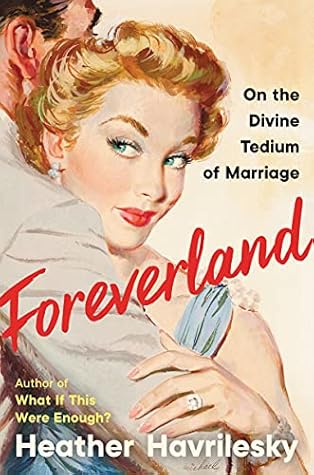
More on this book
Community


Kindle Notes & Highlights

Read between
July 12 - July 15, 2025

Every book about marriage is also a book about mortality, since the success of any marriage is defined not by happiness or good fortune but by death. The assignment, after all, is to stay together until you die. Once one spouse perishes, the marriage has succeeded. Death signals victory.
Only an optimistic fool would declare victory before reaching the finish line. That’s what makes weddings such dark comedies. What’s more entertaining and ominous than watching two naive souls sign a binding contract without understanding the fine print?
Most engaged couples bumble onto the marital bullet train without even knowing where it’s headed. All that matters is that we’ll be ...
This highlight has been truncated due to consecutive passage length restrictions.
Forever is two immortal elves, sipping pink champagne by a burbling stream, then exploring the wild, gorgeous woods around them in everlasting harmony. For...
This highlight has been truncated due to consecutive passage length restrictions.
Even after many satisfying years together, married life has an uncanny way of making even the most buoyant soul feel like a fool and a failure repeatedly. It’s a feature, not a bug.
Marriage is designed to break you. You will forget everything you knew before. You will tremble under the weight of your own shortcomings. Sure, you might bounce back and proclaim yourself lucky and declare your marriage happy and become the masochist your marriage wants you to be. But you’ll still wake up plenty of mornings wondering why you signed on to drag this wretched, snoring heap of meat with you everywhere you go until the day you die.
I wrote this book to explore that tedium, along with everything else that marriage brings: the feeling of safety, the creeping darkness, the raw fear and suspense of growing older together, the tiny repeating irritations, the rushes of love, the satisfactions of companionship, the unexpected rage of recognizing that your partner will probably never change.
We pretend that once you’re married, you’re either happy or unhappy, a binary system, on or off. But the truth is so much murkier and also much more frightening and exciting and joyful than that. Marriage grinds your face into the dirt until you can see new colors and taste new flavors.
To be married is to have the words “This is all your fault” eternally poised on the tip of your tongue.
Having someone by your side every minute of your life sounds so romantic before he’s actually there, making noises, emitting smells, undoing what you’ve just done, interrupting, undercutting, begging to differ.
Sure, I love my husband. But I am still a simple animal, and sometimes I lose the thread. That’s when I find myself asking awkward questions, such as: Why do I need a husband, again? And if I’m going to have a husband, shouldn’t I have chosen a sturdier one, or maybe one with a fully functioning frontal lobe? Also, why do I get only one husband? Wouldn’t it be nicer to have a room full of husbands—some creative, others practical, some extremely pretty, others incredibly dexterous?
That commitment, the one that can withstand and even revel in the darkest corridors of a life, grows and evolves and eventually transcends a contract or a ceremony the way an ocean overflows and subsumes a thimble of water.
And eventually, as grateful as you are for that bond, sometimes you might wish you didn’t recognize its strength. Because some days, it sounds much more fun to feel less permanently chained to your spouse. It sounds much more exciting to lose sight of everything, take it all for granted, and make a giant mess of your life instead. Not only would that be far less boring, but also, it could involve world travel, fancy hotels, and male strangers
Over time, marriage itself starts to feel like a slowly unfolding apocalypse. Your marriage will die or you will die. Which ending seems happier?
My husband Bill is a good person who makes great bread and has a perfect golf swing (not that I know or even care what that means). He also wears golf shirts, which are perhaps the least attractive article of clothing available to humankind.
I myself am a wise guru type of writer who knows everything about everything, which makes me about as appealing a mate as Jabba the Hutt, if Jabba talked to his dogs more than his children and blamed his hormones every time he fed someone new to the rancor. We are both catastrophically flawed. But by unearthing our most discouraged moments together without turning away, by screeching at the moon side by side, admitting “This is all our fault,” we reaffirm our love and also our intention to face the unknown together, from this point forward.
All we needed was a handful of photographs and some witty retorts to get our hopes up way too high.
But really, what good is a boyfriend? A boyfriend is, by definition, impermanent. He is temporary filler, a disposable prop, a transitional object, a traveling salesman. Why invest time and energy into someone who’ll disappear in a year or two? Disappearing is baked into the boyfriend picture.
Who wants to shove all of your beauty and youth and light straight into a boyfriend-shaped garbage bag, when you know you’ll eventually drag it out to the curb, and someone will come to take it to the dump in the morning?
I wanted a grown adult husband. I’d had enough of these half-baked (in more ways than one) man-children. I wanted more. I wanted a partner with a solid career to match my own. I wanted a hunky, square-jawed, mature listener. But that wasn’t all. I also wanted a nurturing daddy type who would hang on my every word. And I wanted an athlete. (Why not hold out for an athlete? What, you don’t think I deserved one?) I wanted an intellectual who was also a comedian, but with a nice ass. I wanted a cross between a therapist and a cowboy. Those existed somewhere, probably! And if they existed, I
...more
People always assume that love is all about celebrating someone else’s amazing qualities, I wrote. But true love is also about accepting another person’s flaws. In order to create a love that grew and adapted over the years, you had to commit to someone else’s flaws the same way you commit to their qualities. That was love. Loving someone’s bouts of neediness and self-loathing the way you love their hot face.
Watching someone fall in love is like watching someone eat a really big, sloppy submarine sandwich. The more they’re enjoying their sandwich, the less enjoyable it is to watch them eat it. Savor your true love as much as you can, just have the good grace to do so in private.
show me your first conversation about recurring minor digestive issues, your first long car trip across unremarkable terrain, your first encounter with each other’s least emotionally stable relative.
“What does it mean to become your mother?” turns out to be a central question of marriage, along with countless other big, uncomfortable questions, most of them spawned by something as small as a ring of red wine.
An afternoon of weeding the garden ends in an argument about toxic plants. A simple inquiry—“What are we going to do about dinner?”—incites an existential crisis, the 742nd of its kind since your wedding day.
Why is this person always the same, and always in the way—a mumbling roadblock, a pointy Lego brick underfoot, a smelly heap of laundry blocking the bathroom door—and also, somehow, the only path back to sanity?
leave this sad specimen alone in the dust of a life you’ve clearly outgrown? Maybe the next one will be less defensive when he’s mad.
Being married is far more interesting than falling in love. The gritted teeth. The clenched jaw. Agony in a half-open, half-empty cereal box. Longing in a badly washed dish. Slow evolution, or a slow unraveling: It can be hard to tell which.
It all boils down to faith, the ability to trust the fates, to accept your role as the cowboy, to love your dog, even though he’s horribly trained. You need to be prepared to watch your franchise player miss 80 percent of his shots in a game. Because marriages survive on a wave of forgiveness. And marriages die when you can’t forgive yourself.
But when your spouse is mostly good, or almost good enough, and you’re sometimes not so good at all, then you have to forgive yourself. It’s not easy. That’s what makes it so interesting.
Marriage is a lifelong market correction to true love’s overvaluation.
I kiss him with feeling, and it’s like all of my nagging questions about what the fuck is wrong with me melt into a warm certainty that I am good and he is good and good choices brought us here, to this hallway. Marriages are best celebrated in hallways, when there’s no time: he’s about to leave and I want more than what I’m getting from the day so far. I want to relish this man.
I’m not romantic about building your little delusional house on the prairie. I’m romantic about trying desperately to repair the walls of your house by the banks of Plum Creek, as they start to crumble unexpectedly.
But that day, we were an island in a hurricane. This is how it should feel, I thought. This is what I’ve been looking for.
You could’ve come as a student and stayed in hostels and gotten drunk on red wine with greasy delicious strangers, but instead you are dragging along with you a disappointing middle-aged dope like an unwieldy, oversized suitcase without wheels. He has nothing to say, you can see that now. He tries to make up for it by reading street signs out loud in a cheerful voice, like some kind of confused half-wit. He is such a nerd and he’s wearing—is that a golf shirt?
Why a man, though? your former selves whisper as your oversized luggage orders a second lukewarm beer. Why spend the rest of your life with a man, of all things? Men, you now see clearly, are tedious beasts with nothing to offer, nothing to add. Why not bring your closest female friends to Europe? There’s nothing you’d like better than to have your girlfriends here instead, drinking and snickering with you about the bad waiter. Why do you and your lady friends isolate yourselves into miserable pairs instead? Why not marry your friends?
All of us were there, our former selves and our current selves. We were excited and melancholy and needy and pissy and impatient and satisfied. And that was the most romantic moment
eyes and we didn’t look away quickly. Because we knew that it was possible to be disgusted and annoyed and bored and still feel love—pounding, elated, passionate. In that moment, we were disheveled and ordinary, and also gorgeous and extraordinary. We matched. Nothing is more romantic than being totally in sync, even if that means you’re totally doomed. Bill and I were both terrified, but we knew we weren’t turning back. We were sure.
The truth was, I found fault with most of the women I encountered in the world. Every single one of them looked like a cautionary tale of what not to become. I didn’t realize yet that I was huffing the patriarchal spray paint that made every woman’s life look like a series of big mistakes.
Dread asks you how much you can handle. Dread tells you you’re too weak for these dark obstacles. Dread makes you forget how capable you are, underneath the shivering and the cowering. The only cure for dread is surrender. You banish dread by announcing: Whatever comes next, I will welcome it with an open heart.
I knew, intellectually, that I wanted to spend my life with him. The year and a half we’d spent together had been so easy, and so relaxing, and so satisfying—at least when we were alone. But we didn’t have much practical experience as a couple out in the world. And under duress, we were both stress cases.
this is the worst, most volatile combination of marital attitudes. When a defensive Just Relax energy meets a murderous You Don’t Get It rage, you’re in trouble.
While I was hoping for an apology, Bill was forming his bulletproof presentation on Why You Are Unwell.
“I am a nuclear reactor” is something I’ve said a lot since then. It’s demeaning and sexist to put it that way, maybe, but it’s also my reality: I’m enormously moody. There’s no way around it. When I’m grumpy, I’m not just mildly annoyed. I am living in a world of chaos and clanging pots and my head is on fire.
Our lives had become a rolling crisis management meeting, demanding a constant reshuffling of priorities. But we managed it all, mostly without falling apart.
we were in the eye of the storm. We could look up at the small circle of blue sky and remember how it felt to relax, to take in the moment, to appreciate what we had. We were at the center, and everything was good. We were in love.
The worst part of the dream isn’t that your bare butt feels all wrong on the wooden chair. It’s that everyone else knew all along. You were the last one to notice. You kept cluelessly acting like your usual self.
But this is how it works with marriage and kids. First you abandon your dignity to merge with another flawed human, and then you start making miniature flawed humans, and then life knocks you down and grinds you into the sand, and just when you think you’re going to make it? That’s when your mother shows up. And your mother does not think you’ll make it. She thinks you’re screwed.
It’s a whole new thing, to have a partner who loves you even after the wheels come off.
They should have to complete lots of pointless worksheets at school, and be tested repeatedly to see if their spelling really is up to par at age six. They should have teachers who focus primarily on neat handwriting, or who punish their students for every ill-timed bathroom break. Nothing would prepare them for the brutal stupidity of the wider world outside quite like the arbitrary mercilessness of the suburbs.
