
More on this book


Kindle Notes & Highlights


To set The Egyptian Book of the Dead in its wider context we need to remember that the civilization of ancient Egypt – the Egypt of the pharaohs – endured for well over 3,000 years before it came to an end with its annexation by Rome in around 30 BC.
Periods of political strife and upheaval were balanced by times of peace and prosperity, the most significant of which coincide with the periods known as the Old Kingdom (2650–2152 BC), the Middle Kingdom (1986– 1759 BC) and the New Kingdom (1539–1069 BC).
It was during the New Kingdom that the Book of the Dead as we now know it emerged, but the ideas and beliefs expressed in it had gradually evolved over the preceding 2,000 years or longer, shaped by a combination of the Egyptians’ experience of ever...
This highlight has been truncated due to consecutive passage length restrictions.
The annual flooding of the Nile, on which the fertility of the land bordering the great river depended, and the orbital movement of the sun, moon and stars, led to the belief t...
This highlight has been truncated due to consecutive passage length restrictions.
Like other ancient civilizations, the Egyptians expressed their beliefs through myths in which the exploits of the gods personified both visible phenomena and the invisible forces that drove the cyclical patterns governing the universe.
The myths and the religion they inspired underwent a considerable evolution in the millennia prior to the emergence of the Book of the Dead, influenced partly by shifts in regional power and partly by the priests who attended to the temples and cult centres in cities up and down the Nile.
However, two elements remained constant: the prominence of the various gods associated with the sun (e.g. Ra, Horus and Aten) and the central role of the king or pharaoh. The latter made offerings to the gods on behalf of his subjects, and th...
This highlight has been truncated due to consecutive passage length restrictions.
Of the many myths left behind by the ancient Egyptians, there is one that is particularly relevant for the Book of the Dead – the myth of Osiris. The full myth is quite lengthy, but its principal elements are as follows.
The sky-goddess Nut and the earth-god Geb had four children: two sons, Osiris and Set, and two daughters, Isis and Nephthys. The brothers m arried their sisters – Osiris married Isis, and Set married Nephthys – and Osiris, as first-born son, succeeded his father to the throne of Egypt.
He ruled the primitive Egyptians with kindness and educated them, thus laying the foundations of the great ci...
This highlight has been truncated due to consecutive passage length restrictions.
Set grew jealous of Osiris and murdered him, dismembered his brother’s body, scattered the pieces across Egypt a...
This highlight has been truncated due to consecutive passage length restrictions.
Isis, with the help of her sister Nephthys and the gods Anubis and Thoth, located the pieces of her husband, gathered them together and mummified his body, thus restoring him to life. Rather than return to earth, however, Osiris became the eter...
This highlight has been truncated due to consecutive passage length restrictions.
The Book of the Dead grew out of a long tradition of funerary texts, the first examples of which are known as the Pyramid Texts because they were written on the walls of the burial chambers in the pyramids of the pharaohs of the Old Kingdom – the earliest known example was discovered in the Pyramid of King Unas at Saqqara and dates from around 2345 BC.
The purpose of the Pyramid Texts was to help the deceased pharaoh take his place among the gods, and to this end they included hymns, prayers and magical spells to ward off the dangers encountered in the afterlife.
Initially they were exclusively for royal use but in the declining years of the Old Kingdom the right to use them was assumed by regional governors and other high-ranking officials, for they too wished to become identi...
This highlight has been truncated due to consecutive passage length restrictions.
A new corpus of funerary texts emerged during the Middle Kingdom – the Coffin Texts which, as their name implies, were written on the inner surfaces of wooden coffins. These texts included spells dr...
This highlight has been truncated due to consecutive passage length restrictions.
Some of them also included illustrations. When coffins changed from rectangular wooden boxes to a shape that followed the contours of the mummified body, the texts were written on a papyrus which was...
This highlight has been truncated due to consecutive passage length restrictions.
The title ‘Book of the Dead’ was first coined in 1842 by Richard Lepsius, the German Egyptologist, but it has been suggested that a more appropriate title would be ‘Spells for Coming Forth by Day’, for its purpose was to enable the deceased to emerge safely from the tomb in a perfected, spiritualized form.
Nowadays the term ‘Book of the Dead’ usually refers to the entire corpus of almost 200 chapters or spells, from which a selection was made for inclusion in individual papyri. Although the format for presenting the selected chapters became more or less standardized, the order in which they were arranged varied from one papyrus to another.
The ancient Egyptians believed that the individual human being was a compound of several elements – the kheperu, meaning modes or manifestations of human existence – which disintegrated at death.
These elements included the physical body (khat);
the heart (ib), believed to be the seat of the mind...
This highlight has been truncated due to consecutive passage length restrictions.
the name (ren), which constituted the individuality of the deceased and was thus essential for his or her conti...
This highlight has been truncated due to consecutive passage length restrictions.
the shadow (shut), which was also related to the individuality of the deceased but was able to separate itself from the body and e...
This highlight has been truncated due to consecutive passage length restrictions.
the life-force or spirit (ka), which remained in the tomb with the body of the deceased and was nourished with...
This highlight has been truncated due to consecutive passage length restrictions.
the soul or spirit (ba), depicted in vignettes as a small bird with a human head, which was free to visit the world of the living during th...
This highlight has been truncated due to consecutive passage length restrictions.
When the mummy was placed in the tomb it was believed to enter the Duat or Netherworld, where it underwent two ceremonial rituals: the ‘weighing of the heart’ and the ‘opening of the mouth’.
The first of these was a form of judgement of the life of the deceased whereby his or her heart was placed in a scale and weighed against a feather, symbolizing ma’at. The ceremony was supervised by the jackal-headed Anubis and the ibis-headed Thoth, who wrote down the outcome. If the heart passed this test, the deceased could continue their passage through the Duat; if it failed, it was eaten by Ammit, the ‘Devourer’.
The second ritual, which was performed by a priest, involved touching the facial covering of the mummy with one or more ceremonial instruments, thereby ‘unstopping’ the mouth, eyes, ears and nostrils of the deceased so that they regained the use of these faculties. The opening of the mouth was of great importance si...
This highlight has been truncated due to consecutive passage length restrictions.
Other items placed in the tomb with the mummy included the canopic jars (which contained the preserved internal organs of the deceased),
If the deceased followed the instructions on the papyrus and recited its hymns and spells, they would become an akh (a blessed spirit) and, leaving the mummy in the tomb, they would join the gods Osiris and Ra.
The papyrus of Ani, which dates from around 1275 BC, was found at Thebes and purchased by the British Museum in 1888.
Ani was ‘overseer of the double granary of the lord of Tawer’, and his wife, Thuthu (or Tutu), was a chantress in the Temple of Amun.
His papyrus is one of the longest known manuscripts of the Book of the Dead, measuring 23.5 metres (77 feet) in length, and c...
This highlight has been truncated due to consecutive passage length restrictions.
Many of these chapters are illustrated with richly coloured vignettes depicting the various stages of Ani’s journey through the Duat ...
This highlight has been truncated due to consecutive passage length restrictions.
The majority of the text is written in black ink, while red ink is used for chapter headings and the instructions (rubric...
This highlight has been truncated due to consecutive passage length restrictions.
Subsequent vignettes show the ceremonies of the ‘weighing of the heart’ and the ‘opening of the mouth’; Ani’s funeral procession and the placing of his mummified body in the tomb; and his meetings with various gods in the course of his journey through the Duat.
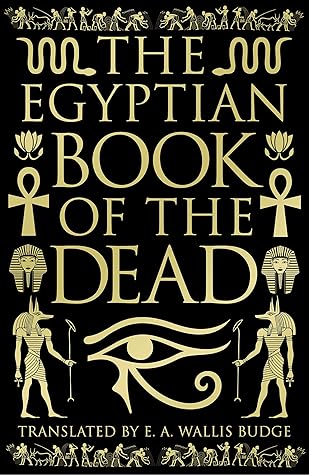
The translation of the papyrus of Ani presented in the following pages is by E. A. Wallis Budge, Keeper of the Department of Egyptian and Assyrian Antiquities from 1894 to 1924. As well as enlarging the museum’s Egyptian collections, Budge wrote many books that did much to stimulate popular interest in ancient Egypt.
