
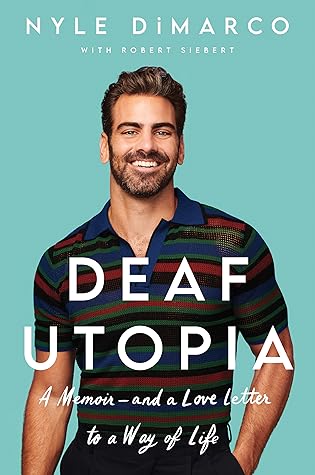
More on this book
Community


Kindle Notes & Highlights

by
Nyle DiMarco
Read between
June 21 - June 24, 2022

Our writing process began with my hands. I first told Bobby my stories in American Sign Language—or ASL—in video-recorded interviews, which Bobby then translated into English on the written page. And then together, we worked on the translated source material, chipping away, molding, shaping, and polishing, until it took its final form.
I started the writing process in ASL because it is my natural language, the one I most feel comfortable expressing myself in. ASL is distinct from most other languages, like English. One of the biggest differences between ASL and English is the modality in which each is expressed during conversation. ASL is signed, expressed with the hands, face, and body, and received visually; English is expressed with vocal sounds and received auditorily.
translate my stories from one language to another; we also had to condense the visual-spatial nature of the source language, ASL, into the linear, two-dimensional symbols of the output language, written English.
This is not because ASL is broken English, but rather because ASL has its own rules, separate from those of English. For instance, in ASL sentences words appear in a different order.
keep your attention on the fact that the majority of the people in this book are Deaf and communicate using a language that is very different from the spoken ones a hearing person is exposed to in everyday life and in mainstream media.
Personal storytelling is a special kind of love—it is you affirming your existence. It is you telling the world that you matter. Stories are also the glue that holds communities together.
WASN’T TAUGHT AMERICAN SIGN Language; I was submerged in it. That’s how people acquire their native language: they don’t learn it consciously; they naturally absorb it from the available language input in their surroundings.
The purpose of the conference was to decide the best, most effective approaches to educate the Deaf, and only 1 of the 164 delegates in the room making those decisions was Deaf.
All the Deaf schools in New York City taught their students this way, mandating hearing aids and using sim-com in classrooms.
The goal should never be for Deaf people to pass as hearing, but to achieve their full potential using methods and languages that work for them.
The school, as is typical of the oral education school of thought, confused speaking ability with intelligence and potential to learn.
Through ASL, I could communicate with other people, learn new skills, and understand more about the world.
we learned enough about hearing kids to know that Deaf kids were different.
Language was a big difference that we were well aware of.
The mystique of the strange other world of the hearing slowly dissipated. The more ordinary my hearing friends appeared to me, the more comfortable I became around them.
As a Deaf person, I don’t have time to be upset at my own people. We can’t stop and point at each other. We have to be vigilant; we have to continue to look outward and battle the storm, created and imposed on us by larger society, that continues to rage all around us.
it was an insensitive request to make of a Deaf person who communicates primarily in ASL. In fact, a lot of Deaf people would have found the request to be deeply offensive. First of all, the request implies that speech is a superior form of communication compared to signing.
It completely disregards the Deaf person’s ability to communicate in sign language, instead shifting the focus to whether or not the Deaf person can communicate the hearing person’s way. It’s a test to see if the Deaf person can pass as a hearing person.
It’s not the interpreter’s responsibility to guess the intent of the speaker and filter out what should be interpreted or not. If a skilled and professional interpreter hears something, they will make their best effort to relay it to the Deaf audience. I mean everything, including cuss words. The interpreter is not there as a censor or a moral purifier of language.
It goes both ways, too—if a Deaf person mumbles something not intended for the hearing person, the interpreter should translate it into spoken English for the hearing audience present. That’s the way it should be. Unfiltered, no-barriers interpreting helps make access a little more equal for all involved, both Deaf and hearing.
Yet only a week and a half into the competition, the show was holding an event without an interpreter and hadn’t bothered to provide me with even a detailed written summary of the two guests’ comments to help me fill in the gaps.
On TV, the judging comes at the end of episodes, and they’re often brief—maybe five or ten minutes at most. But in real life, judgings took six to eight hours to film.
The opportunity to come out when I was ready and felt fully empowered to do so had been stolen from me. My coming out, this conversation, everything I’d done that night, was forced on me. I still wasn’t sure of my sexual identity and hadn’t yet found the community of people who were like me, a community I felt I belonged to.
This silence, to me, is not the audible silence created by Deaf people using sign language, but the oppressive silence that occurs when a tremendous injustice is being inflicted upon a community, and no one outside of the oppressed community stands up to fight it.
One of the most important things I learned about the LGBTQ world is that it is a massive, inclusive umbrella of sexual identities. So many people exist at different points along the spectrum between straight and gay.
It was even rarer for Deaf people to appear as characters in productions that eschewed the typical woe-is-me Deaf storyline; I seldom saw Deaf actors taking on roles of ordinary characters who just happened to be Deaf and were going out and doing and experiencing everyday stuff.
The casting director wasn’t quite right when he said the stars would align for me. But the stars were indeed there, and I moved them until they were in the perfect position.
