
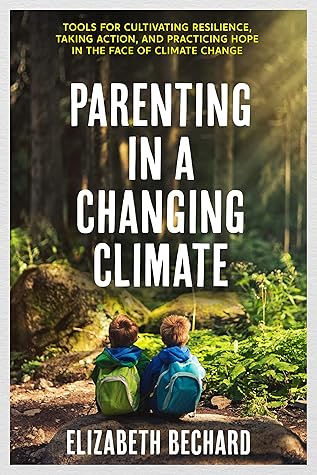
Kindle Notes & Highlights

Read between
December 15, 2021 - February 7, 2022

Taking on the identity of the person who could achieve the outcome you want leads to small actions that help you to reinforce that identity. Eventually, those small actions become solid, sustainable habits. If you want your children to inherit a livable planet, what kind of person would you have to become to contribute to that outcome?
As recently as 2016, up to a third of the members of the United States Congress were climate change deniers, according to the Center for American Progress Action Fund. In 2016, the list of high-ranking climate-denying politicians included then-Senate Majority Leader Mitch McConnell. A report released the day the twins were born showed that 63% of Americans were represented by a climate-denying politician, in spite of the fact that 67% of Americans supported climate action.
Only 58% of voting-eligible Americans voted in the 2016 election.
As actor Samuel L. Jackson put it in a Biden campaign ad before the 2020 U.S. election: “If your vote didn’t matter, they wouldn’t be trying so hard to take it from you.” Voting does matter. Democracy matters. It matters
Each time someone thanked me for handing me their ballot, I realized that showing up for the election meant that other people saw me as someone who was protecting democracy. This was another win, another step in the direction of becoming the kind of person I wanted to be.
While the spark of the modern environmental justice movement is often credited to the 1982 protest in Warren County, North Carolina, just sixty miles from my hometown, Indigenous communities and communities of color have advocated for environmental protection for generations.
Founded in 2009 by veteran climate activist Harriet Shugarman, author of How to Talk to Your Kids About Climate Change, Climate Mama offers education and workshops about global warming to climate-concerned parents and grandparents. Mothers Out Front has mobilized over 35,000 moms in their movement to fight for a livable climate for all children, with an agenda focused on environmental justice, civic engagement, and clean energy. With state campaigns currently active in California, Massachusetts, New York, and Virginia, Mothers Out Front has played an active role in protesting gas pipelines and
...more
Our Kids Climate, a sister network to Parents for Future, was founded in 2015 by a group of parent climate activists in Sweden who wanted to bring the perspective of concerned parents to the Paris Climate Agreement. Our Kids Climate has a network of fifty-eight parent groups across twenty-three countries, and has recently partnered with Parents for Future to offer fellowships to parent climate organizers around the world;
If I could go back in time to 2018, meeting the version of myself who spent months in a climate change-induced panic, the one piece of advice I’d give myself would be to join a climate action group or civics engagement community sooner. I’d have spent far less time feeling so alone.
New Yorker article about “the other kind of climate denialism.” The other kind of climate denier, Julia explains, is someone who thinks that someone else will take care of climate change. That it’s a problem, but not an everyone must drop everything and run kind of problem. Something bad, but something that can wait. The other kind of climate denier might be a mom who thinks she can’t be an activist until her children are older, because of a story about activism that isn’t compatible with early motherhood.
Before my own “penny drop” moment with climate change—the month that three of my fertility coaching clients worried out loud that maybe they weren’t getting pregnant because the babies didn’t want to come—I had been that kind of climate denier, too.
Riederer explores a range of attitudes towards climate change. One is the “climate truth” approach taken by Wallace-Wells and Margaret Klein-Salamon, author of Facing the Climate Emergency, that offers no sugar-coating or optimistic frame to stories about climate change, choosing to report in brutal detail exactly how bad many scientists think things are going to be. Another approach, promoted by John Fraser, a psychologist who has studied burnout among environmentalists, recognizes the possibility that for many people, “doomsday reporting” tends to lead to paralysis and inaction, sabotaging
...more
And there is no more needed music than this: our children need parents who are actively working to build their confidence as activists in the climate movement. Our children need parents who hold their representatives accountable for climate action, who are students of and advocates for environmental justice, who write postcards and organize community discussions. Our children need parents who show up on the front lines of nonviolent direct action protests, even if they’ve never attended a protest before in their lives. Our children need parents who are willing to start small, and then
...more
Chapter 9 Reflection Key practice: Align your beliefs about yourself with the world you want to see. Questions for reflection and discussion with others: How do you relate to the word or idea of “activism”? What stories do you hold about what activism means, or what “counts” as activism? How has becoming a parent shifted your capacity for engagement with the social and political issues you care about? How might your sense of identity need to shift in order for you to engage in an active response to climate change? The chapter references a New Yorker article about “the other kind of climate
...more
What’s the boldest climate action you could imagine taking part in? What would it take to become the kind of person who could take that action?
“In the face of climate change,” Figueres and Rivett-Carnac write, “we all have to be optimistic, not because success is guaranteed but because failure is unthinkable… Optimism is not the result of achieving a task we have set for ourselves. That is a celebration. Optimism is the necessary input to meeting a challenge.”
Writer Trebbe Johnson explores our relationship with broken places in her book Radical Joy for Hard Times. Referencing the work of prominent ecotherapists Sarah Anne Edwards and Linda Buzzel, Johnson acknowledges that the grief we feel about environmental changes is not a one-time loss that we eventually learn to move on from; it’s more akin to living with a chronic, degenerative illness, one we know will worsen throughout our lifetimes. For those of us who are parents, it’s like living with a chronic, degenerative illness that’s genetic, knowing we’ve passed it on to our children. We know
...more
One of these practices is gazing: looking with love, openness, and receptivity at a landscape, image, or being that we might otherwise look away from in shame, horror, or sadness. Johnson describes her experience of sitting vigil for a clear-cut forest: “Being willing to gaze at the broken forest, we discovered that what we had feared would be too painful to bear was not. The first sight had packed a powerful punch, but as the reality of the place seeped into our consciousness, we were able to settle down into what it offered. The forest’s past blended with the details of its present
...more
One of the myths about climate optimism is that it’s a mindset one can arrive at as if to a sunny destination with a one-way ticket. I’ve seen many climate workshops headlined with the encouraging charge to “Move from anxiety to action!” But to me, this is an oversimplification of the reality of climate engagement. I’m active and anxious. I’m optimistic and heartbroken.
There will be no moment within our lifetimes where we’ll arrive safely on the other side of the threat of climate change, no moment when we get to go back to life as it was. Life will not ever go back to the way it was; all of us will have to learn how to allow optimism and grief to coexist. “The next twenty years will be a period of deep uncertainty and tremendous risk, no matter what,” writes author Roy Scranton in a New York Times op-ed about climate change. “The first thing we need to do is let go of the idea that life will ever be normal again.” Even if the very best-case scenarios were
...more
as author Isak Dinesen wrote, “the cure for anything is saltwater—tears, sweat, or the sea.”
tell her I hope she can understand why I’ve closed the door on trying again. It’s complicated, but in large part, it’s because I want the future to be a place where Minnie and Milo might feel safe choosing to have their own children, and having fewer children now is one small contribution I can make to that future. Maybe, I tell her, she can return decades from now through one of them. We would so love to meet her.
I’d still wondered if letting them come to love the North Carolina coast was the right thing to do as a parent. I still wondered if they’d come to resent me someday for letting them love a world that would only break their hearts.
Key practice: Go beyond binary thinking. Practice holding space for grief and love, beauty and brokenness, anxiety and optimism, and everything in between. Questions for reflection and discussion with others: Have you ever had an experience of “topoaversion”? How do you typically respond when faced with images or in the presence of broken places? What is it like for you to sit with the idea that life will never go back to “normal” again? What climate change-related losses are or will be most personal for you? How might you honor these losses in a tangible way? How do you cultivate joy and
...more
My children will have larger carbon footprints than most other humans on the planet, by simple fact of their being U.S. citizens. Their birthday is just a week before the United States’ “Earth Overshoot Day,” the day when, if everyone on the planet consumed like the average American, the ecological resources consumed would exceed what the Earth could regenerate in a year. Their birthday is in early March.
One of my coaching colleagues, a passionate climate activist and veteran coach named Eve, asks groups of climate-concerned coaches to reflect on the following question: what is mine to do? What resources do I have to offer? What part of the climate movement can I most effectively contribute to, within the finite bounds of my time, energy, strengths, and money? How can I influence systems of power? In her presentations, Eve often shares a poem called hieroglyphic stairway, by Drew Dellinger. The poet is awake at 3:23 in the morning, troubled by the insistent questions of his yet-to-be born
...more
I have spent the last three years trying to figure out my own answers to these questions in the context of early parenthood: What does it mean to be a “good enough” parent in a changing climate? What is mine to do? What did I do once I knew? One day at a time, I’m learning how to let the reality of climate change and a love for the future inform nearly everything in my life. It has informed a decision to shift career paths and go back to graduate school to study public health and climate change in my late thirties, to get more involved with several climate action groups, and to talk about
...more
But what is ours to do together is simple: as parents, our job is to love children. Our job is to love children so much that we see all of the world’s children as our own, all worthy and deserving of a livable planet. Our job is to love children so bravely that we are willing to remake the world for them, to participate with all of our inner and outer resources in moving towards a way of being that is sustainable, just, and equitable for all. Our job is to love children so deeply that we cannot help but be moved to adore and protect the natural world that is their home, and to do so with the
...more
What does it mean to you to be a “good enough” parent in a changing climate?
What is yours to do in response to the climate crisis? How might you use your unique circumstances (your resources, strengths, connections, privilege) to contribute to positive change?
What do you hope your personal life looks like in ten to twenty years? In twenty to forty years? (For the purpose of this exercise, you can pick just one time point if that feels easier.) What might an ideal day look like for you and your family in the future? How might your day-to-day lifestyle or relationships be different than they are now? What do you hope our collective life looks like in the coming decades? How do you hope current systems and ways of being have shifted? What role could you imagine yourself playing in the movement for climate action and climate justice in the coming
...more
How are you spending your time, energy, and money? If you have the time, it can be helpful to sketch out a typical day, week, or month. You might also take a look at recent bank statements. What patterns do you notice? What is your family’s current carbon footprint? This is another way to look at how you’re spending energy, in a very literal sense, and there are a number of carbon footprint calculators available online. I like the EPA’s calculator, as it allows you to see in concrete terms how much you can save in terms of dollars and carbon emissions by making simple changes at home:
...more
If nothing about the way you spend your time, energy, and money changed significantly in the next ten years, how would that impact the future? How do you want to act on your responses?
Where do you want to begin taking action? Is there a specific goal you’d like to set? When setting goals, it’s often helpful to create a clear goal statement that’s SMART: specific, measurable, action-oriented, realistic, and time-bound. In coaching, goals are often set with a three- to six-month time frame in mind,
(1) By the end of March, we will be eating a fully plant-based diet three days a week. (2) By the end of next month, we will reduce our household food waste by at least 25% through planning our meals. (3) By the end of this week, I will make an appointment with a climate-aware therapist. (4) By the end of this year, we will reduce our household carbon footprint by at least 25%.
How does this goal or action align with your values and your hopes for the future? What personal strengths or past successes could help you with this goal or action? What barriers or obstacles could potentially arise? How might you overcome them? What “small wins” might support this goal or action? For example, if your goal is to move towards a plant-rich diet, small wins could look like buying a plant-based cookbook, trying a new meat or dairy substitute, experimenting with a new recipe, or dining at a plant-based restaurant. Who might offer support or accountability? (We’re more likely to
...more
How is climate change likely to impact your job or career path? Are there changes you could make now to better prepare for these impacts? How is climate change likely to affect your local community and neighborhood? How might you help your community adapt to climate change? Your community may already have a climate adaptation plan—if so, it’s worth taking the time to read it. If not, how could you advocate within your community for a climate adaptation plan to be created? How is climate change likely to affect your home or living space? Are there changes you could think about making that would
...more
A note about emergency and adaptation planning: it can be easy to shift into a “prepper” mindset while thinking about these things, and I emphatically don’t encourage that. The “prepper” movement, which encourages individuals to be prepared for apocalyptic climate disasters, tends to be highly individualistic, emphasizing personal survival over community resilience. In truth, your personal resilience in the context of climate change will be inseparable from the resilience of your community. It’s possible to take personal preparation efforts seriously as a matter of responsibility while
...more
Two great starting places for learning more about the connections between environmental justice and racism are the Intersectional Environmentalist website (www.intersectionalenvironmentalist.com) and the Climate Justice Alliance (www.climatejusticealliance.org).
(And if you don’t like the word “activist,” feel free to substitute another word that resonates more, like “advocate” or “change maker.”)
For individuals, two books that can help you learn how to shift your investments out of fossil fuels are The Do-Gooder’s Guide to Investing, by Adrian Reif, and Investing to Save the Planet, by Alice Ross.
Green America, which offers a user-friendly Guide to Social Investing and Better Banking to help people make the switch to greener banks and investments.
SwitchIt, a U.K.-based global campaign to divert money from the fossil fuel industry, offers a simple tool to help consumers in the U.K. switch to renewable energy providers (they can also help with switching to ethical banking and investing; you can find them online here: www.switchit.money
Climate Justice Alliance (www.climatejusticealliance.org), which mobilizes communities on the front lines of climate impact to organize for a just transition.
If you don’t already know your neighbors, it’s time to meet them. Getting involved in local groups and projects—think community gardens, book clubs, neighborhood organizations, PTAs, kids’ sports teams, or local events—can be a great way to build authentic, long-term relationships within your community. Another way to help strengthen your local community is to ensure that it has a climate resilience and adaptation plan. If such a plan exists, there’s a good chance you can find it and read it online. If there isn’t a climate resilience plan for your community yet, it’s time to start advocating
...more
