
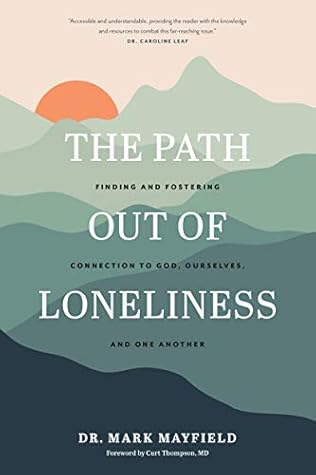
Kindle Notes & Highlights

Read between
December 2 - December 2, 2025

The most terrible poverty is loneliness, and the feeling of being unloved. MOTHER TERESA
Avoidance leads to disconnectedness.
We are the most connected generation in history, yet we are also the loneliest generation.
We are relational beings who need eye-to-eye, face-to-face contact and proximity on a regular basis. As a society, we are operating out of significant deficits.
To think that two bodies, crooked by life into question marks, when encountering one another did not form a heart. To do that, all we needed was to look each other in the eye, but you looked away. ANNA JAE
Because Adam chose the pleasures of sin, humanity has inherited the pain of loneliness and the pain of separation from God and others. At its root, loneliness began in the garden of Eden, and we are all children of Eden. PAUL MATTHIES, “ONLY THE LONELY”
Why do we see asking for help as a sign of weakness instead of a sign of strength?
Autonomy (I am able to do this by myself) and interdependence (we do this together) are topics that we don’t often consider as the cause of loneliness.
define loneliness as: The state of being unseen or unnoticed relationally, mentally, emotionally, physically, or spiritually. It can be driven by lack of purpose or meaning, relationship, and/or identity and is marked by a deep sense of hopelessness.
Depression on my left, Loneliness on my right. They don’t need to show me their badges. I know these guys very well. ELIZABETH GILBERT
Over time, loneliness gets inside you and doesn’t go away. CARLOS RUIZ ZAFÓN
What are the effects of loneliness? Is mental, emotional, physical, and spiritual distress the cause of loneliness? Or is loneliness the cause of mental, emotional, physical, and spiritual distress?
Loneliness directly decreases spiritual health and relational community because it’s a blatant repurposing of the original lie. Without community rooted in the gospel, we lose all ability to recognize truth.
Loneliness, I am pretty sure, is one of the ways by which we can grow spiritually. Until we are lonely we may easily think we have got further than we really have in Christian love; our (natural and innocent, but merely natural, not heavenly) pleasure in being loved—in being, as you say, an object of interest to someone—can be mistaken for progress in love itself, the outgoing active love which is concerned with giving, not receiving. It is this latter which is the beginning of sanctity. C. S. LEWIS
What defines us as Christians is not most profoundly that we have come to know him but that he took note of us and made us his own. JOHN PIPER
Any man could, if he were so inclined, be the sculptor of his own brain. SANTIAGO RAMÓN Y CAJAL
A sum can be put right: but only by going back till you find the error and working it afresh from that point, never by simply going on. C. S. LEWIS
The deepest desire of every human being is to be seen, valued, and loved—to be securely attached to another human being despite our shortcomings, faults, struggles, and inconsistencies.
They recognize the importance of growth. Far too often, I get individuals in my office who are seeking counseling because their lives are falling apart, but instead of looking for ways to grow, they want to sit in their struggle and blame others. For growth to happen, you must first recognize its value. They have a growth mindset. Growth isn’t only important; it’s possible. Having a growth mindset means you recognize you don’t have it all figured out but that you have the skill needed to move forward. This is different from having a fixed mindset, where you don’t believe change or growth can
...more
Conversely, individuals who run away or are frozen by challenges also have a distinct set of characteristics: They have a fixed mindset. They easily latch on to the victim mentality. They don’t think they need to change or that anything is wrong. They have an excuse for everything. They aren’t teachable. Resiliency and grit are foreign concepts. They give up or place blame when things don’t go their way. Fear is their master. They’re afraid of change and unwilling to make necessary adjustments.
Before I conclude this chapter, I want to make a clear distinction: Loneliness is not solitude, and solitude is not loneliness. As we have discussed, loneliness is a state of being unseen or unnoticed relationally, mentally, emotionally, physically, and/or spiritually. It can be driven by lack of purpose or meaning, relationship, and/or identity and is marked by a deep sense of hopelessness. Solitude, on the other hand, is a by-product of discovering identity, purpose, and hope. Henri Nouwen stated: We enter into solitude first of all to meet our Lord and to be with him and him alone.
...more
Loneliness happens in the chaos and noise of this world. Solitude can only be found in purposeful silence.
There are six stages of change: Precontemplation: In this stage, the individual has no intention to alter their current status and no desire for things to be different in the foreseeable future. Contemplation: The individual desires to change eventually but not yet. Preparation: The individual is ready to act toward change. Action: The individual is making the necessary changes and is ready for help and support. Maintenance: The changes are taking root, and things are noticeably different. Termination: In this stage, there’s no desire to return to old ways.[1]
. . This cheerful denial of loneliness proves only that the speaker has never walked with God without the support and encouragement afforded him by society. A. W. TOZER
