
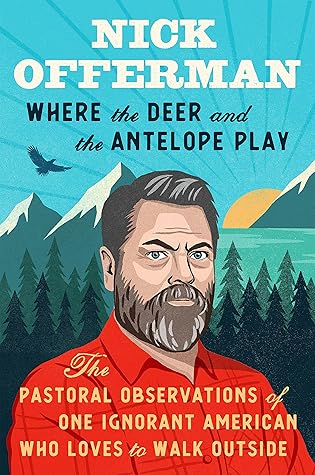
More on this book
Community


Kindle Notes & Highlights
Read between
December 31, 2021 - February 18, 2022

Once again, instead of working toward producing meat that is healthy for the consumer, the animal, and the environment, the corporate mindset works in the other direction—toward exactly how much ill they can get away with.
Aldo Leopold: “All ethics so far evolved rest upon a single premise: that the individual is a member of a community of interdependent parts. The land ethic simply enlarges the boundaries of the community to include soils, waters, plants and animals, or collectively the land.”
places with more openly “conservative” politics (which is a polite term for discriminatory culture, as in “We would prefer you take your rainbow ass elsewhere as we are conserving a Christian™, white ethno-state hereabouts”),
There are people who want things to stay the way they are, or be “conserved,” and then there are people who understand that “the way things are” is actually quite shitty for a lot of our fellow Americans, so they are interested in our social construct’s “progressing” to the long-dreamed-of point where the promises of the Constitution can be kept for all Americans.
It is inherent in human nature to destroy, with ever-burgeoning ease, everything we touch. It’s truly what we’re best at.
But at the heart of these efforts is one form of compassion or another, and that is compassion for everyone. That’s the deal, that’s what Jesus taught.
I suspect that instead of liberal tears, the cups of these losers are actually filled with warm schadenfreude, and the sad folks who sip from them don’t understand that “whatsoever you do to the least of your brothers and sisters, you do unto me,” to coin a phrase.
We must respect our position, our rank, in the Great Economy. Appropriately scaling our consumption to the economy of Mother Nature all over the globe is a difficult row to hoe, but we have done an amazing job so far, all things considered, in that we have not only survived, but we have flourished as a species. Things have gone so well, in fact, that a large number of Americans are able to live in relative comfort, lulled into paying little attention to the way our country is being run. I get this. I have, in the past, been in touch with the part of me that thinks, “I have a car, I have a job,
...more
We’re all racist, we exist in a world, a framework, that was constructed by, and for the benefit of, white people, particularly wealthy white people. Let’s start by owning that. To deny it is a violent sort of ignorance. If our entire infrastructure is largely racist, then let us turn our attention to educating ourselves about that history, and then instituting programs by which reparations can be exacted. It’s really not that complicated: We fucked up.
Therefore the conversations I want to be part of, and the debates I want to engender when I tour, simply examine where we American dipshits need to be applying our focus, for the common good.
the physical and spiritual health of our bodies and also of our environs can pay out great dividends indeed, without sending anybody a check.
How can we expect anyone to pay attention to our relationship with labor upon the land when our military-industrial complex won’t even value the human being to start with?
Whether it’s with foul, fish, beast, or grain, when we exclude any and all variety from our farming produce, we supply an open invitation to Mother Nature to discipline us by sending any number of plagues to wipe out the harvest.
A Sand County Almanac.
Wendell Berry wrote, “The clear tendency of industrial agriculture has been to destroy any living thing that cannot be sold,”
All of which is to remind myself (and you, should you care to hear it) that life can be incredibly rich and rewarding without involving modern distractions and consumer goods. I might even argue that the well-curated lifestyle of the Luddite is more edifying because it lacks the disappointment of empty accomplishments.
We have tried focusing solely upon the quantity of dollars that might be wrung out of a given piece of territory, and discovered it to be an empty and destructive task, excepting that a very few people make some money, and that, only temporarily.
As James wrote in The Shepherd’s Life, “Later I would understand that modern people the world over are obsessed with the importance of ‘going somewhere’ and ‘doing something with your life.’ The implication is an idea I have come to hate, that staying local and doing physical work doesn’t count for much.”
Some of us garden, or perhaps keep bird feeders, but that is the extent of our direct communing with the Great Economy, and even so, we are considered the outliers.
When Aldo Leopold wrote, “A land ethic, then, reflects the existence of an ecological conscience—and this in turn reflects a conviction of individual responsibility for the health of the land. Health is the capacity of the land for self-renewal. Conservation is our effort to understand and preserve this capacity,” he was really giving us Americans a lot more credit than we have proven to be due. How often do we think about our “individual responsibility for the health of the land”?
Where I come from, values still exist, and they’re based not on skin color, or religion, or sexual orientation, but solely on decency. I was taught to examine my actions and see if they can be reconciled with my sense of decency when held up against it.
But here in America, our Supreme Court has decided that corporations must be treated as having the same rights as individual citizens, and I wonder about that. Did the corporations’ parents teach them about decency, and if so, do they hold each of their corporate actions up against that ruler of moral values to see if it is reconciled positively? Do they maintain a “conviction of individual responsibility for the health of the land”? How stupid are we?
my general happiness depends upon my ability to accomplish good, productive work that does somebody some good.

I feel this.
When you have no electricity and it’s night in the desert, look up.
It goes back to that sense of “heroism” and “patriotism” that we softies discussed in part 1. These terms generally referred to acts of violence in the service of one’s own family or tribe or state or nation.
I am so grateful that a percentage of our population is woke, and always has been, because that is the contingent that recognizes our human flaws and the subsequent flaws that have been built into the organizational structures of our civilization.
No matter what those people were telling themselves about their stance and their values, for those of us opposed to that candidate and what has slavishly become his party, their flag was little different from a Klan hood. We can’t be expected to think that it represents good people who want the best for our country, when you have told us yourselves that you want to see us liberals crying in pain.
When I see a Trump hat or flag, on the other hand, the message I receive, as a person opposed to his racism, misogyny, flagrant lifelong dishonesty, titanic narcissism, I mean, you name it—his utter lack of decency across the board—the message I receive from that symbol on your head, chest, or lawn is that you condone those qualities.
Masks signal a tacit agreement to behave in the best way we can for the common good, selfishly for our own health, but also for the well-being of our loved ones, our neighbors, and everyone else, which is one of the basic tenets of Christianity to which I seldom see Republicans adhere.
Sarah Kendzior, a sharp St. Louis journalist who tells it like it is, has written, “When wealth is passed off as merit, bad luck is seen as bad character. This is how ideologues justify punishing the sick and the poor. But poverty is neither a crime nor a character flaw. Stigmatize those who let people die, not those who struggle to live.”
They are simply not focused on local produce, which is going to be the only way we will rescue the few small farms remaining across our nation.
They=Whole Foods
If you are lucky or wise enough, or both, to be living in an idyllic fashion à la Aldo Leopold, sleeping at the shack with loved ones, food to eat, songs to sing, fish to catch, and plenty of nature in which to occupy one’s days, then you will only occasionally, maybe once a week, need to “get to town,” for milk or eggs, or if you’re anything like me and Megan, for a Snickers bar or an ice cream.
The Hidden Life of Trees by Peter Wohlleben,
Thoreau wrote, “Pursue some path, however narrow and crooked, in which you can walk with love and reverence. Wherever a man separates from the multitude and goes his own way, there is a fork in the road, though the travelers along the highway see only a gap in the paling,” and
Okay, we’re going to need some smart people. We take the smart people, and we get them to strategize a way to convince our legislators—the people whom we ostensibly choose to represent our wishes (over the nefariously purchased preferences of corporate interests nationwide) in the way they legislate the laws of the states and the country—that we care more about climate change than white supremacy; that we care more about the health of our farms and farmers and our food systems than we do about being able to wear our guns into more public places. That we care more about people than money. But I
...more
The argument that our nation should be allied with any one religion, or religion at all, is simply bonkers.
“To know fully even one field or one land is a lifetime’s experience. In the world of poetic experience it is depth that counts, not width. A gap in a hedge, a smooth rock surfacing a narrow lane, a view of a woody meadow, the stream at the junction of four small fields—these are as much as a man can fully experience.”
Patrick Kavanagh
We must understand that each and every one of us is a cog or a wheel in the ecosystem of Leopold’s parlance, and that like it or not, you need me. And I need you, every gorgeous, goddamn one of you, to continue to engender the ethics of agrarianism throughout the world, to save our food systems, our farmers, our civilization, and ultimately ourselves. It’s the biggest no-brainer in the history of mankind.
