
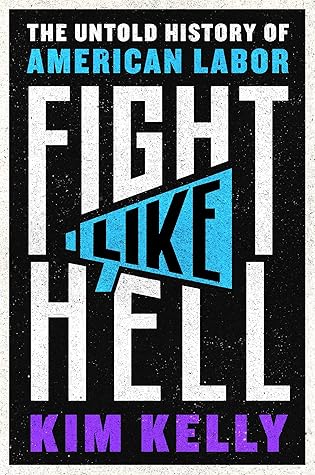
More on this book
Community


Kindle Notes & Highlights

by
Kim Kelly
Read between
September 2 - September 5, 2024

We must have money; a father’s debts are to be paid, an aged mother to be supported, a brother’s ambition to be aided and so the factories are supplied. Is this to act from free will? Is this freedom? To my mind it is slavery. —SARAH BAGLEY, NINETEENTH-CENTURY LABOR LEADER
On a balmy spring 1824 day in Pawtucket, Rhode Island, 102 young women launched the country’s very first factory strike, and brought the city’s humming textile industry to a standstill.
By 1793, Slater Mill was in full operation, staffed in part by local children aged between seven and thirteen years old. As the business expanded, Slater devised “the Rhode Island System,” hiring entire families en masse. His “system” proved both effective and influential. By 1860, more than half of the mill workers in all of Rhode Island were children. He initially sought out the children of unhoused or incarcerated people to build up his workforce, but finding them too costly to house and feed, he began to encourage local working-class families to quite literally bring their children to work
...more
It was an early foreshadowing of conflicts that would be seen time and time again in the American labor struggle—different groups of marginalized workers were pitted against one other as profit-obsessed business interests scrambled to hire the most vulnerable people they could get their hands on.
the Port of Galveston emerged as a major hub for immigration in the years prior to Ellis Island’s 1892 opening.
This viewpoint would prove to be a recurring theme throughout the early American labor movement, and remains a problem today, when far too many trade unionists still view immigrants as competition instead of welcoming them as fellow workers.
This finding directly reinforces the Garment Worker Center’s 2021 claim that 85 percent of L.A.’s garment workers experience wage theft. Workers interviewed by the Guardian in 2021 spoke about drawing wages as low as $6 per hour—well under the prevailing minimum wage in Los Angeles, which is the center of the country’s garment production industry (California also employs the most garment workers of any state, with forty thousand in Los Angeles alone).
By 1934, the Great Depression had cast a pall over the entire country, but the workers of Birmingham, Alabama, were having a particularly tough go of it. During this period of economic collapse, Birmingham—which the Roosevelt administration deemed to be “the worst hit town in the country”—saw its massive steel mills close down and its coal mines left idle.
Today’s agricultural worker is still likely to have arrived from another country; 73 percent of all American agricultural workers are foreign-born, with 69 percent hailing from Mexico. Those workers, nearly half (47 percent) of whom are “undocumented,” are part of a continuing struggle—one
Seventy-plus years later, Hawai’i remains heavily unionized, boasting the highest rate of union membership in the nation at nearly 24 percent.
During the 1930s, President Herbert Hoover enacted a massive deportation raid on people of Mexican descent, in which up to 1.8 million Latinos—nearly 60 percent of whom were U.S. citizens—were forcibly removed to Mexico. (President Eisenhower would reprise this racist campaign in 1954, when more than 1 million more Latino people were violently rounded up and deported.)
According to the Farm Bureau, at least 50 to 70 percent of today’s farm laborers are undocumented, which deprives them of essential labor law protections and the opportunity to formally organize.
By the early 1900s, the Pullman Company was the largest employer of Black workers in the United States.
(George Pullman is often credited with hastening the widespread adoption of tipping as a customary practice in America—thanks for that one, George).
