
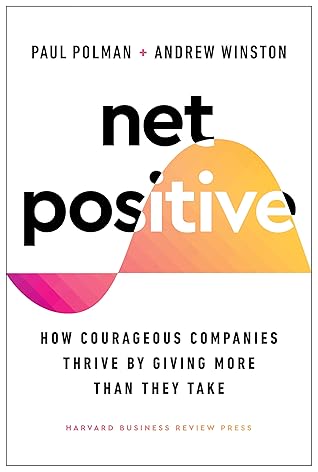
More on this book


Kindle Notes & Highlights

Read between
September 28 - December 23, 2023

the only impossible journey is the one you never begin.
The goal of the USLP is financial gain because of sustainability, not despite it—not profits with a side of purpose, but profits through purpose.
In a volatile, uncertain, complex, and ambiguous (VUCA) world, resilience is everything.
deep connections to its employees, communities, business partners, and governments.
positive territory would indicate not only zero accidents but the creation of a “health-producing workplace.”
our vision of net positive is a business that improves well-being for everyone it impacts and at all scales—every product, every operation, every region and country, and for every stakeholder, including employees, suppliers, communities, customers, and even future generations and the planet itself.
The ultimate question is this: Is the world better off because your business is in it?
Milton Friedman view that the purpose of business is shareholder value
It will, for example, eliminate more carbon than it produces; use only renewable energy and renewably sourced materials; create no waste and build everything for full circularity; and replenish and make cleaner all the water it draws.
As a people-driven company, it will ensure everyone working in the value chain has the dignity of earning a living wage. The company will offer extensive opportunities for inclusion of all races and abilities, and achieve gender balance in management and pay equity. Through its products, services, and purpose-led initiatives—not philanthropy—consumers and communities will be better off. NGOs will be treated as equals and collaborators, not antagonists. Government leaders will find they have demanding partners, not self-serving lobbyists, trying to develop a system of rules that benefits all.
...more
The fashion and apparel business, for example, was an early leader, creating the Sustainable Apparel Coalition to develop supply chain standards. But at the same time, fast fashion dramatically increased sales of apparel … and the energy, water, and waste impacts that came with
These attributes, fully embraced, separate the net positive companies from the merely well-run and well-meaning businesses: Ownership of all impacts and consequences, intended or not Operating for the long-term benefit of business and society Creating positive returns for all stakeholders Driving shareholder value as a result, not a goal Partnering to drive systemic change
Unilever has faced pointed attacks over skin-whitening products in India. Many Indian women defend the use of these products, saying it’s their choice to pursue an “ideal” of lighter skin. But for Unilever, it was a major mismatch between the message of whitening, and the purpose of a brand such as Dove that helps women build self-esteem and appreciate their own unique beauty. The company took the whitening ingredients out of those face creams a couple of years ago and has rebranded the products “Glow & Lovely” instead of “Fair & Lovely.” But the brand damage was done.
Creating long-term value means not shooting for the moon in a given year, but investing every year to get the compounding effects and benefits of consistency over time.
The Unilever Sustainable Living Plan (USLP), launched in 2010 with a ten-year horizon, has forced long-term thinking at the company. It’s a tool for converting a long-term philosophy on how to run a business into action, and a road map to shift the business toward serving others.
Increase those long-term flows, and the buyers will come. And if the stock market is not connected to actual corporate performance and cash flows, then it’s a casino, and why bother speaking to short-term shareholders at all.
“We’re not going to report quarterly earnings or provide guidance anymore.” Paul took this big step about three weeks into his job as CEO,
Yesterday I was clever, so I wanted to change the world. Today I am wise, so I am changing myself. —Rumi, thirteenth-century Iranian poet
Darwin wrote about being adaptable and fit to survive, not being the fitt-est.
Smith believed that self-interest aligned with sympathy and justice.2 The opening line of The Theory of Moral Sentiments declares, “How selfish soever man may be supposed, there are evidently some principles in his nature, which interest him in the fortune of others, and render their happiness necessary to him, though he derives nothing from it except the pleasure of seeing it [emphasis added].”
In this sense, the caring that leads to the happiness of others is selfish.
