
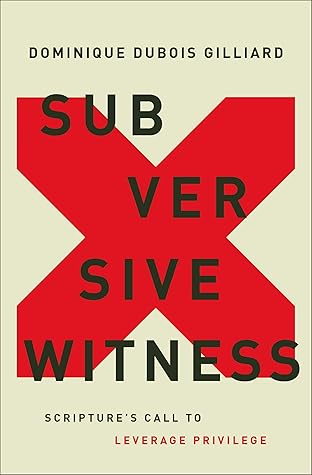
More on this book


Kindle Notes & Highlights
Read between
October 20 - October 28, 2021

I think we all want reconciliation. We want peace, we want understanding, we want redemption—all of these wonderful things. But we haven’t committed ourselves to truth-telling. Truth and reconciliation are not simultaneous. They are sequential. Tell the truth first, and it’s the truth that motivates you to understand what it will take to recover, repair, endure—to reconcile.10

quote from Bryan Stevenson
The spiritual disciplines of remembrance, confession, lament, and repentance allow us to discern what producing fruit in keeping with repentance entails. Denying that privilege exists only exacerbates the evil it produces and prohibits us from actively participating as colaborers with Christ in reconciling the world to God.
System1 and 2 work
Without history and proximity, lamentation seems unwarranted. No one laments what they do not know, and most people gloss over statistics that they cannot associate faces with—regardless of how heartbreaking the stats are. Lamentation compels us to expose what the empire seeks to conceal and deny. It emboldens us to see suffering anew, speak truth to power, and draw near to our neighbors on the margins. When the church takes history seriously, lament will become requisite.
Our unwillingness to soberly address history, acknowledge systemic sin, reckon with our ancestors’ sins, and answer Scripture’s call to corporate responsibility leads us to forsake lament. Rah expounds, “Lament calls for an authentic encounter with the truth and challenges privilege, because privilege would hide the truth that creates discomfort.”16 He concludes, “The dismantling of privilege requires the disavowal of any pretense of exceptionalism.”17
The problem, however, is that we have deluded ourselves into thinking oral confession is repentance. Saying “I am sorry” is not equivalent to turning away from sin. Confession of sin is only part of what turning back to God entails.
Moses fought, but his resistance did not further the kingdom. Since he had not tended to the root causes of his trauma, discerned God’s call upon his life, or learned to hone his righteous indignation by channeling it for constructive change, he responded to imperial violence with violence.
Moses, like the women who raised him, learned to constructively act in the face of oppression and fear, channeling his righteous indignation into kingdom change. He, too, embodied a self-giving ethic of belonging to those whom he was socialized within the palace to see as disconnected from him, as inferior to him. He, too, put his life on the line, opposing Pharaoh to fight for justice, pursue freedom, and stand in solidarity with those he had the “privilege” of ignoring. God compelled Moses to reexamine his life and all that he had been entrusted with. Moses came to realize that he was
...more
Having privilege is not a sin, though privilege emerges from sin. What is sinful is exploiting privilege for our own advantage and turning a blind eye to the suffering of our neighbors in order to sustain it. Scripture repeatedly acknowledges privilege and provides insight into how privilege insidiously functions today. Learning to unmask privilege can be painful work, but the cure for the pain is in the pain. By candidly addressing privilege, we create a unique opportunity for the body of Christ to turn away from sin and reorient ourselves toward God and neighbor through the spiritual
...more
Justo González writes that Luke uses a double typology, in which the theme of Adam in the garden parallels the theme of Israel in the wilderness. Significantly, while the entire passage reminds us of the temptation of Adam in the garden, the string of quotes from Deuteronomy with which Jesus responds reminds us of the temptation of Israel in the wilderness. Thus the entire story of the exodus and the wanderings in the wilderness becomes a typological axis, showing that from ancient times God was beginning to undo the evil that was done in the fall.
Esau McCaulley writes, Isaiah realized that true worship of Yahweh had implications for how one treated their neighbor. According to Isaiah, Israel’s oppression of the poor in his day betrayed a practical apostasy. For Isaiah, piety must bear fruit in justice. Jesus knew that inasmuch as his message of justice impinged on the lives of the powerful, he was liable to rejection and death. Jesus not only embraced this prophetic tradition, he declared himself the climax of it by claiming that the acceptable day of the Lord (Is 61:1–2) had arrived in him (Lk 4:14–21). . . . Jesus saw his ministry as
...more
When Jesus went to Zacchaeus’s home, he did not go just to engage in table fellowship—he went to heal the sick and to call Zacchaeus to repentance.
This proclamation demonstrated that Zacchaeus knew he exploited the poor, and he also understood that merely saying, “I’m sorry, Lord. I’m a sinner; please forgive me,” while retaining the booty his sins commandeered, would have been insufficient. Zacchaeus understood that repentance required more than words.
Zacchaeus understood that his sins had created communal trauma and constructed a perpetual underclass. He knew that his economic exploitation harmed more individuals than the people he directly extorted. Zacchaeus acknowledged that the depraved system of tax collection generated oppressive patterns of debt, poverty, and abuse that had to be atoned for. When we are spiritually mature enough to soberly assess our sins and the collective impact they have had on our neighbors, the Spirit leads us to discern what true reconciliation requires.
While the entire system is guilty, as we work to transform broken systems, we also need eyes to see the people of God within these systems who need to be called to repentance. As the people of God who are integrated within broken systems and structures awaken to their sinful complicity and follow Zacchaeus’s model, we establish kingdom pressure points that help us topple oppressive systems that counteract the will of God.
Black people were relentlessly terrorized by white vigilantes—with impunity—after the Emancipation Proclamation, as soon as the Reconstruction Era culminated. From 1865 to 1877, more than two thousand African Americans were lynched.3 For eighty-seven consecutive years, from 1865 to 1952, at least one Black person was lynched every single year in the US.4 Lynchings, however, did not stop in 1952; this was just the first year there was any sort of reprieve. The number of Black people lynched between 1880 and 1968 averages out to a Black person being lynched weekly for eighty-eight consecutive
...more
White lynch mobs were empowered by elected officials who embraced white supremacy. For example, James K. Vardaman, the governor of Mississippi, declared before his constituents in 1907, “If it is necessary, every Negro in the state will be lynched; it will be done to maintain white supremacy.”8 As much as we want to believe Vardaman was an anomaly, he was not.
Reinhold Niebuhr wrote, “If there was a drunken orgy somewhere I would bet ten to one a church member was not in it. . . . But if there was a lynching, I would bet ten to one a church member was in it.”15
When the people of God refuse to address the sins of our ancestors and the privileges their sins continue to systemically imbue, we also forsake Jesus’ instruction: “I give you a new commandment, that you love one another. Just as I have loved you, you also should love one another. By this everyone will know that you are my disciples, if you have love for one another” (John 13:34–35 NRSV). When we choose not to address inequities that we know infringe upon the shalom God created all people to enjoy and ignore privileges that sustain ungodly inequities, we miss out on precious opportunities to
...more
Yang and Soerens explore in detail what the Bible says about immigration and conclude, “God does not suggest that we welcome immigrants; he commands it—not once or twice, but over and over again.”3 This is not to say there are not valid and vital questions that must be addressed regarding immigration reform and what it entails, but it does mean that too many Christians are using sources other than Scripture as the foundation for their beliefs and civic engagement regarding immigration. This was exemplified by a 2015 poll that revealed that only 12 percent of evangelical Christians said the
...more
René Padilla defines misión integral as “the mission of the whole church to the whole of humanity in all its forms, personal, communal, social, economic, ecological, and political.”6 This is the work of the church, the liturgy Scripture calls us to pursue.
We won’t find genuine freedom without developing the courage and fortitude to soberly confront sin, access its deadly impact, and return to right(eous) relationship with God and neighbor. Followers of Christ must realize that we cannot crucify what we cannot name. When the church sidesteps naming sin or uses adulterated allegories and metaphors to make sin more palatable, our response to sin will always be insufficient. As Pastor Richard A. Villodas Jr., lead pastor of New Life Fellowship, explained in his response to Louie Giglio’s comments, we empower sin to establish a foothold within the
...more
Pastors who cower before imperial power and white discomfort must own their share of the blame because they fail to cast a gospel vision for their members. They fail to make disciples who desire to participate in biblical justice and are equipped to engage in a Spirit-filled righteous resistance against the powers, principalities, and spiritual wickedness that oppose the will of God. Pastors cannot allow the gospel we proclaim to be dictated by what our members are ready for on their own. We are called to lead and disciple, not placate, our members.
