
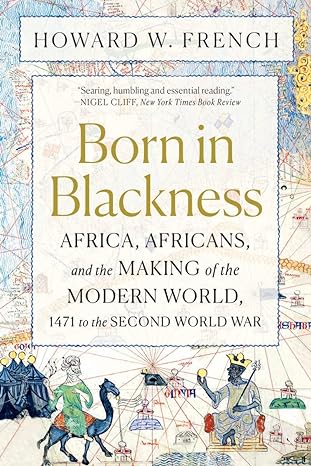
More on this book
Community


Kindle Notes & Highlights
Read between
August 24 - September 14, 2025

Without African peoples trafficked from its shores, the Americas would have counted for little in the ascendance of the West.
The history of maritime exploration during the hundred years after the publication of the Catalan Atlas would be dominated not by thoughts of Asia but by the emphatic desire to nail down the source of West Africa’s wealth in gold.
And it was this openness that gradually positioned the Jewish community of Majorca to play the crucial and little-known role of intermediary between two adjacent continents, Africa and Europe. This was due in part to the long-standing commercial traditions of the Jews, and in part to the fact that members of their religion, unlike Christians, were allowed to travel freely and even dwell in Islamic North Africa,
According to the Spanish missionary and historian Bartolomé de las Casas, Columbus wrote in his diary, “We saw naked people. They were a people poor in everything.”
Sheer arrogance and superficial impressions, based on ignorance about the languages, religions, and governments of native peoples, would lead to conflict and devastation throughout the Atlantic world.
This time, the islanders prevailed using wooden swords and shields, copying the weaponry of the invaders.
“the plantation production of sugar was among the deadliest innovations known to humanity.”
Some have argued that austere and inwardly turned Confucianists in the Ming court prevailed in a contentious debate against rival factions about the costs and rewards of exploration and of the projection of naval power on the high seas. This caused China to abruptly withdraw from the world of maritime exploration and even destroy Zheng He’s fleet, a startling shift given its enormous size.
it was Portugal’s far deeper connections with sub-Saharan Africa, first through gold and then through slaves, that more than any other factors in this era, bequeathed to us our familiar world.
People who meet occasionally remain friendlier than do neighbors, on account of the nature of the human heart. KWAMENA ANSA (CARAMANSA), 1471
Whether flattered or simply undaunted, Azambuja continued to press his request, upon which Ansa issued a parable of a kind still so favored among the Akan and many other peoples of West Africa. “People who meet occasionally remain friendlier than do neighbors, on account of the nature of the human heart,” he replied.
The Portuguese were not the only ones, however, who through such court receptions and diplomacy were forming new ideas of self-awareness in relationship to the perceived “other,” another essential building block of what we commonly think of as modernity.
The overall impression one gets, though, is that the missionary work of the late fourteenth and fifteenth centuries was mostly about providing religious and ideological cover for the horrors of the recent innovation we now know as chattel slavery, not to mention an intra-European competition for legitimacy and prestige in which the Catholic Church and a global contest with Islam played outsized roles.
if slavery was so incidental to the prosperity of Europe and of its New World offshoots, did the powers of the Old Continent invest themselves so heavily, for so long, and at such enormous cost in terms of their own blood and treasure
The Dutch actually lent firearms to rival states on the Gold Coast on the condition that their African clients would sell whatever prisoners they took captive to the Dutch as slaves,

Similar to how the US funds and arms other countries to fight wars that we then benefit from.
The availability of hot, sweetened, stimulating drinks gave birth to the first coffee shop, which opened its doors in Oxford in 1650. From there, coffee shops quickly spread to London, where they proliferated, and this in turn helped rapidly establish a medium only recently invented in Germany: the newspaper.
a quest for full citizenship in the country they had helped build.
