
More on this book
Community


Kindle Notes & Highlights

Started reading
July 23, 2023

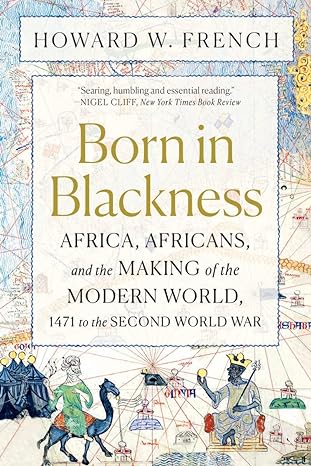
The first impetus for the Age of Discovery was not Europe’s yearning for ties with Asia, as so many of us have been taught in grade school, but rather its centuries-old desire to forge trading ties with legendarily rich Black societies hidden away somewhere in the heart of “darkest” West Africa. Iberia’s most famous sailors cut their teeth not seeking routes to Asia, but rather plying the coastline of West Africa. This is where they perfected techniques of mapmaking, and navigation, where Spain and Portugal experimented with improved ship designs, and where Columbus came to understand the
...more
Well before he mounted his expeditions on behalf of Spain, Columbus, an Italian from Genoa, had sailed to provision Europe’s first large, fortified overseas outpost in the tropics at Elmina, in modern-day Ghana. Europe’s expeditions to West Africa of the mid-fifteenth century were bound up in a search for the sources of that region’s prodigious wealth in gold. Indeed, it was the huge trade in this precious metal, discovered by the Portuguese in 1471, and secured by the building of the fort at Elmina in 1482, that helped fund da Gama’s later mission of discovery to Asia. This helped make it
...more
Of central concern in the following pages is the deeply twinned and tragic history of Africa and Europe that began with geopolitical collisions in the fifteenth century. Events and activities that flowed from Afro-European encounters set the most Atlantic-oriented Europeans onto a path that would eventually propel their continent past the great civilizational centers of Asia and the Islamic world in both wealth and power. This ascension was not founded upon any innate or permanent European characteristics that produced superiority. To a degree that remains unrecognized, it was built on the
...more
Daniel Defoe, the English author of Robinson Crusoe, but also a trader, pamphleteer, and spy, bested them both when he wrote: “No African trade, no negroes; no negroes, no sugars, gingers, indicoes etc.; no sugar etc no islands no continent, no continent, no trade.” Postlethwayt, Raynal, and Defoe were surely right, even if they were far from comprehending all of the reasons why. As this book will make clear, more than any other part of the world, Africa has been the linchpin of the machine of modernity. Without African peoples trafficked from its shores, the Americas would have counted for
...more
In sugar’s wake, cotton grown by slaves in the American South helped launch formal industrialization, along with an immense second wave of consumerism. After plentiful calories, abundant and varied clothing for the masses became a reality for the first time in human history. As revealed here, the scale and the scope of the American antebellum cotton boom, which made this possible, were nothing short of astonishing. This made the value derived from the trade and ownership of slaves in America alone, as distinct from the cotton and other products they produced, greater than that of all of the
...more
Spain and Portugal waged fierce naval battles in West Africa over access to gold. Holland and Portugal, then unified with Spain, fought something little short of a world war in the seventeenth century, with control of trade in the richest sources of slaves in Africa, present-day Congo and Angola, flipping back and forth between them. On the far side of the Atlantic, Brazil, the biggest producer of slave-grown sugar in the early seventeenth century, was caught up in this same struggle, and repeatedly changed hands. Later in that same century, England fought Spain over control of the Caribbean.
...more
Nowadays, the consensus estimate on the numbers of Africans brought to the Americas hovers around 12 million. Lost in this atrocious but far too neat accounting is the likelihood that another 6 million Africans were killed in or near their homelands during the hunt for slaves, before they could be placed in chains. Estimates vary, but between 5 and 40 percent perished during brutal overland treks to the coast, or while being held, often for months, in barracoons, or holding pens, as they awaited embarkation on slave ships. And another 10 percent of those who were taken aboard died at sea
...more
In most of the New World plantation societies the average remaining life span of trafficked Blacks was reckoned at seven years or less. In 1751, an English planter on Antigua summed up the prevailing slaveowner sentiment this way: “It was cheaper to work slaves to the utmost, and by the little fare and hard usage, to wear them out before they become useless, and unable to do service; and then to buy new ones to fill up their places.”
In 1808, a typical picker in South Carolina, then still the heart of America’s cotton-growing region, averaged 28 pounds per day of harvest. By 1846, the average Mississippi cotton picker delivered up 341 pounds to his masters, a rate of increase fully in step with the growth of factory productivity in Manchester.
Specialists aside, few imagine that islands like Barbados and Jamaica were far more important in their day than were the English colonies that would become the United States. The nation now known as Haiti, even more so. In the eighteenth century it became the richest colony in history, and in the nineteenth, by dint of its slave population’s successful revolution, Haiti rivaled the United States in terms of its influence on the world, notably in helping fulfill the most fundamental Enlightenment value of all, ending slavery.
I hiked a verdant peak in northern Haiti. There, Henri Christophe, that country’s early Black leader, built the formidable Citadelle Laferrière, the largest fortress in the Western Hemisphere, arming it with 365 cannons to defend the country’s hard-won independence from France. Other hints came when I wandered into the mountains and rain forests of Jamaica and Suriname, respectively, and was thrilled to be able to make myself understood speaking bits of Twi, the lingua franca of Ghana learned while courting my wife, as I spoke with the descendants of proud runaway slave communities known as
...more
There stood a faded sign attached to a rusty iron post. It announced the site to be part of something called “The Slave Route,” but it provided no further information. With the sun racing downward in the western sky, I paced about briefly, snapped a few photographs, and then finally collected myself as the wind whistled through the cane. I tried mightily to conjure some sense of the horrors that had transpired nearby, and of the abundant wealth and pleasure that the sweat of the dead had procured for others. In the moment, there was little else I could do to render proper homage to the
...more
Djenne-jeno, or “ancient Djenné,” sprung to life roughly 250 years before the birth of Christ, on a floodplain near the banks of the Bani River, not far from where it joins the course of one of the continent’s greatest rivers, the Niger, on its long, trundling arc through West Africa. In its early phases of growth, the city counted more than fifteen thousand residents, many of whom lived inside a high, 1.3-mile-long wall that was twelve feet thick at its base. Another thirty thousand or so people lived in related urban clusters nearby. Early in the Christian era, an aggregate population like
...more
