
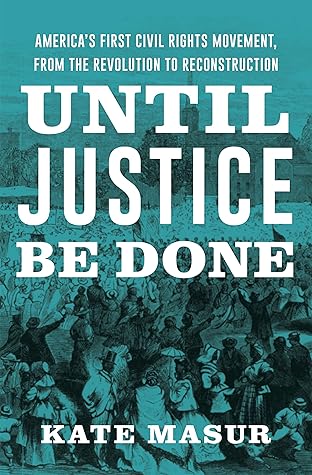
More on this book

Kindle Notes & Highlights

by
Kate Masur
Read between
December 2 - December 31, 2022

In Ohio in 1849, the assembly that repealed most of the black laws adopted a new statute designed to reduce migration by people who were “likely to become chargeable as paupers in any township … or to become vagrants.” A similar fungibility of race and class continued after the Civil War. The idea persisted in many quarters that poor people who were transient or appeared not to be working posed a threat to public peace and good order, and that such people were not entitled to the same basic rights as others. Freedmen’s Bureau agents and other northerners in the post–Civil War South insisted on
...more
Southern state legislatures quickly adapted to Republican priorities by abandoning the flagrant black codes of 1865 in favor of race-neutral statutes that penalized vagrancy and demanded enforcement of labor contracts. “No reference to color was expressed in terms,” one Freedmen’s Bureau official observed of an Alabama law, “but in practice the distinction is invariable.” Strict antivagrancy laws often remained on the books but went unenforced while Republicans were in charge of southern state governments. Democrats, on regaining control, enforced them with new stringency and adopted even more
...more
the Supreme Court did not recognize poor people’s right to move from state to state until 1941. Amid the upheavals and destitution of the Great Depression, the court finally allowed that even the migrant poor were persons before the law, invalidating a California law that, like the laws of many other states, punished the importation of “any indigent person who is not a resident of the State.”11
In the post–Civil War years, many northern white communities continued to do everything in their power, with or without the sanction of law, to prevent African Americans from moving in. Where African Americans did reside, whites often demanded separation in housing, schools, and recreational facilities. Yet regional distinctions remained tremendously significant. For decades before the Civil War, the free states had offered a climate in which Black and white people could coalesce in a movement for racial equality that made significant inroads into state and then national politics. Many of the
...more
Still, African American activists and their white allies wanted to see a federal ban. Their strongest ally in Congress was Massachusetts Senator Charles Sumner, who in the early 1870s fought for a federal law that would bar discrimination by railroads, steamboats, public conveyances, hotels, restaurants, licensed theaters, public schools, juries, churches, and cemetery associations. The measure was controversial, including among Republicans. Congress finally passed Sumner’s law in 1875, after the senator had died and with the sections barring discrimination in schools, churches, and cemeteries
...more
This highlight has been truncated due to consecutive passage length restrictions.
THE ASPIRATIONS OF antebellum civil rights activists notwithstanding, the federal measures adopted during Reconstruction did not secure a baseline guarantee of racial equality in civil rights. Operating on the principle of “separate but equal,” state and local governments continued to insist that race was a legitimate distinction in public policy and to reinforce forms of racial subordination that, as antebellum activists well understood, had originated in race-based slavery. Governments regularly used facially neutral laws—including those associated with vagrancy and other crimes linked to
...more
Removing racist laws did not remove racism, and ostensibly race-neutral laws were readily put to discriminatory purposes. Hard as it was to eradicate policies that explicitly discriminated based on race, it was even more difficult to take the next step: to confront the longstanding interpenetration of racism with the criminalization of poverty, and to address meaningfully the ways seemingly race-neutral policies perpetuate racial inequality. Much remains to be done.
