
Kindle Notes & Highlights

Read between
July 4 - July 6, 2023

The problem with systematic theology is not, therefore, with the system itself. The problem, rather, is the system’s function, how it does or does not move. All living systems, we know, naturally tend towards entropy. Their desire is to be undone and poured out. Any energy we input to maintain order in one place always leads to disorder elsewhere. The frequent shift of energy’s input and flow, the slight imbalance of order and chaos, is what keeps the living system living. When we forget that a theological system is living too, it gets stuck. An overly tight maintenance of orthodoxy at one
...more
If a shocking image is seen to have any moral value – be that image artistic, literary, theological, or otherwise – that value is typically understood to reside in the power of the shock to wake us up. A shocking image can challenge complacency, clothe the reality that eludes us with the visceral, lure the unrepresentable towards something that can almost be grasped. It can bring to the realm of awareness something we have – on some inarticulable level – always known to be true.
When I began my fieldwork, that particular feeling – in its most detestable form as insecure arrogance – gripped me too. It was also still there, unfortunately, when I completed my fieldwork. By naming a methodological orientation towards ‘transformative practice’, I could sneak in my desire to make my church more progressive. Sure, I wanted our teaching–learning to be mutual. But I also wanted the scales to be slightly tipped so that a little more teaching came from me to them. I didn’t realize at the time that the transformation I was seeking wasn’t quite the one I thought.
The performance theologian isn’t conservative, but she also doesn’t march to the beat of progress. She’ll both arabesque and stumble, to beautiful music but out of time. The God who I long to proclaim doesn’t work with the straightforwardness I crave.
This means that when I disable God the Father (Chapter 1), make the Holy Spirit indecent (Chapter 2), and disfigure God the Son (Chapter 3), I am not making claims about God’s nature itself. Rather, each rupture to the systematic theological imaginary rearranges it so it can be performed anew. Chapters 4 to 6 then perform these doctrines in multiple modes of drag. None of them directly represents or argues for a theology of the cross. But each one grapples with performing theology from it.
So I’m not actually saying in this chapter that God has dementia (what would that even mean?). Rather, cognitive impairment provides a framework for perceiving the power-laden social conditions through which God might currently be trying to visit us.
Acknowledging that for mortals suffering and death are unavoidable, however, Moltmann argued that they are not to be negated but redeemed. ‘God suffered in the suffering of Jesus, God died on the cross of Christ … so that we might live and rise again in his future.’19 God thus takes on the death that our mortality makes us die. And by taking on the very thing we fear, God undoes our need to be scared. Theism fails to fathom the Christian God precisely because the Christian God doesn’t need our protection.
God doesn’t make himself vulnerable because vulnerability is easier for finite humans to see. God makes himself vulnerable in the act of making space in himself for humans to enter in. It’s as though God not only tears his self apart to make room for us, but that God refuses to heal the tear, such that God’s wound becomes the point of ontological connection with all human woundedness. Our shared suffering is the precise point of ontological connection between God and humanity.
On that morning when I woke up no longer believing in God, the only place I could go was to the foot of the cross. Not to understand it but to be enveloped by it. To face the abyss of being forgotten, being abandoned – and risk falling all the way in. And then to linger, even loiter, in that place where eternity and time, death and life, despair and hope and all we’ve lost and still might gain embrace. To allow the bend from anamnesis to epiclesis to stretch out.
The build-up of the fourth to sixth ways is intense, as the soul gets ‘dominated’, ‘contained’ and ‘conquered’ until Beatrice ‘can hardly control herself’ and no longer has any ‘power of her limbs and senses’ (fourth way). The fifth way includes a period of ‘tensed expectation’, as the soul burns strong and furious, ‘repeatedly [and] painfully wounded’ until her ‘marrow pines away, and her legs weaken and her chest scorches, and her throat dries up so that her face and all her limbs take part in the heat inside, take part in this primal rage of love.’ I mean, that just sounds to me like a good
...more
The Holy Spirit’s role in Christ’s conception is indecent. Or, rather, if it is to be anything other than a divine rape, then it needs to be reclaimed in this mode. Because really, our modern paradigms of consent simply cannot deal with a power differential this immense. How could Mary possibly feel free to say ‘no’ to a Holy Spirit who descends as fire, who sets free tongues, and who would kill you if you held a little back for yourself. Her ‘yes’ needs not just to accept the possibility of her own undoing, but to desire it. Giving herself to God requires giving herself completely, even –
...more
For reality to become permeable enough for this performance, we cannot play it safe. To unlock the true indecency of Mary’s pneumatological story, we need to dig beneath its pervasive heteronormative frame. To even begin to understand the immensity of what it means to be penetrated beyond protection by the Spirit who comes as both life and death, a riskier game is required – a game that can complicate the gender and power dynamics of a Christmas story that is both too sanitized and too familiar.
Despite later attempts to soften the thrust of this claim with the doctrine of communicatio idiomatum, here when God enters flesh, flesh likewise enters God.33 Mixed and mingled all together, Christ is threatened on both sides. And if you never check your serostatus, so to speak, then you never know if Logos Spermatikos has turned to infection. If it does, God gets infected, and we all do too.
This murky ontology was the reason why Paul instructed Corinthian women to cover their heads during prophecy. It was not to promote subordination or modesty, as inherent gender ideologies often lead us to believe. Rather, their veil, according to Martin, essentially functioned as a prophylactic to ensure that their spiritually vulnerable state – the state they had to embody to be penetrated by the Holy Spirit – did not make them open to more malignant spirits as well.34
Perhaps poor Joseph spent his whole life trying to live up to what had become for Mary a distant – but ever potent – memory. A memory so hard to believe that it almost negated itself with each surfacing. A memory that could not possibly be true. And still, broken though that memory would be, I hope it was real and not just a fantasy of Mary’s own imagining. I like to picture the Spirit returning to her bedside, playfully hoping to rekindle the flame they had once shared. Gender-bending ghost and deviant wisp, she comes with tongues of fire after all.
Incarnation demanded that the only way to hold everything together was to let everything also come undone. And with this Paul articulates the truth of all that is. Even so, at that dangerously true place where he reverses the cosmic flow – where two become one, where one becomes three, and where God and the cosmos and everything come together – Paul also plants the prophylactic seed of truth’s unravelling. The Holy Spirit drives all these polyamorous entries across space and time, opening and filling cracks and crevices until they overflow.35 This is not perichoretic dance. It is mutual
...more
Albert Schweitzer – the musician turned philosopher-theologian turned doctor turned missionary turned anti-colonial critic/Nobel Peace prize winner and all-round tenacious guy – diagnosed this problem well in his appreciative critique of the Modern ‘Lives of Jesus’ tradition. Treating the Gospels as biographies to crack, these Modern scholars of the quest to know the ‘historical Jesus’ ended up failing to encounter the man who ‘comes to us as One Unknown, without a name’.6 Without that encounter to animate their work, however, they just kept reconstructing Jesus in their own image. Each time
...more
When Christ comes and comes again, he’s always coming to destroy everything that is known. He destroys the worlds where people live, the one in which he’s born, all theologies about him, every power that constrains him. Christianity’s patient zero will always escape the quarantine, because the Spirit is a sneaky one when it comes to bolted doors (Acts 16.25–26).
This excommunication is part of why multiple quests for the historical Jesus end up re-producing the image of the questers. We always sneak ourselves back in. Perhaps it’s just better not to hide in the first place. This has certainly been the tactic of multiple liberation theology approaches: the feminine Divine, Jesus as Black, God as disabled, the fat Jesus, the Queer God, and the list goes on.
Humanity, for Schleiermacher, comes equipped with a deep intuition that everything we are and everything we do is held within, together by, and emerging from, a Source that is beyond all being. He called this deep intuition the feeling of absolute dependence. We are dependent on that Source for our existence. We are absolutely dependent because that Source is the Source not only of everything, but also of the way in which everything is ordered, as well as of the position each of us occupies within that ordering. We are dependent all the way down.
So all humans have this equipment, I continue, including Jesus. And the equipment is made up of what Schleiermacher called God-consciousness and Self-consciousness. On the one hand, God-consciousness is that immediate, pre-reflexive awareness of the feeling of absolute dependence. Self-consciousness, alternatively, is our mediated, reflective perception of it. Now, our God-consciousness is supposed to order our Self-consciousness, but in fallen humanity, the opposite is true.21 We rarely encounter God in his self. We mostly encounter our own perceptions of God.
As our teacher, Jesus is both the image that we copy and the image that makes us his copy. Schleiermacher referred to this former image as Vorbild, literally the image (bild) out in front of us (vor) for emulation. This is what people think of when they say he’s just a teacher. But because Jesus’ God-consciousness always had priority over his Self-consciousness, he also functioned as what Schleiermacher called Urbild, that is, the original (ur) image (bild) upon which humanity is patterned. As Vorbild, Jesus gives us the example of how to live. As Urbild, he exerts pneumatic power to form us
...more
The ever-unanswered technicalities of how two natures can make up one person in a way that allows those natures to communicate their properties to each other without mixing or mingling becomes, in Schleiermacher’s vision, a problem of how two forms of consciousness can constitute one subject without creating a fractured self – perhaps even pathologically so.
Christology as the play of projection must remain in this kind of unnerving space that ORLAN creates. The Son’s incarnate entry into time requires he leave his equality with God behind, become nothing, a servant, a human unto death. The Christ who comes to us, the one in whose death and resurrection we participate simultaneously, is not yet our idealized projections. He may pass through those projections on his way to what he will be or he may swerve around them entirely. Still, we have to keep projecting as we yearn towards what’s there.
To be made in God’s image actually requires that we also make God in ours. In such a view, Christological self-projection might be less a problem and more a stop-gap measure on the jagged Way to God. Not a sin but a strategy. Because if Christ’s perfection can consist in his own striving towards it, then so too can ours. As such, Christological self-projection might be the very practice by which we and God grope our way towards finding each other in the dark, towards the uniting embrace that will either destroy us both or save us.
Rather than a contextualized rejection once again of what the cross represents, we must let it rupture and reorganize the particular forms of self-sacrifice that God desires to perform through us. And if we don’t grapple with the cross’s violence when we do this, then it becomes all too easy for us inadvertently to repeat that violence in the mode of its consolidation rather than disruption. It becomes all too easy to block the violence we see, or sometimes only fear, is directed at ourselves in ways that actually do deflect it on to others.
The problem with theologies of kenosis, Coakley demonstrates, is that they tend to over-focus on articulating a right definition. But any understanding of kenosis must instead be oriented by its appearance in the second chapter of Philippians, where it functions liturgically as a hymn. It’s not an invitation ‘to speculate dispassionately on [Christ’s] nature,’ she writes, but rather it invites us ‘to enter into Christ’s extended life in the church’.12 Authentic (that is, non-patriarchal) Divine power unites to the Son’s human vulnerability in a way that makes the latter ‘wholly translucent’ to
...more
Because for many of us, in that place where sexual desire and desire for God are messily entangled, a little something tends to be better than nothing. Prayers in the morning, then off to work. Grace at dinner, then Netflix and chill. Chreaster Christians can love God too.37 We can’t all be Beatrice, after all. Most of us are less interested in the ‘explosive value of unreleased desire’, and perfectly happy to enjoy the explosion of desire’s release. At least, that’s transcendent enough for me.
Ecstasy gives access to a certain wild way of knowing God. A knowing beyond words, beyond cognition and even beyond embodiment. It’s a mode of knowing that requires giving all our self and more. It requires fullness overflowing beyond containment. Usually just a little bit more than enough for.
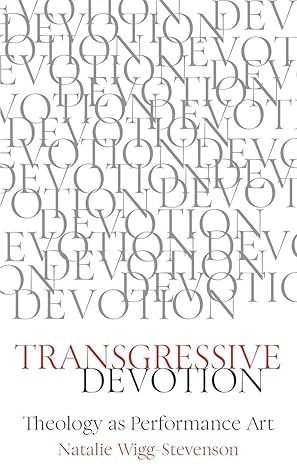
Devotion only remains transgressive until time’s end, when we hope we’ll see God face to face. Transgressive Devotion is a theology for right now, this moment. It’s not intended to last for ever, or even till tomorrow. Just one small performative repetition in the mode of both disruption and consolidation. Purely provisional, we can embrace the false projection that keeps us yearning. But return to these pages and they will mean something else. ‘Don’t go trying to use the same route twice.’20 Transgressive devotion is fragmentary touch, the fleeting presence of a stranger in the dark. It
...more
