
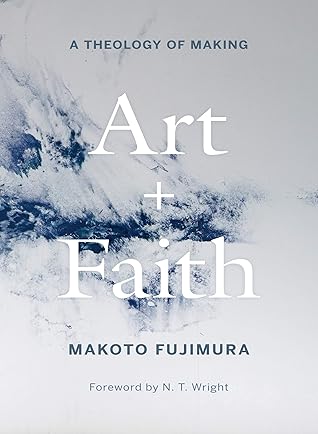
More on this book
Community


Kindle Notes & Highlights

Spirit’s leading. As my colleague William Dyrness has noted, “Artists, after all, think with their hands and their fingertips, with their eyes and their ears, usually in ways they cannot articulate in words.”14 Such somatic knowledge can lead a whole community to experience God in deeper, fuller ways, speaking into all the senses and gifts of the congregation.

Dyrness - artists think with their fingertips
(Matthew 16:25). We need to find our art by losing it. But I had one question: “So, what I am experiencing through art is not from God?” Other questions followed: “Is art merely an occupation? Are artists a ‘people-group to reach’?”
Experiencing God through art yes!!!!
I was afraid to even raise questions (for fear they might sound rude) or to share that art was not a mere occupation to me, but a calling, and the greatest of art is created by laying down all things at the altar of the greatest Artist. In
This is the paradox Blake was addressing. Unless we become makers in the image of the Maker, we labor in vain. Whether we are plumbers, garbage collectors, taxi drivers, or CEOs, we are called by the Great Artist to co-create. The Artist calls us little-‘a’ artists to co-create, to share in the “heavenly breaking in” to the broken earth. In order to be called a Christian, we need to be marked with our capacity to make, and generatively create with, and through, the fruit of the Spirit.
All are called to create!!
God is indeed THE Artist (I believe God to be the only true Artist, as I’ve noted), and this role of God as the Creator/Artist deserves a far more central role in the domain of theology and missions. Therefore, the gospel (as an entire history of God’s people) is God’s artwork, God’s ultimate story. The
God the artist!!
God. God continually commissions God’s children to create. But as all good teachers do, God first creates a context for creativity. God had an educational plan for Adam and so created a “discovery zone” (not a correctional institution!) in Eden. Zones for discovery serve as foundation blocks for a human society to thrive. Our education plan involves all of our senses, our intellect, our emotions, and our empathic capacities, as well as our spiritual capacities. We are to “love the Lord [our] God with all [our] heart and with all [our] soul and with all [our] mind” (Matthew 22:37). We are to
...more
micromanage. Jennifer Allen Craft, in Placemaking and the Arts, writes this about Genesis 1 and 2:
Jennifwr Allen Craft
painted. By faith, I began to imagine painting with Christ’s tears—began to see that the very materials I use, extravagant, water-based materials, are mixed with Christ’s tears.
Paint with Christ's tears
Often, Jesus does call us out of our despair. Jesus doesn’t want us to be stoic but rather to be honest about our pain. Both of the sisters believed that Jesus could heal Lazarus and are disappointed that he did not arrive in time to do so.
Archaeologists have discovered that in biblical times, there were objects that we now call “tear jars.” Tears were so coveted that people kept them in jars. Jesus’s tears were not collected. They dropped one by one onto the hardened ground of Bethany. They evaporated into the air, and they are still with us today. We can collect them by faith today. Our institutions, and our lives, should be made up of these jars of tears. Our theology should carry the gratuitous, extravagant weight of those tears. This is the miracle of the intuitive: to invoke mystery that no analysis can tap into.
Tear jars - collecting Jesus' tears by faith
so much for you! We could call this the beginning of the feminist movement. Jesus is the founder of every movement that liberates men and women from oppression or inequality. Further, this act of remembrance reveals something about God’s
In Mary’s devotion, she expressed the beautiful to Jesus. What makes us truly beautiful? What makes us not just good, not just right, but beautiful? Can our churches be beautiful again, and not just promote goodness and truth? These
Artists may be the first to recognize the invisible presence of divine tears. That’s why the church needs artists—people like Mary—in the world. When we weep and join God, our tears are commingled with God’s tears, and multiplied like the fishes and the loaves that Jesus touched.
I have sat in front of Rothko for a very long time. The National Gallery and the Phillips Collection in Washington, D.C., and the Rothko Chapel in Houston are three places that you might find me doing this. It takes about fifteen minutes before we can feel settled to truly see something. Most of the time, we are trained not to see, but to categorize and move on. It’s our basic survival mode. But if you allow yourself to simply sit and stare, the eye can open up to take in beauty in a way that is rarely experienced in life. Rothko painted in layers, and each layer, it seems, comes alive to our
...more
A second thematic journey I took with Four Quartets was as a painter. I did a series of paintings with the titles of Four Quartets and exhibited them in Tribeca in my first solo show after 9/11. That led to a second cycle, the collaborative project called Qu4rtets. My paintings and Bruce Herman’s are joined in this exhibition that responds to Eliot; Bruce is deeply moved by Eliot’s poetry, too. One of the first times I heard of Bruce was at a gathering of the organization Christians in the Visual Arts in 1997. I had
Bruce Herman Visual arts group
And if you utter these prayers in faith, what you say and do will last, even through the most destructive fires. And Jesus will translate what you say into a building block of eternity. I do not know what that will look like: I only know it will take time. It took Melissa her lifetime to utter those prayers. No, it took faithful grandmothers and several generations of faith for Melissa to utter that prayer. One thing is sure: As we build on the foundation of Christ, we will choose to be in the pyre. Even our grandmother’s deathbed. The pyre is what Christ’s building block looks like from the
...more
Time to utter prayers
The art of waiting depends upon our willingness to die to ourselves and trust in God. Art, poetry, and music all depend on waiting. There is no music without pauses. There is no art if we are unwilling to wait for paint to dry. More significantly, the process of making mimics what we need to learn to do in life. Holy Saturday is the critical day on which we are invited to die to ourselves. When we are able to fully die to ourselves, we will hear the voice of God on Easter morning. If we do not, Easter will not mean much.
Art requires waiting
We have nothing to fear in Christ. I can therefore relax with Lazarus and love freely and boldly, listening to the voice of the Good Shepherd who has called me out of the darkness into the light. To sum up, three attributes characterized Lazarus’s condition. He was relaxed—relaxed in the presence of Jesus. He was confident—as we can be in the future hope of the Spirit, whatever is happening in our lives. And he was faithful—ready to serve God in every moment.
Nothing to fear in Christ - Lazarus relaxed in the presence of Christ
Our world is broken but also enchanted in the sense of the medieval word for gospel, gōdspel—“good spell.” The words and breath of Jesus have cast a good spell, and Mary’s nard, her offering that now has been accepted as part of the New, surrounds us. Now, the arts need to cast good spells into a world that is dying and cynical.
Godspel
Jesus’s tears are like that—perhaps unnecessary for our exegesis of scripture and preaching. But that, to me, is why the gratuitous, even unnecessary
Jesus tears are like hyphens
In the art world, claiming to be a follower of Christ often seems as transgressive as anything that one could do in a world full of transgressions. But when I speak of “practicing resurrection,” artists welcome it—even those who are atheists. They see such practice as an act of resistance against the status quo, or the world that wants to negate our creative resistance. I see these resurrection moments everywhere. Let me tell you the story of one of them.
Practicing resurrection
The Theology of Making journey has only just begun with this final chapter of the book. The journey is not just for artists and theologians. The word “art” may result in thinking that this book is only for artists. The word “theology” may result in thinking that this book is only for Christians. By connecting “art” to Making, I am intentionally broadening the word “art” to every human being’s act of making. We are all artists in that sense. This book also broadens the word “theology,” directly connecting “knowing God” to all of our making as well. Certainly, a theologian is someone who
...more
Theology of making
Let us reclaim creativity and imagination as essential, central, and necessary parts of our faith journey. Imagination is a gift given to us by the Creator to steward, a gift that no other creature under heaven and earth (as far as I know) has been given.
Reclaim creativity
God is an artist. God is THE Artist (the ONLY true Artist), and an Artist creates and makes. God stated “Let there be . . . ,” and there was the world full of abundance and poetry. God invites us not to a church program (as important as those may be) but, as N. T. Wright has noted, to a meal. God THE Artist invites little-‘a’ artists to a feast and a dance. And, I understand now, it took Jesus to give himself to us, to shed tears for our current state, for us to be invited by grace. I end this book with a benediction for all of us on this journey toward the New.
God is THE artist
