
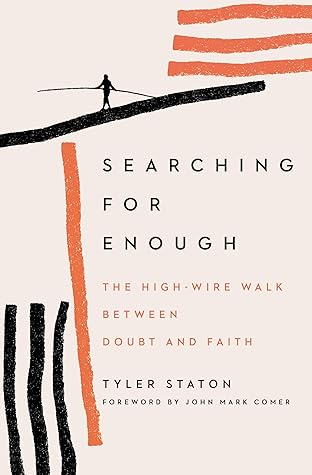
More on this book


Kindle Notes & Highlights

by
Tyler Staton
Read between
February 16 - March 10, 2023

God does not treat us as we deserve. He does not repay us according to our actions. He does not sit behind a desk, flipping through a stack of résumés. He assures us that no amount of wandering will change who we are. He assures us that no past offense, no mismanagement of his resources, will cause him to become stingy. Squander half the estate, and he just cuts us right back into the will.
What Genesis suggests is that this original self, with the print of God’s thumb still upon it, is the most essential part of who we are and is buried deep in all of us as a source of wisdom and strength and healing which we can draw upon or, with our terrible freedom, not draw upon as we choose . . . The original, shimmering self gets buried so deep that most of us end up hardly living out of it at all. Instead we live out all the other selves which we are constantly putting on and taking off like coats and hats against the world’s weather.
Jesus’ life wasn’t about better coverings; it was about shameless nakedness.
It’s that profoundly simple prayer of Søren Kierkegaard: “Now with God’s help I shall become myself.”
“It feels as if I was made—from all the possible shapes a human might take—not to prove myself worthy but to refine the worth I’m formed from, acknowledge it, own it, spend it on others.”
The trouble with sin isn’t that God has a tight moral grid—and coloring within the lines is how we prove we’re on his side. It’s that sin inhibits us from doing what we were made to do—love.
Right into that emptiness, carefully disguised in prestige and success, Jesus spoke a better story. He spoke freedom to the captivity of trading everything for a position and reputation and still being eaten alive by emptiness and anxiety.
John Ortberg comments, “One of the most impressive aspects of Jesus is how he was impressed by unimpressive people.”14 The most striking part of this observation is that it is not based solely on Jesus’ words. Jesus didn’t only preach a new social order in sermons; he created it through his life.
We are all most terrified of being fully known, and yet we all long to be seen for who we are (not for who we try to make ourselves) and be loved for that person.
No matter what you think of Jesus’ claims of divinity, this part of his life is universally admired. Through the simple means of friendship, he reunited a fractured world. But the two-thousand-year gap between him and us might give us a wide enough buffer to admire this part of his life without being confronted by it.
The modern world, led by my generation, loves the idea of community, but are we willing to pay the cost of community? I know we celebrate the idea, but do we actually want to live in a diversity of relationships that discomfort, challenge, and stretch us?
Though the term “community” is widely and loosely used by Americans, and often in connection with lifestyle, we would like to reserve it for a more specific meaning. Whereas a community attempts to be an inclusive whole . . . lifestyle is fundamentally segmented and celebrates the narcissism of similarities. For this reason, we speak not of lifestyle communities . . . but of lifestyle enclaves. Such lifestyles are segmental in two senses. They involve only a segment of each individual, for they concern only private life, especially leisure and consumption. And they are segmental socially in
...more
Community is a word typically used to mean “people who match my habits of leisure and consumption—the people I’ve found who unwind like me and indulge like me.” Community gets reduced to people who like the same bands I do, plan travel to the same places I do, and have the same opinion of who should win Best Picture this year at the Oscars. The robust, radical, familial ideal of community has in our time somehow become people who start their workday at the same local coffee roaster as I do and their weekend at the same microbrewery, people who wear the same brands I do, whose general lifestyle
...more
Jesus was born into a divided world that he personally didn’t divide. He didn’t help draw a single one of those lines, but he found a thousand ways to erase them.
To follow Jesus is to be ever curious about the other. It is to cultivate the habit of learning the story of the other. This is often inconvenient, but compassion is rarely convenient or comfortable.
To join Jesus’ mission of compassion is to have a dinner table that breaks racial, economic, and social barriers. It is to have a circle of friends that provokes compelling questions from your colleagues. It is as simple as listening to the other and as profound as recreating the world in the image of the Creator.
Jesus reminds us who our neighbor is with the words on his lips, but that was only the beginning. Much more profoundly, Jesus shows us who our neighbor is with the actions of his life. He didn’t love the “idea” of other people; he actually loved the many individual people his life came into contact with. He didn’t celebrate the sentiment of community. He created a family with prostitutes, lepers, tax collectors, and often confused but passionate disciples. He recovered the plot.
The point of this “cursed ground” is that suffering was not God’s idea. Cancer, natural disasters, broken bones, and sinus infections—these and everything like them were not God’s ideas. They are consequences, horrible consequences, that God is fighting against. This fight is so universal it’s expressed in supernatural, miraculous power, but that fight is also so personal it involved God himself, feeling pain, sickness, grief, and suffering.
From what I can tell, the main difference between Jesus and the modern church is the effect each has on the larger community—particularly the community that doesn’t participate in the rituals of gathered worship, those potentially open to the church’s help but uninterested in the church’s teaching.
Jesus wasn’t healing for the sake of spectacle. He wasn’t doing a few magic tricks to increase the attendance on his preaching tour. He wasn’t working miracles to prove he was worth believing. He was undoing the curse that had soaked all the way into the soil. He was reversing the effects of sin.
The English novelist E. M. Forster draws a distinction between a story and a plot with the single word because. A story is merely events arranged chronologically—“the king died and then the queen died.” A plot occurs when the focus zeroes in on the causality, the because, of those events—“the king died, and then the queen died of grief.”
Is my life merely a story, or is it a plot? Am I the sum total of chronological events, or is there a coherent plot?
The Bible isn’t the only story. There are plenty of other stories painting different portraits of an all-powerful Designer with exclusive truth claims. The myriad of available religious, mystical, and philosophical stories makes this absolutely clear: An all-powerful Creator is not necessarily “good news.” It all depends on what the Creator does with all that power. The life of Jesus claims that the all-powerful God of the universe is loving, kind, and merciful. He is for you, not against you. In Jesus, God undressed himself of every speck of divinity that might separate you from him. He came
...more
God came as a human being because we didn’t just need missing information; we had a debt to pay. The choice to put the self at the center is a transaction in hope. To place the self at the center, to sit down on the throne of your own life, is creation saying to Creator, “Thanks for the boost. I’ll take it from here.” I’ll find my own fulfillment. I’ll construct my own identity. I’ll write a story big enough to satisfy my own soul.
For every day of Jesus’ life, God was his protector, provider, and the recipient of his exaltation. Another way of saying this is that Jesus lived without sin—and remember, I don’t primarily mean Jesus never told a lie, watched pornography in middle school, and got blackout drunk on prom night (Jesus didn’t do any of those things, but sin isn’t exclusively about morality). I also don’t mean that Jesus avoided ever choosing, even for a second, the self for the center (though, again, he did avoid ever doing that, but to focus on what Jesus didn’t do is to miss the point entirely). Jesus lived
...more
Jesus did not fight the dying light. He was living in only light and chose to dive headfirst into darkness. Why did he do it? He let go of his free life so we could hope again. He was opening up the possibility for us to reverse the exchange, to return our hope to God, to accept his offer to pay the debt we couldn’t pay. He took on death so you and I wouldn’t have to.
Make no mistake, Jesus’ death was brutal, but the brutality of the way he died was not his passion; the passion of Jesus Christ was his free choice to die.
For thirty-three years, Jesus gave us his activity, his life. He was always active, always doing—teaching, healing, advocating, feeding, freeing, including, comforting, noticing, inviting, hoping, instructing, loving. His final twenty-four hours represented a distinct shift, obvious to every close observer. Beginning with his arrest in Gethsemane, Jesus gave us his passivity, his death. Every gospel author’s description of Jesus takes an obvious grammatical turn at that point—all the verbs become passive. He is led away. He is questioned. He is tortured. He is whipped. He is mocked. He is
...more
The greatest gift God ever gave us was his passivity, not his activity; his restraint, not his action. It was his willingness to be acted on without intervention. It was his chosen powerlessness, not his power. It was not his doing, but his allowing.
The centurion recognized the divine bloodline in Jesus by his weakness, not his strength; his surrender, not his victory; his death, not his life; his love, not his power. There was something otherworldly, something wondrous, about the way he willingly gave up his life.
A bodily resurrection means Jesus isn’t a likable revolutionary. He can’t be. Kurt Cobain, Will Hunting, Gandhi, Mandela, MLK—none of those men walked out of their graves. An actual resurrected Jesus does not make him a great man. It makes him Lord. It means he flooded the recurring darkness with constant light—overcame systemic evil, swallowed up personal failure, and defeated death. The parts of life so painful that the best we can do is “change the subject”—he cut a way through. If Jesus really rose, we fall on our knees in worship or stand up in offense because it means he is either Lord
...more
The life of Jesus was about recovering the plot of the story; the resurrection of Jesus was about breathing life back into the cast.
A dignifying sort of hope sounds something like this: The universe we inhabit is the very good creation of a very good God who is deeply grieved by the darkness that haunts the lives of his children. This God is so relentless in unwavering hope and pursuing love that he stopped at nothing to heal and redeem us. He promises justice in place of every societal failure, and justice for every last victim. He promises forgiveness to cover over every personal failure, and freedom from the guilt and shame it drags behind. He promises that life, not death, will have the final word because death has
...more
Hope that lives in you and me and anyone else who chooses it—that’s what was released early one Sunday morning when the tomb was found empty. Jesus didn’t walk out of his grave to cheapen this life with a first-class ticket to another world. He did it to dignify this life by bringing heaven to earth and to dignify you by giving you, right now in the midst of the mess, a unique, tailor-made, participatory role in that redemption.
The compelling thing about Jesus is that his story starts with love, ends with love, and brings redemption through love. He offers us a story big enough to explain the complex mess we call the world, and powerful enough to redeem every square inch through love—the sort of love that never gives up, the sort of love that swallows up fear, the sort of love that heals, however quickly or slowly, the sort of love that outlasts the sting of pain.
When our souls are overwhelmed, the human temptation is self-isolation, to turn inward, not outward. There’s a strange comfort we find in withdrawing from a believing community during times of unbelief or uncertainty. Doubt can create the feeling that “I’m on the outside, and these people can’t understand or relate.” This feeling is almost always the product of perception, not conversation. It usually comes from looking at a whole group of people and categorically making assumptions about them, not the repeated experience of voicing our doubts humbly, honestly, and vulnerably to individuals in
...more
The gut reaction of doubt is to withdraw. That’s the instinct. It’s the immediate comfort. The primary reason is that we need a bit of distance from a person or group representing belief in order to wholly dismiss them. Distance is dehumanizing.
Haven’t you noticed that it is much easier to invent narratives for the motives of a person or group when you don’t have to look them in the eye and actually talk to them? Other people are much more easily dismissed when we can have dialogues with those other people only in our imaginations. So that’s what we do.
Sometimes the truth is we aren’t ready to seek reparations for our unbelief or fractured belief. Maybe the community surrounding us is actually making a lot of sense. Maybe we love and respect the people in it. Maybe we’d still like to laugh with them, make plans with them, or share meals with them, but we just can’t stand to open up this subject with them because belief is a topic of pain or frustration or anger or just plain disinterest for us at the moment.
Community that affirms you without challenging you will make you feel comfortable, but it will never move you, never heal you.
Life without community is incomplete; life with community but without God is bearable but tragically underwhelming and still incomplete.
we all know what it is to live defined by disappointment. Every last one of us does it at some point, and most of us do it forever.
We are much quicker to see the world through disappointment than hope because it’s safer. Building our lives on disappointment won’t make anything better, but it will protect us. It will cover us like fig leaves and keep the most vulnerable parts of us hidden. When we are mentored by our disappointment, we get uneasy around hope; we learn to resist it at all costs. Allowing disappointment to play a defining role in your life might guard you from pain, but it will also most definitely guard you from any greater hope that might bring life.
Doubt is an experience in the world you can’t reconcile with the story you believe.
Doubt is not, I’ve got a few questions I’m gonna need to have satisfactorily ironed out before I can commit to this set of ideas. Doubt is, Why, God? How dare you, God? Are you even there, God? And even if you are there, if this is how you run things, do I even care to know you, God?
I wonder if our communities have the space available to be as honest as Thomas was. I wonder if we honor one another and trust God enough to let the question fill the air without puncturing a gut-level question with an oversimplified, head-level response. I wonder if the Bible makes more room for God to meet people in the midst of doubt than the communities that are formed around the very same Bible.
What does it tell us about the heart of God that he put the keys to the kingdom in the shaky hands of people who were something less than certain? That he looks the doubter in the eye and says, “Not at some future point when you get every intellectual quibble sorted and every question answered, but right in the midst of your doubt, I choose you. I trust you. I send you.” Apparently, Jesus was much more comfortable with doubt than most of our churches are.
We live in a culture that has, for centuries now, cultivated the idea that the skeptical person is always smarter than the one who believes. You can be almost as stupid as a cabbage, as long as you doubt. The fashion of the age has identified mental sharpness with a pose, not with genuine intellectual method and character.2
The modern person is schizophrenic when it comes to belief and doubt. We want belief (we always have), but we also fear disappointment. “We are simultaneously both cynical and gullible,” writes Pete Greig, “fearful of missing out yet afraid of commitment too.”4 We want deep meaning, but we want it packaged in a way that protects us from pain. We want true love without ever risking rejection. The battle between belief and doubt is often the intellectual expression of a deeper emotional battle between love and fear.
Human beings have a remarkable ability to ignore evidence that contradicts their beliefs and an equally remarkable ability to exaggerate evidence that confirms their beliefs. People don’t change their minds. They guard and protect their conclusions. Any evidence that might call our current belief systems into question is unconsciously identified as an attack by the human brain and fended off by any means necessary.
