
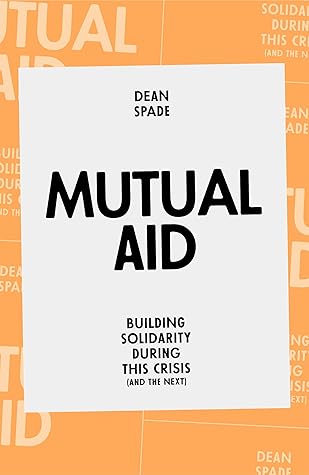
More on this book
Community


Kindle Notes & Highlights


Mutual aid is collective coordination to meet each other’s needs, usually from an awareness that the systems we have in place are not going to meet them.
More and more people report that they have no one they can confide in when they are in trouble. This means many of us do not get help with mental health, drug use, family violence, or abuse until the police or courts are involved, which tends to escalate rather than resolve harm.
In this context of social isolation and forced dependency on hostile systems, mutual aid—where we choose to help each other out, share things, and put time and resources into caring for the most vulnerable—is a radical act.
Being able to get help in a crisis is often a condition for being politically active, because it’s very difficult to organize when you are also struggling to survive.
Getting support at a place that sees the systems, not the people suffering in them, as the problem can help people move from shame to anger and defiance. Mutual aid exposes the failures of the current system and shows an alternative. This work is based in a belief that those on the front lines of a crisis have the best wisdom to solve the problems, and that collective action is the way forward.
Solidarity is what builds and connects large-scale movements. In the context of professionalized nonprofit organizations, groups are urged to be single-issue oriented, framing their message around “deserving” people within the population they serve, and using tactics palatable to elites.
Solidarity across issues and populations is what makes movements big and powerful. Without that connection, we end up with disconnected groups, working in their issue silos, undermining each other, competing for attention and funding, not backing each other up and not building power. Mutual aid projects, by creating spaces where people come together on the basis of some shared need or concern in spite of their different lived experience, cultivate solidarity.
An initial goal of serving people impacted by homelessness quickly reveals that racism, colonialism, immigration enforcement, ableism, police violence, the foster care system, the health care system, transphobia, and more are all causes of homelessness or causes of further harm to homeless people. Solidarity and an ever-expanding commitment to justice emerge from contact with the complex realities of injustice.
Mutual aid is inherently antiauthoritarian, demonstrating how we can do things together in ways we were told not to imagine, and that we can organize human activity without coercion.
You can be sure that help like that is not designed to get to the root causes of poverty and violence. It is designed to help improve the image of the elites who are funding it and put a tiny, inadequate Band-Aid on the massive social wound that their greed creates.
Not surprisingly, the charity model promotes the idea that most poverty is a result of laziness or immorality and that only the poor people who can prove their moral worth deserve help.
Charity makes rich people and corporations look generous while upholding and legitimizing the systems that concentrate wealth.
Elite solutions to poverty are always about managing poor people and never about redistributing wealth.
The false separation of politics and injustice from ordinary life—and the idea that activism is a kind of lifestyle accessory—is demobilizing to our movements, hides the root causes of injustice, and keeps us passive and complicit.
Activism and mutual aid shouldn’t feel like volunteering or like a hobby—it should feel like living in alignment with our hopes for the world and with our passions. It should enliven us.
The charity model encourages us to feel good about ourselves by “giving back.” Convincing us that we have done enough if we do a little volunteering or posting online is a great way to keep us in our place. Keeping people numb to the suffering in the world—and their own suffering—is essential to keeping things as they are. In fact, things are really terrifying and enraging right now, and feeling more rage, fear, sadness, grief, and despair may be appropriate. Those feelings may help us be less appeased by false solutions, and stir us to pursue ongoing collective action for change.
This has been the historical pattern for poor relief in the United States: it gets expanded during a crisis, and then contracted and stigmatized as soon as the crisis has lessened, quickly making people once again desperate and exploitable by their employers.
Whenever we rely on a capitalist, imperialist system to provide vital necessities, we can guess that the provisions will be fragile and inadequate, and designed to transfer far more wealth toward the populations those systems were designed to support: white people, rich people, straight people, and men.
