
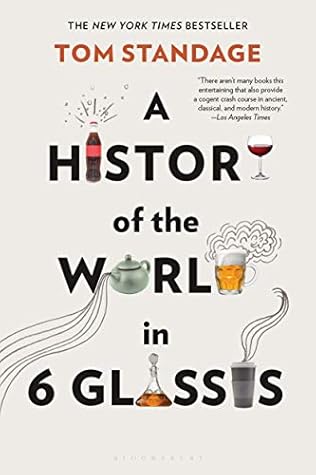
More on this book
Community


Kindle Notes & Highlights


writing was originally invented to record the collection and distribution of grain, beer, bread, and other goods. It arose as a natural extension of the Neolithic custom of using tokens to account for contributions to a communal storehouse.
Officially, these goods were offerings to the gods, but in practice they were compulsory taxes that were consumed by the temple bureaucracy or traded for other goods and services.
wine started to be produced during the Neolithic period, between 9000 and 4000 BCE, in the Zagros Mountains in the region that roughly corresponds to modern Armenia and northern Iran.
The convergence of three factors made wine production in this area possible: the presence of the wild Eurasian grape vine, Vitis vinifera sylvestris, the availability of cereal crops to provide year-round food reserves for wine-making communities, and, around 7000 BCE, the emergence of pottery, instrumental for making, storing, and serving wine.
The finest wine of all, by universal assent, was Falernian, an Italian wine grown in the region of Campania.
It is descended from al-koh’l, the name given to the black powder of purified antimony, which was used as a cosmetic, to paint or stain the eyelids.
Unlike beer, which was usually produced and consumed locally, and wine, which was usually made and traded within a specific region, rum was the result of the convergence of materials, people, and technologies from around the world,
Sugar, which originated in Polynesia, had been introduced to Europe by the Arabs, taken to the Americas by Columbus, and cultivated by slaves from Africa. Rum distilled from its waste products was consumed both by European colonists and by their slaves in the New World.
rum then accounted for 80 percent of exports.
Paying the federal militia to suppress the rebellion cost $1.5 million, nearly one-third of the entire excise duties collected during the ten years the excise law was in force.
The production of this new kind of whiskey was pioneered in Bourbon County, so that the drink became known as bourbon. The use of corn, an indigenous crop, gave it a unique flavor.
The number of cases of dysentery in Britain went into decline starting in the 1730s, and in 1796 one observer noted that dysentery and other waterborne diseases “have so decreased, that their very name is almost unknown in London.”
By the early nineteenth century doctors and statisticians agreed that the most likely cause of the improvement in the nation’s health was the popularity of tea.
Infants benefited too, since the antibacterial phenolics in tea pass easily into the breast milk of nursing mothers.
Twining put up a specially designed sign over the door of his shop in 1787 and labeled his tea with the same design, which is now thought to be the oldest commercial logo in continuous use in the world.
There are many reasons why Britain was well placed to be the cradle of industry: its scientific tradition, the Protestant work ethic, an unusually high degree of religious tolerance, ample supplies of coal, efficient transportation networks of roads and canals, and the spoils of empire, which provided the funds to bankroll British entrepreneurs.
The political power of the British East India Company, the organization that supplied Britain’s tea, was vast. At its height the company generated more revenue than the British government and ruled over far more people, while the duty on the tea it imported accounted for as much as 10 percent of government revenue. All this gave the company both direct and indirect influence over the policies of the most powerful nation on Earth.
Supporters of the East India Company also cooperated on occasion with politicians with interests in the West Indies; the demand for West Indian sugar was driven by the consumption of tea. All this ensured that in many cases company policy became government policy.
Rampant smuggling reduced the sales of legal tea, and the company found itself with huge stockpiles: Nearly ten thousand tons of tea were sitting in its London warehouses.
The result was the Tea Act of 1773. Its terms, dictated by the company, included a government loan of 1.4 million pounds to enable it to pay off its debts, and the right to ship tea directly from China to America. This meant the company would not have to pay the British import duty, just the much lower American duty of three pence per pound.
An enormous semiofficial drug-smuggling operation was established in order to improve Britain’s unfavorable balance of payments with China—the direct result of the British love of tea.
But the appeal of automata soon wore off, and the problem remained: The company had to pay for its tea in hard cash, in the form of silver. Not only was it difficult to get hold of the vast quantities of silver required—the equivalent of about a billion dollars’ worth a year, in today’s money—but to make matters worse, the company found that the price of silver was rising more quickly than the price of tea,
So the company set about increasing the production of opium in order to use it in place of silver to buy tea.
The silver traveled by a circuitous route: The country firms sent it back to India, where the company purchased it using bankers’ drafts drawn on London. Since the company was also the government of India, these drafts were as good as cash. The silver was then shipped to London and passed to company agents, who took it all the way back to Canton to buy tea.
The Chinese were forced to sign a peace treaty that granted Hong Kong to the British, opened five ports for the free trade of all goods, and required the payment of reparations to the British in silver, including compensation for the opium that had been destroyed by Commissioner Lin.
by the end of the nineteenth century patent medicines accounted for more newspaper advertising than any other product.
Thomas and Whitehead soon realized that rather than doing the bottling themselves, it made much more sense to sell subsidiary bottling rights to others, in return for a large cut of the profits.
40 percent of the bottled water sold in the United States is, in fact, derived from tap water, though it is usually filtered and may have extra minerals added.
