
More on this book
Community


Kindle Notes & Highlights


“Abolition is about presence, not absence. It’s about building life-affirming institutions.” —Ruth Wilson Gilmore
transformative justice, the work of addressing harm at the root, outside the mechanisms of the state, so that we can grow into right relationship with each other.
have a vision of movement as sanctuary. Not a tiny perfectionist utopia behind miles of barbed wire and walls and fences and tests and judgments and righteousness, but a vast sanctuary where our experiences, as humans who have experienced and caused harm, are met with centered, grounded invitations to grow. In this sanctuary we feel our victory, where winning means a mass and intimate healing. Where winning isn’t measured by anyone else’s loss, but by breaking cycles of abuse, harm, assault, and systemic oppression. Where winning is measured not just by the absence of patterns of harm,
...more
Can we release our binary ways of thinking of good and bad in order to collectively grow from mistakes?
principled struggle is when we are struggling for the sake of something larger than ourselves
and are honest and direct with each other while holding compassion.
It is when we take responsibility for our own feelings and actions and seek deeper understanding before responding (by asking questions, or reading the referenced materials).
our collective response to…everything…is collapsed. Call outs elicit both a consistent negative and dismissive energy, and a pleasurable take-down activation, regardless of what the call out is addressing.
In the past, I have lost my connection to life, to wanting to live, thought it didn’t much matter if I was here or
not, and so it didn’t much matter how I treated myself or others.
When I was in that phase of ambiguous commitment to life, I took risks with my mind and body that I couldn’t imagine taking now. I practiced cynicism and hopelessness, as if they were the measures of humor, of intelligence. It was a brie...
This highlight has been truncated due to consecutive passage length restrictions.
“seemed easier to just swim down” in that place.6 I have had to choose life from deep within me. That’s why I’m still here. I want to live. I want to want to live. I think everyone chooses each day to move towards life or away from it, though some don’t realize that they a...
This highlight has been truncated due to consecutive passage length restrictions.
My dear friend Malkia Devich Cyril teaches me that there is the fear intended to save your life, versus fear intended to end it. What I mean by discernment is the
set of noticings, fears, wisdoms, deductions, and gut tremblings that want to save, or even just improve, my life, versus the fear that makes me unable to do anything, that makes me unable to draw on my life force to take action.
Supremacy is our ongoing pandemic. It partners with every other sickness to tear us from life, or from lives worth living.
Right now, call outs are being used not just as a necessary consequence for those wielding power to cause harm or enact abuse, but to shame and humiliate people in the wake of misunderstandings, contradictions, conflicts, and mistakes.
The call outs generally share one side of what’s happened and then call for immediate consequences.
As movements trying to break cycles of harm and abuse, how do we hold survivors and those who cause harm as community members once they speak up?
Currently, a wide variety of harm doing gets collapsed
into one label of “bad, disposable person/organization” and receives one punishment: a call out, often for so...
This highlight has been truncated due to consecutive passage length restrictions.
Our conflicts, our interpersonal disagreements, can currently get escalated into the language and response of harm and abuse.
We are afraid, and we think it will assuage our fears and make us safer if we can clarify an enemy, a someone outside of ourselves who is to blame, who is guilty, who is the origin of harm.
Can we acknowledge that trauma and conflict can distort our perspective of responsibility and blame in ways that make it diff...
This highlight has been truncated due to consecutive passage length restrictions.
“Instead of asking whether anyone should be locked up or go free, why don’t we think about why we solve problems by repeating the kind of behavior that brought us the problem in the first place?” —Ruth Wilson Gilmore
Too often, we are using call outs to avoid direct conflict. Call outs are also being used to tilt public opinion about organizational or sectoral conflicts.
I long for more people to experience the satisfaction of the processes I have been in and held—not perfection, but satisfaction. People getting to name what caused hurt, where the conflict is, what is needed; people receiving an authentic apology; people getting to commit to paths of unlearning harmful belief systems and
behaviors.
When we engage in knee-jerk call outs as a conflict-resolution device, or issue instant consequences with no process, we become a cancer unto ourselves, unto movements and communities. We become the toxicity we long to heal.
I want us to adapt from systems of oppression and punishment to systems of uplifting and transforming. I want us to notice that this is a moment when we need to orient and move towards life, not surrender to the incompetence and hopelessness of our national leadership.
I want our movement to feel like a vibrant, accountable space where causing harm does not mean you are excluded immediately and eternally from healing, justice, community, or belonging. I want us to grow lots and lots of skill at holding the processes by which we mend the wounds in our communities and ourselves.
I want satisfying consequences that actually end cycles of harm, generate safety, and deepen movement. I want us to have an abundance of skill in facilitation and mediation when what needs to be addressed is at the level of misunderstanding, contradiction, mistake, or conflict. I want us collectively to be able to use precise language and to be comfortable asking each other questions for the sake of providing each other the absolute
best, most healing and most satisfying su...
This highlight has been truncated due to consecutive passage length restrictions.
I want us to acknowledge that the supremacy and hopelessness and harm and conflict are everywhere, and make moves that truly allow us to heal into wholeness.
recently I’ve had the experience of seeing people I know and love targeted and taken down. In most cases, very complex realities get watered down into one flawed aspect of these people’s personalities, or one mistake or misunderstanding. A mob mentality takes over then,
transformative justice—justice practices that go all the way to the root of the problem and generate solutions and healing there, such that the conditions that create injustice are transformed.
We need to center and build relationships with one another and not keep tearing one another down publicly without trying to have direct conversations.
While there are many places of learning, growth, and contradictory practice within the world we live in, why can’t we talk to one another directly and allow room for learning from our mistakes or differences? By making these public attacks on each other, we are engaging in the same disposability politics of capitalism and the prison industrial complex that we purport to be against while feeding into state surveillance tactics that are monitoring how we are tearing each other down.
In every situation there are lessons that lead to transformation.
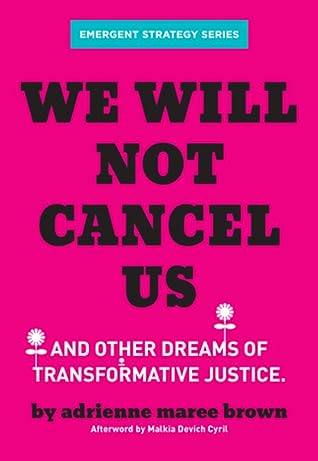
We will not cancel us. We hurt people. Of course we did, we are human. We were traumatized/socialized away from interdependence. We learned to hide everything real, everything messy, weak, complex. We learned that fake shit hurts, but it’s acceptable. Our swallowed pain made us a piece of shit, or depressed, or untrustworthy, or paranoid, or impotent, or an egomaniac. We moved with the herd, or became isolationist and contrary, perhaps even controversial. We disappointed each other, at the level of race, gender, species…in a vast way we longed for more from us. But we will not cancel us.
...more
This highlight has been truncated due to consecutive passage length restrictions.
But I believe we can build effective and accountable movements. We can tear down this system without destroying each other. With attention, intention, and practice, we can transform our understanding of accountability. Over many years, I’ve learned that accountability isn’t something anyone can hold another to, it is something we can help each other be, within boundaries that keep us secure. Accountability isn’t punishment, though it is frequently wielded as such. But, when we are able to discern between what our triggered bodies say and what our grounded bodies do, we can build the kinds of
...more
At the end of the day, forging the principles we need and the practices, people, institutions, and conditions we need to adhere to them—that has always been the heart of movement building to me. Being willing to acknowledge the breaking points without disavowing the broken pieces in your hands requires bravery. It requires great honesty to admit that innocence is an imagined narrative created to deny everyone agency, and to set up those who cross lines and cause harm as deviant outliers, exceptions to humanity’s rule.
I believe that’s what we are all searching for: a way home. A path through this wilderness. But to walk through wilderness we must become more and more comfortable with what is wild in each of us. The contradictions, the ways suffering shapes who we are and how we organize. That’s why our way forward isn’t to dismiss call outs, or to urge people to stop. No, our words are powerful
and are meant to be heard. The way forward is to forge abolition with both hands in the dirt, building empathy in the mirror; it’s to remember that innocence is never a prerequisite for human dignity, nor for human rights and freedom; that the words we speak aloud offer a prediction for what will be, and must therefore manifest not our smallest vision for the world, but our biggest.
and when we speak we are afraid our words will not be heard nor welcomed but when we are silent we are still afraid So it is better to speak remembering
we were never meant to survive.
