
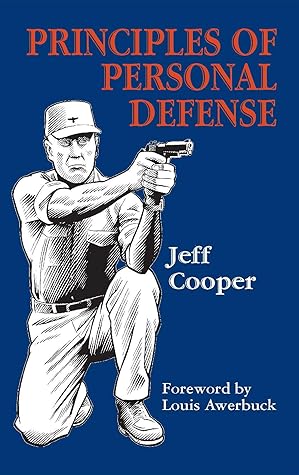
More on this book
Community


Kindle Notes & Highlights


“Acommander may be forgiven for being defeated, but never for being surprised.” This maxim is among the first to
Two rules are immediately evident: Know what is behind you, and pay particular attention to anything out of place.
The great majority of the victims of violent crime are taken by surprise. The one who anticipates the action wins. The one who does not, loses. Learn from the experience of others and don’t let yourself be surprised.
The foregoing suggestions are merely random examples of ways in which the principle of alertness is manifested. Situations are numberless, and specific recommendations cannot be made to cover them all. The essential thing is to bear always in mind that trouble can appear at any time. Be aware. Be ready. Be alert.
Short of extensive personal experience, which most of us would rather not amass, the best way to cultivate such tactical decisiveness is through hypothesis: “What would I do if … ?” By thinking tactically, we can more easily arrive at correct tactical solutions, and practice — even theoretical practice — tends to produce confidence in our solutions which, in turn, makes it easier for us, and thus quicker, to reach a decision.
In defense we do not initiate violence. We must grant our attacker the vast advantage of striking the first blow, or at least attempting to do so. But thereafter we may return the attention with what should be overwhelming violence.
we can propose a corollary: “The best personal defense is an explosive counterattack.”
Aggressiveness carries with it an incalculable moral edge in any combat, offensive or defensive. And the very fact that the assailant does not expect aggressiveness in his victim usually catches him unaware.
Now how do we cultivate an aggressive response? I think the answer is indignation.
If it is ever your misfortune to be attacked, alertness will have given you a little warning, decisiveness will have given you a proper course to pursue, and if that course is to counterattack, carry it out with everything you’ve got! Be indignant. Be angry. Be aggressive.
(Absence of speed is what history will probably decide caused us to lose in Vietnam.)
on the very instant that we know that our assailant intends us serious physical harm, we must work just as fast as we can. If he is holding us by threat of force, we have the edge of reaction time over him.
The stake in personal defense is your life. You cannot afford to play by sporting rules. Be fast, not fair. Be “offside” on the play. No referee will call it back.
The perfect fight is one that is over before the loser really understands what is going on. The perfect defense is a counterattack that succeeds before the assailant discovers that he has bitten off more than he can chew. Therefore, if you are attacked,...
This highlight has been truncated due to consecutive passage length restrictions.
just keep your head. Anger, as long as it is controlled anger, is no obstacle to efficiency.
If you improvise a weapon from objects at hand, use it in a way most likely to do damage without loss or breakage. The points of most improvised weapons, from umbrellas to fire pokers, are usually more effective than the edges, as they can be applied with less warning and without exposure during a “windup.” A blunt point should be directed at the face or throat. Drive it carefully, coolly, and hard. The optimum defensive arm
If you are fortunate enough to have access to any sort of firearm when under attack, remember that it is as good as your ability to keep cool and shoot carefully.
Under any sort of attack, keep cool. And if you must shoot, shoot with precision.
Anyone who willfully and maliciously attacks another without sufficient cause deserves no con-sideration. While both moral and legal precepts enjoin us against so-called “over-reaction,” we are fully justified in valuing the life and person of an intended victim more highly than the life of a pernicious assailant.
The attacker must be stopped — at once and completely.
Don’t hold back. Strike no more after he is incapable of further action, but see that he is stopped. The law forbids you to take revenge, but it permits you to prevent.
If you are justified in shooting you are justified in killing, in all but a few quite obvious circumstances. Don’t try to be fancy. Shoot for the center of mass. The world is full of decent people. Criminals we can do without.
The law seems completely disinclined to discourage violent crime. The sociopath who attacks you has little to fear, at this writing, from either the police or the courts.
If violent crime is to be curbed, it is only the intended victim who can do it.
Starkweather,
The coddling of murderers has brought us to an evil pass. If it is truly a wise and just policy (which we may have serious reason to doubt), leave it to the courts. When your life is in danger, forget it.
If you
find yourself under lethal attack don’t be kind. Be harsh. Be...
This highlight has been truncated due to consecutive passage length restrictions.
what he usually least expects is instant, violent counterattack, so the principle of aggressiveness is closely tied to threat of surprise.
