
More on this book
Community


Kindle Notes & Highlights
by
Alan Lew

Sigmund Freud, he said, was the one who had introduced the single great idea upon which all the significant developments of the twentieth century had rested: the invisible is more important than the visible.
They were talking about an invisible process. They were talking about a spiritual process. They were talking about transformation.
we realize how much these constructs have been keeping us from the reality of our lives—how we have been using them to give us distance from the gnawing suspicion that we have no house—that we are afloat in a great sea of being, an endless flow of becoming in which we are connected to all beings.
Our response to every moment is a judgment on us, one that is continuously unfolding, and subject to continuous modification.

every year this line gets me.
the mournful collapse of a house and ends with the joyful collapse of a house,
repetition compulsion, the unconscious craving to master the unresolved elements of our life. According to this theory, we never leave the age at which trauma occurs.
Judaism believes in the particularity of time, that certain times have special spiritual properties:
Heartbreak is precisely the feeling that we have done our best, we have given it our all, but it hasn’t been enough.
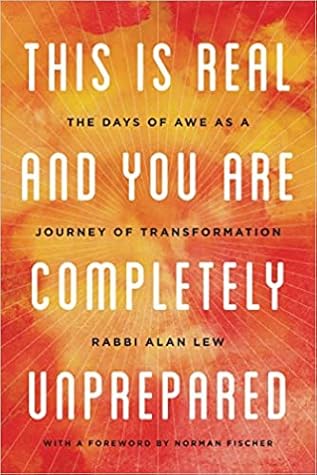
This is real. This is very real. This is absolutely inescapable. And we are utterly unprepared. And we have nothing to offer but each other and our broken hearts. And that will be enough.
I try to come back to this book every year before the HighHos and every time I read it I am so happy to return.
God stopped and re-nefeshed himself, re-ensouled himself.
God watches the whole video with a boundless, heartbreaking compassion.
the process of Teshuvah is neither clear nor linear.
The possibility of transformation always exists, but we have to consciously turn toward it in order to activate it.
