
More on this book
Community


Kindle Notes & Highlights

by
Alan Lew
Read between
August 29 - October 2, 2022

In those days a story was often told of a Jewish peasant who, looking elsewhere for a great treasure, returned home only to find it buried beneath the floor of his own house. This was taken to mean that Jews didn’t have to look elsewhere (to Asian spiritualities, for instance) to find spiritual treasures; they could discover them hidden deep within their own tradition.
When man sins he creates a distance between himself and God. To sin means to remove oneself from the presence of the Master of the Universe. I was standing before you and Sin came and estranged me from you and I no longer feel that I am “before You.” The whole essence of the precept of repentance is longing, yearning, pining to return again. Longing develops only when one has lost something precious. Sin pushes us far away and stimulates our longing to return…. This is why Rambam wrote: How powerful is repentance, for it brings man closer to the presence of God.
Teshuvah is the little death that connects us to the big one. Or as the Rambam says: The repentant should change his name, as if to say, I am another. I am not the same person who did these deeds. It is as if that person has died. This is why this day resembles a dress rehearsal for our death.
Rabbi Solevetchik said of the Prophet Samuel that although he belonged to all of Israel, his true home was only in one place, Ramah. Although he led and judged in many different places, the force of his leadership and judgment stemmed from Ramah, from his home. “No matter how great a person may be, he cannot leave his real home. All of his judgments are derived from there.”
Our home is a river, a fluid place, a place where there is no stopping point—a place where we can stop clinging, and stop being driven out of life. A place of Teshuvah, a place that will return us to ourselves, where we can feel our lives flowing, healing, toward home.
Don’t worry, the Rambam replied. They always do. The unresolved elements of our lives—the unconscious patterns, the conflicts and problems that seem to arise no matter where we go or with whom we find ourselves—continue to pull us into the same moral and spiritual circumstances over and over again until we figure out how to resolve them.
On Tisha B’Av, there is invariably a commentator from the Israeli left who explains that the Temple was destroyed and Israel was conquered by the Romans because of the intolerance of the religious right of that day. Then a right-wing commentator explains that both the Temple and Israel itself fell to the Romans because of the failure of the Jewish people to unite against the enemy militarily. Then it invariably falls upon Gafni to explain that there was one reason for the fall of the Temple and one reason alone: Rome was absolutely invincible, and its huge armies were marching through the
...more
The answer is that neither the rabbis nor Moses cared a fig about history. They weren’t historians; they were spiritual leaders, and spiritually, the only question worth asking about any conflict, any recurring catastrophe, is this: What is my responsibility for it? How am I complicit in it? How can I prevent it from happening again? When things go bad, there is an enormous temptation to blame it on externals, on the evil of others, or on an unlucky turn of events. Spiritually, however, we are called to resist this temptation, no matter how strong it may be and no matter how strongly rooted in
...more
Why do our relationships always fail in precisely the same way? Why do we always fall into the same kind of conflict at work? Why do we always have the same arguments with our children? With our parents?
The psalmist promises us, “The Guardian of those who struggle to know God never slumbers nor sleeps. He will protect you. He will not let the sun smite you by day, nor the moon by night.”
In Torah study, the watchword is “follow the language.” A given Torah portion will often convey its essential meaning by repeating a particular word or word-root (shoresh) a significant number of times.
The time between Tisha B’Av and Yom Kippur, this great seven-week time of turning, is the time between the destruction of Jerusalem—the crumbling of the walls of the Great Temple—and our own moral and spiritual reconstruction.
If anyone else entered this place, or if the high priest entered on any other day, the charged emptiness at the Sacred Center, the powerful nothingness there, would break out on him and overwhelm him, and he would die. So Yom Kippur is, among other things, the day we enter the vacated space, even if only by proxy, the day we experience the charged emptiness at the Sacred Center.
Several have actually died. And getting fired, even from a terrible job, often leads to a debilitating depression. If we see ourselves primarily as parents, as protectors of our children, then the walls can come tumbling down when our children suffer.
Then her son, the bright, handsome musician, had a major breakdown. He came home from college and curled up on his bed in the fetal position. When people came to visit, they asked about him, and wondered why he never came out. His mother would turn beet red then, but it was far worse when he did come out. Always a quiet and rail-thin blond, he was now coarse and overweight. He would sit in the living room in a funk, insulting his mother’s visitors, several times driving them from the house. This went on for years. There was a seemingly endless succession of psychiatrists, mental institutions,
...more
Then, after three or four years, the misery ended as suddenly and as mysteriously as it had begun. The son met a young woman. They fell in love. They married and had three children. His life regulated itself in almost every way. There was almost no trace of those years of near madness and rage. And when the smoke had cleared, it was apparent to everyone that there was no trace of his mother’s hard edge anymore, no trace of her social ambitions. Her son’s nightmare and his sudden, inexplicable recovery from it had softened her. The walls of her ego had crumbled. Her son had torn them down. But
...more
When the walls crumbled, when the façade of fake joy fell away, he was real; he was authentically who he was, and that’s why I liked him so much.
What might we see as a result? What deep wellspring would suddenly become apparent to us? What pattern would we see ourselves repeating? What larger gesture would we see about to complete itself in our lives? What do we need to embrace? The walls of our soul begin to crumble and the first glimmerings of transformation—of Teshuvah—begin to seep in. We turn and stop looking beyond ourselves. We stop defending ourselves. We stop blaming bad luck and circumstances and other people for our difficulties. We turn in and let the walls fall.
So it is that the Mateh Moshe proclaimed, “Every person must prepare himself for thirty days beforehand with repentance and prayer and charity for the day when he will appear in judgment before God on Rosh Hashanah. Therefore let every person scrutinize their actions with a view to mending them. Let them exclude themselves for one hour every day and examine themselves,” and Rabbi Chaim David Azulai declared, “During Elul [the month before Rosh Hashanah], one should devote less time to study and more time to fixed periods of introspection and self-evaluation,” and the Kav Hayashar recorded that
...more
Every moment contains the capacity for good and evil, life and death, a blessing and a curse, and everything depends on our choice. “Look…. I call Heaven and Earth to witness against you this day that I have set before you life and death, the blessing and the curse. Therefore choose life, so that you may live,” Moses repeats in the ringing peroration to the Book of Deuteronomy.
Prayer—The Hebrew word for prayer is tefilah. The infinitive form of this verb is l’hitpalel—to pray—a reflexive form denoting action that one performs on oneself. Many scholars believe that the root of this word comes from a Ugaritic verb for judgment, and that the reflexive verb l’hitpalel originally must have meant to judge oneself. This is not the usual way we think of prayer. Ordinarily we think we should pray to ask for things, or to bend God’s will to our own. But it is no secret to those who pray regularly and with conviction that one of the deepest potentials of prayer is that it can
...more
On Rosh Hashanah, all the inhabitants of the earth stand before God, as it says in the Thirty-third Psalm, “[God] fashions their hearts as one, and discerns all their actions together.”
Everything we do is an expression of the entire truth of our lives. It doesn’t really make any difference what it is that we choose to focus on, but it ought to be something pretty basic, something like eating or sex or money, if for no other reason than that these concerns are likely to arise quite frequently in our lives and to give us a lot of grist for the mill.
This is the time of year we are bidden to know the truth. In fact, we are commanded to do so. Re’eh—look, pay attention—for I have put before you a great blessing and a considerable curse, right there in the moment before you. All that’s required of you is to see what’s in front of your face and to choose the blessing in it.
The idea of all this seems to be that if we leave something incomplete, we fall into the state of mind the rabbis called trafe da’at—a torn mind—a mind pulled in various directions. A person in such a state of mind would be of little use in an army. He would be unable to focus on the task at hand and might even present a danger to his fellow soldiers. During a brief stint as a prison chaplain, I once spoke to a gang member who described what it was like to go to war with his fellow gang members. He spoke glowingly of the sense of total trust you had to have in the person in front of you and
...more
What is the pain that is pressing on your heart right this moment? That’s what you need to make Teshuvah about. You need to make Teshuvah about your fractured mind and your fearful heart. What is occluding the deep connection between you and your fellow human beings? That is also right there over your heart, and that also needs to be looked at. One of the things that most often impedes this connection is our fear of one another’s pain. We have already established that we all have one heart. Deep down, we know this very well. But what we are usually not aware of is how much we feel other
...more
And what shadow of fear or anger—what imagined impotence—is keeping us from a deep emotional and spiritual connection to the people around us?
Is the world really torn and dark, or does it just appear that way to us because we are taking it in through a torn mind and a hardened heart?
Standing under the chuppah with bride and groom on the week we read Parshat Ki Tetze, I am often reminded that carefully done fingernails, well-coifed hair, and alluring dresses are still frequently employed to arouse a passion in a man sufficient to get him under the wedding canopy.
The kind of impulse Keats describes arises in our lives in many forms. It shows itself in the impulse that might seduce us into a ruinous midlife affair, or that might cause us to sacrifice our families for ambition, or to give up our heart’s work for the pursuit of material excess, or to give up our integrity for fame and fortune, or God for the pursuit of pleasure.
Since we can’t and probably shouldn’t repress our desires, and since it is so often a calamity when we follow them, what should we do?
Why do we run after ambition? Why do we need fame and fortune? Why do we need to have a sexual conquest? If we try to push these desires down, they’ll only come up somewhere else.
If we kill them off altogether, we may be doing violence to ourselves; we may be killing off the basis of our real creativity.
But if this desire stripped of its romantic trappings simply fades away, then we’ve learned something even more useful. We’ve learned that there is more to heaven and earth than those things on the surface of the world that provoke desire in our hearts. We’ve learned that if we always act on our desires, on those unmitigated impulses that constantly rise up in our hearts and our minds, then we are doomed to a living death, doomed to be always palely loitering after a lock of hair, and a bit of nail and cloth, the ghostly phantoms of desire.
Better to just watch our impulses arise and wait for truth, wait for something deeper. Better to be strong and brave of heart than to surrender our lives to the empty stuff of desire, and to spend the rest of our lives palely loitering on a cold hillside where no birds sing.
So the Ba’al Shem explained with the following parable: In the palace of the King, there are many secret chambers, and there are secret keys for each chamber, but one key unlocks them all, and that key is the ax. The King is the Lord of the Universe, the Ba’al Shem explained. The palace is the House of God. The secret chambers are the sefirot, the ascending spiritual realms that bring us closer and closer to God when we perform commandments such as blowing the shofar with the proper intention, and the secret keys are the kavanot.
And the ax—the key that opens every chamber and brings us directly into the presence of the King, wherever he may be—the ax is the broken heart, for as it says in the Psalms, “God is close to the brokenhearted.”
And this is what we call heartbreak. Heartbreak is precisely the feeling that we have done our best, we have given it our all, but it hasn’t been enough. Not nearly enough. And this is what we mean when we say, “God is close to the brokenhearted.” And this is what we mean when we say ain banu ma’asim—we have no good deeds.
This is what it says in “Avinu Malkenu,” that lovely song with the haunting, heartbreaking melody we all love to sing so much on Rosh Hashanah. Avinu malkenu, chanenu v’anenu—Our Father, our King, be gracious to us, be gratuitously loving, and answer us even though we don’t deserve it—ki ain banu ma’asim—because we have no good deeds to invoke in our own defense.
We need each other now. We need each other deeply. Here in the full flush of the reality of the life-and-death nature of this ritual, here in the full flush of our impotence as individuals to meet this most urgent emergency, our need for each other is immense. We heal one another by being together. We give each other hope. Now we know for sure—by ourselves, ain banu ma’asim, there is nothing we can do.
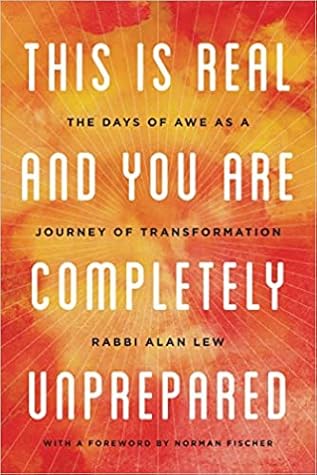
So on the first night of Rosh Hashanah, there we are, ba’agudat achat, pressed together in a large room, a single spiritual unit, helping each other to acknowledge our actual condition, and reciting this ancient service given to us by the Divine Physician as a medicine for that condition, and that condition is this: This is real. This is very real. This is absolutely inescapable. And we are utterly unprepared. And we have nothing to offer but each other and our broken hearts.
Something very strange happens to the Torah just before Rosh Hashanah. It disappears from the weekly services, as if it has fallen into a void. The Torah is read in a cycle of weekly readings that is both completed and begun again on Simchat Torah, the last day of the festival of Sukkot, some ten days after Yom Kippur. Toward the end of the cycle, Moses dies a noble and tragic death, poised on the border of the Promised Land he will never enter. Then the round of weekly Torah readings halts and remains suspended for several weeks until the long round of holidays—Rosh Hashanah, Yom Kippur,
...more
There is a void at the beginning of creation and a void afterward. Life is the narrow bridge between these two emptinesses. Usually all our focus is on the narrow bridge of our own life, rather than on what comes before or after. In its accounts of both the death of Moses and the creation of the universe, the Torah focuses our attention instead on the void.
But our problem is not that we don’t try hard enough. It is that we try too hard. It’s that we have such an exaggerated belief in the force of our own effort that we never stop trying. Our pursuit of pleasure and success is relentless, feverish, sometimes bordering on the demonic. We never rest. We have portable computers and faxes and e-mail that we take on vacation. We have phones in our cars. We have call waiting, so that even our interruptions are interrupted. Even those small moments of contemplation—of nefesh, of nothingness—we used to enjoy on vacation or even just driving back and
...more
That’s why we need God. We can forgive others on our own. But we turn to God, Rabbi Eli Spitz reminds us, because we cannot forgive ourselves. We need to feel judged and accepted by a Power who transcends our limited years and who embodies our highest values. When we wish to wipe the slate clean, to finalize self-forgiveness, we need heaven—a sense of something or someone larger and beyond our self. Though self-forgiveness may end with God, it begins with us. Self-forgiveness is difficult largely because we hold ourselves to such high standards, higher than it is possible to live up to. And it
...more
The Talmud tells us that in the world to come, everyone will be called to account for all the desires they might have fulfilled in this world but chose not to. The things we desire—the desires themselves—are sacred. Who put them in our hearts if not God? But we have been taught to be ashamed of what we want; our desires become horribly distorted and cause us to do terribly hurtful things. Even a betrayal as painful as adultery might turn out to have its roots in a perfectly innocent desire—in the desire to be loved, to have
our experience be intense and exciting—and if we could acknowledge these innocent desires, we might not feel compelled to act them out in such hurtful ways.
The act of Teshuvah is no longer seen as ripping up the evil decree. Now it transforms the evil of the decree. Teshuvah doesn’t change what happens, and it doesn’t change the way we are. It merely changes the way we see these things. We no longer see things as evil, we simply see them as they are, and that makes all the difference.
The Sabbath is a time when we inhabit ourselves this way. This may be the real reason so few Christians or Jews observe the Sabbath anymore. Work, commerce, and our usual frantic rush of activities are all devices we use to distract ourselves from ourselves, to keep from looking at who we are, to keep us from fully inhabiting our lives. Perhaps the real reason more of us don’t observe a Sabbath is not because it’s inconvenient—not because we are spiritually lazy—but rather because we are afraid. We are afraid of reflection because we are afraid of ourselves. We are afraid that if we ever
...more
This I can promise you: neither you nor your children conform to the ideas other people are trying to foist on you. You are the unique creations of God, and any attempt to pin you down to some idea will only diminish you. You are equal to your life. You have been given exactly what you need, not one thing more and not one thing less.
