
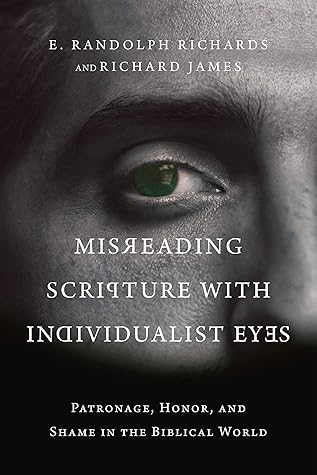
More on this book


Kindle Notes & Highlights

Read between
March 19 - December 26, 2023

we often fill in what went without being said in their world (collectivism) with what goes without being said in ours (individualism).
Sarah makes the suggestion because she is thinking of herself and the family. She is not a strangely submissive wife who is willing to live with injustice so her husband can have an heir. Sarah wants to build a family for herself through Hagar. Hagar is just a pawn in Sarah’s (perhaps selfish) plan.
Despite it all being her plan, she blames Abraham: “You are responsible for the wrong I am suffering. I put my slave in your arms, and now that she knows she is pregnant, she despises me.
We are supposed to notice the only one who acts with care and compassion in the entire story is God.
Esau despises his birthright because he considers the promise of God to be worthless.
Firstborn wasn’t a title to indicate birth order but rather to identify who would inherit and take on responsibility for the family.
we have seen how he treated them arrogantly. This is one of the reasons why the Bible is careful to tell the full story and show how the sons of Leah are not discarded.
To see the kingdom of God, you need to belong to a new family.
In the ancient biblical world, people adopted so that the adopted son could care for the family.
Part of the reason for adoption was high child mortality; perhaps more than 50 percent of children (of those who survived childbirth) died by age ten.
they adopted an adult, not a child.
While our presumptions may slander her character, John’s Gospel does not. It is good for us to be cautious of simply assuming she was immoral.
Giving the coat would be a gesture of magnanimity, goodwill, even a desire for relationship. It seeks to turn the adversary into a friend.
Jesus points out that God benefits us with rain. But God does not send rain only on those who are good. He sends rain on the righteous (which could be expected) and the unrighteous (which is very different).
We seek to use gifts to make enemies into friends in the same way God used a gift, Jesus, to turn us into friends “while we were yet sinners” (Rom 5:8).
most of our aversion to dependency is that Western cultures value independence, and so creating dependency seems to us like a self-evidently unhelpful thing.
In fact, one can argue it is antibiblical. God helps those who depend on him—and each other.
Perhaps we Western Christians need to worry a bit less about creating one-sided dependency and more on creating friendships that hold hands
we find all kinds of examples in the Bible of God treating someone as special because of connections.
We do not do this to try to earn favor. We do this because we trust we have already been given favor in Christ.
grace and faith are not about me having an individual, isolated relationship with God. Faith means swearing allegiance to Jesus and his household. It isn’t “me and Jesus.” By God’s grace, I am made part of God’s household.
I don’t invite Jesus into my heart. I join his flock. I become part of his we.
The fault lies not with the younger generation but with the older one that failed to adequately teach it, enforce it, and constantly reinforce it.
What does Jesus mean by “become like little children”? Matthew doesn’t say. In our culture, we value a child’s simple faith, believing without facts. Aside from the questionable value of believing without facts, the passage isn’t about faith.
Jesus urges them to become like children, who are not concerned with worldly status.
Jesus doesn’t mean to “have simple faith” but to show a lack of concern about seeking status.
serving without thought of one’s own status.
Jesus is pretty dismissive of the Sadducees: “You are in error because you do not know the Scriptures or the power of God”
The man would not be forced to admit (or deny) the deed. (In the West, we would think the problem is that the man hasn’t confessed his sin.
Arman said, “We use the tool of shame because it is the best tool to use in this situation. If I label him a thief, he must fight or flight. Both would ruin the relationship. I don’t shame him to condemn him, but to restore him.”
It is like my grandmother’s idea that “having shame” means you know the proper way that “we” the group believe you should act.
It is not that I am guided by my values but that we guide one another by our values.
Westerners often prefer a direct approach. We don’t beat around the bush; we cut to the chase. We confuse this with honesty. Such a direct approach easily leads to the misuse of shame. It may lead us Westerners to apply shame too heavily, especially in crosscultural situations where we don’t understand the power of our actions and words.
Paul is saying that women should dress in a way that wouldn’t cause the voice in their head to say “shame” or for the community to think “shame.” Again, let’s avoid being too individualistic. It is not that an individual woman should determine for herself what is proper but that the women in the community, as a “we,” should determine proper dress. We
Translating aidōs as “with modesty” can mislead in other ways too. In America, we assume Paul is talking about dressing in sexually modest ways. Paul is actually talking about economics, being economically modest. Women are not to dress lavishly, with expensive clothes, gold, and pearls.
Paul is using shame to reinforce a value: everyone has an equal seat at the Lord’s Table.
It is possible the parable was initially aimed at Peter, who may have been upset that Jesus had invited the local tax collector, Levi, to join the disciples (Lk 5). Levi had surely stolen from Peter, collecting more tax than was fair. If so, Jesus is honoring Peter by calling him the elder brother who had been doing right all along but now was resenting the return of the prodigal Matthew.
Clearly, they should not have made any kind of idol of him, but why did they pick a young bull? Well, it’s how they imagined God: young and powerful. Wait, we might insist. God is the Creator of heaven and earth and is omnipresent, omniscient, and omnipotent. Yes, but they didn’t know that. God had yet to reveal most of this.
The cardinal vice in the patronage system was ingratitude. The elder son dishonors his father, but not only that, he publicly shames his father, by accusing him of being stingy (Lk 15:29), of being a poor patron.
The parable is about how the father restores both sons to their community. As a modern individualist, I might miss these signposts in the story.
The story is about alienating oneself from one’s community. In fact, that’s the story of the Bible.
The Bible has been working all the way through to show that while kinship is a wonderful system, it doesn’t end with just God as father of a bunch of lone individuals.
“Our insurance policy won’t allow it,” my deacon protests. I know, I know. But if we were really family, wouldn’t we find a way?
It can be hard to form a deep community from individualists because individualists often do not understand the importance of community.
While Jesus did tell the parable of the shepherd going to find the one lost sheep (me), he did it to bring me back to the flock, to join my ninety-nine brothers and sisters.
We individualists can miss this horizontal dimension of grace. We can imagine grace means I am reconciled to God. It does, but it also means we are reconciled to God and to one another.
We read Paul and the New Testament picture of church better when we read it as “we strengthen us.” Who benefits when I give to a poorer brother or sister? Us. Who benefits when I preach? Us. Who benefits when I tolerate an annoying member of the church? Us. Who benefits when you are gentle to me? Us. For Paul, this is the meaning of fellowship in the church: “Therefore encourage one another and build each other up, just as in fact you are doing” (1 Thess 5:11
Nonetheless, the author of Hebrews points out that Jesus is a better broker than Moses because “Moses was faithful as a servant in all God’s house, bearing witness to what would be spoken by God in the future. But Christ is faithful as the Son over God’s house. And we are his house, if indeed we hold firmly to our confidence and the hope in which we glory” (Heb 3:5-6). Jesus is a better broker than Moses, first, because Jesus is closer to God than Moses was. Moses was God’s servant; yet Jesus is God’s Son. There can be no better mediator than a son to his father. Second, Jesus is superior by
...more
