
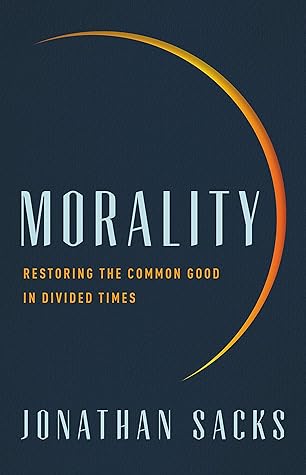
More on this book
Community


Kindle Notes & Highlights

Read between
September 3 - September 16, 2020

A FREE SOCIETY is a moral achievement.
All countries and cultures have three basic institutions. There is the economy, which is about the creation and distribution of wealth. There is the state, which is about the legitimization and distribution of power. And there is the moral system, which is the voice of society within the self; the “We” within the “I”; the common good that limits and directs our pursuit of private gain. It is the voice that says No to the individual “Me” for the sake of the collective “Us.” Some call it conscience. Freud called it the superego. Others speak of it as custom and tradition. Yet others call it
...more
Morality achieves something almost miraculous, and fundamental to human achievement and liberty. It creates trust. It means that to the extent that we belong to the same moral community, we can work together without constantly being on guard against violence, betrayal, exploitation, or deception. The stronger the bonds of community, the more powerful the force of trust, and the more we can achieve together.
But, in the end, we each have to take responsibility for our lives. The decisions, the willpower, the stamina, and resilience are up to us. But for most of us, it is other people who make the necessary difference to our lives, guiding us, inspiring us, lifting us, and giving us hope. It is the quality of our relationships that more than anything gives us a sense of meaning and fulfillment.10 Most important of all, it is the ability to love that lifts us beyond the self and its confines. Love is the supreme redemption of solitude.
Not everything collective is political. Some of it is moral, a matter not of power but of conscience, duty, and virtue.
The entire thrust of postmodernism, inspired by Marx, Nietzsche, and Freud, is to develop a “hermeneutics of suspicion” in which there is no truth, only victory. Every argument is a (concealed) exercise of power, an attempt to establish a “hegemonic discourse.” Judaism rejects this idea, not because it is never true—in the case of an argument not for the sake of heaven, it is—but because we can tell when it is and when it isn’t. There is such a thing as truth, and collaborative argument in pursuit of it. That is the basis of trust on which all genuine communication depends.
The choice of freedom brings the defeat of victimhood and the redemptive birth of hope.
Life is a story. It is our response to the call of suffering in the world.
What has happened in the past half-century has been precisely what de Tocqueville feared. It took a long time to appear, precisely because of the strength of the institutions on which he discerned American democratic freedom to rest: religion, community, family, and the sense of the nation as a moral community. As these eroded from the 1960s onward, individualism was left as the order of the day, and so it is today. The individual trumps society. The “I” prevails over the “We.” We have the market and the state, the two arenas of competition, one for wealth, the other for power, but nothing
...more
Morality is no longer a code imposed on us by the culture in which we live. It has become instead a matter of personal choice.
Durkheim believed that religion was best understood not in terms of beliefs but behaviors, and not as a supernatural phenomenon but as a natural one. This is how he defined it: “A religion is a unified system of beliefs and practices relative to sacred things… which unite into one single moral community called a church, all those who adhere to them.”15 Religion creates community.
