
Kindle Notes & Highlights
Read between
August 29 - December 2, 2025

Effective teaching requires much more than subject expertise: it requires effective communication with students and knowledge of how to best foster student learning.
Similarly, education professor Ana M. Martínez Alemán describes how the title of “professor” is a racialized one, and how this influences her teaching, noting that “to be a professor is to be Anglo; to be a Latina is not to be an Anglo. So how can I be both a Latina and a professor? To be a Latina professor, I conclude, means to be unlike and like me.”8

I had never heard this.
There are entire libraries of research about learning, and if we want to be effective teachers, we should know some of the basics. A good starting place is the seven “learning principles” identified by pedagogical researchers in the influential book How Learning Works: • Students’ prior knowledge can help or hinder learning. • How students organize knowledge influences how they learn and apply what they know. • Students’ motivation determines, directs, and sustains what they do learn. • To develop mastery, students must acquire component skills, practice integrating them, and know when to
...more
GINs also need to understand some of the other well-documented facts about learning that impact our teaching, such as: • Sitting still and listening is not an effective way to learn. Yes, fellow scholars, I know you can learn this way and so can I, but most people need a lot of movement, interaction, and actual application of ideas in order to learn.30 • Students do not learn content by merely listening to us talk about the content, because “telling students information does not translate to learning.”31 We’re not the Matrix Operator uploading kung fu directly into Neo’s cerebral cortex, so
...more
This highlight has been truncated due to consecutive passage length restrictions.
One of the best summary lists of this type I’ve ever seen.
We academic nerds have embraced a life of constant learning but when it comes to our students and to our own efforts to be effective teachers, we also have to keep remembering that learning is hard.
I need to be reminded of this.
On a related point, the stress and fear of being wrong and of not succeeding appears to be increasing among all new college students.48 Pedagogical scholar Rebecca Cox makes a convincing argument that fear of not succeeding academically and of not really “belonging” in college manifests in some of the student behavior that professors find most exasperating, such as not seeking faculty assistance, not reading the syllabus, and waiting until the last minute to begin assignments.49
I see this even at the day to day class level.
Contrary to the popular discourse about snowflakes overly protected by helicopter parents and society’s trophy-for-showing-up cult of self-esteem, academic entitlement most frequently manifests in students who are fearful, feel helpless, and who are “harboring doubt about their abilities.”54 Studies show that it is consistently associated with a student’s belief in an external locus of control over academic achievement.55 Many students believe that the power to do well in any one class depends not on their own individual effort or behavioral self-regulation or increasing their own skills but
...more
Effective teachers distribute “Prior Knowledge” surveys at the beginning of class or other types of questionnaires (and then read and reflect on the student responses); they ask students to meet with them individually at the beginning of the term; they create a variety of ways to learn as much as they can about students’ preparation and expectations for the class.60 So by whatever means necessary, we have to learn their names and learn a few things about each of our students.
Most of our students, even the ones who are earning good grades at elite universities, are not budding professional scholars.
One of my most important realizations ever was fully understanding this.
But if we want to be effective teachers, we must accept Vulcan philosopher Kiri-kin-tha’s first law of metaphysics: “Nothing unreal exists.” Or as the Vulcan proverb goes, kaiidth (what is, is). Awareness of what is, learning and continually relearning it, is foundational to effective teaching.
the four realities discussed in this chapter are essential: identity is important, learning is hard, who our students are, and who we are.
For all our brainy ability to deeply and thoroughly understand our discipline, when it comes to teaching we need to better understand the classroom as a social space. Content knowledge and even pedagogical content knowledge is not sufficient because “a teacher’s success not only depends on effective methods of teaching and subject knowledge but above all it depends on the strong relationships teachers develop with their students.”10 Or as another group of researchers puts it: “Student-teacher interaction is at the core of students’ classroom experience, even in online courses.”11 Moreover,
...more
HALLMARKS OF EFFECTIVE TEACHING THAT CAN BE ESPECIALLY CHALLENGING FOR GINS • Care for students and student learning • Immediacy and rapport • Authenticity and enthusiasm • Clear communication of ideas and expectations
There are even options for those with teaching styles not particularly nurturing or supportive. These can be things as simple as an occasional kind comment, a bowl of candy set beside the student chair in the office, or conscientious responses to email queries. Expressions of caring should be genuine, but they can be varied and should fit comfortably with your teaching persona.15 The possibilities are indeed “varied” and “can be expressed in different ways,” but what caring about students really boils down to is being fair and treating students with basic courtesy and respect. Or as Ken Bain
...more
Learning objectives are the broad goals and intended purpose of a class, a program, a major, or even the university at large. They express, often but not always in some detail, what educators hope students will achieve during a course of study. Learning objectives may or may not be included on any one syllabus, but learning outcomes are an essential component of effective syllabi, stating as clearly and specifically as possible, the identifiable content knowledge, skill, ability, and end-product of a student’s successful course of study. Learning outcomes are what students do (verbs matter)
...more
As Linda Hodges and Katherine Stanton write, “Too often we provide students with the answers in our discipline before they even understand the questions.”67 In their discussion of how expert blind spots can hamper our ability to foresee what issues students will face, Hodges and Stanton describe the common occurrence of students complaining that “the exam problems were nothing like what we did in class”: These remarks may lead us to assume that students are not paying attention, are not spending enough time on assignments, or simply are not studying hard enough. In some cases these
...more
Even more irritating is the seeming inability of students to use what they have learned on any problem that is not an exact copy of the problem they used when they were learning it. This shows up frequently on tests, where students lament the use of tricky questions while the instructor thinks he or she is asking students to use information in a similar type of problem.70
Once we have our short list of what students should learn how to do and why they should learn how to do it, we must figure out how students will demonstrate/prove they’ve learned it. And we must be specific. What assignments, tests, or projects, specifically, will document their learning? And how? How will you assess it? “I’ll know it when I see it” is not fair to students. They deserve to know what we expect them to do and how they will show they can do it, and they deserve a clear and concise explanation. It boils down to telling students why. Why they’re doing this, why you’ve assigned
...more
Many students’ expectations of or prior experience with college classes entail teachers standing in front of the room and “telling.” Anything that deviates from this appears out of place and discomforts students for at least two reasons. First, all their experience says that our job is to do the talking, leaving them the choice of engaging with the subject or not. A second reason for their discomfort, however, is how they view the process of learning. Dualistic thinkers believe that gaining knowledge is as simple as listening to and repeating the views of an authority figure. . . . [Doing
...more
active learning will argue that it’s a “‘professor’s job’ to tell them what they need to know and to deliver a well-prepared lecture. Some students will even suggest that they have paid with their tuition dollars for their teachers to teach them. . . . They believe somehow that teaching is something that can be done only by the professor.”128 Richard M. Felder and Rebecca Brent describe this same common student reaction to learner-centered pedagogy, which is a radical change from teachers “telling them everything they needed to know from the first grade on. . . . When confronted with the need
...more
Resistance to active learning techniques expressed in negative SET is an entirely predictable response based on the students’ previous understanding of how school works. In order for SET to offer productive feedback, the SET forms we use have to take this reality into account because students themselves are often “satisfied with passive learning and don’t appreciate faculty who make them work for their grade beyond taking a multiple-choice test, especially not assignments requiring critical thinking and problem solving.”42
We can create our own types of forms or draw on the SoTL for forms such as the “Classroom Survey of Student Engagement” or the “Classroom Critical Incident Questionnaire.”61
When one of your favorite students asks you for a recommendation letter, send an unofficial copy to the student along with your thanks for the rewarding experience of being their teacher. You know the kind of student I’m talking about here: the one you were always happy to see in class because they had a genuine interest in your arcane field or they exhibited the kind of intellect and leadership that could elevate a whole class or they overcame truly daunting odds to succeed. In whatever way they gifted you with moments of teaching happiness, saying thank you to that student could be the start
...more
Whatever the mechanism, whether informal conversations or peer review or teaching portfolios or organized communities of inquiry, support for improving teaching is, at its heart, teachers talking to other teachers about teaching.7 Such conversations can take a wide variety of forms, from faculty learning communities to teaching squares to peer observations and review.8 Again and again, professors report that “communities of practice” and networks of support for teaching, tailored to address their specific teaching context, improve their own individual teaching efficacy.9
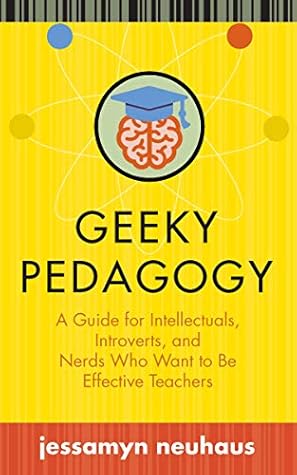
The more we employ the four pedagogical practices I’ve described in Geeky Pedagogy and the more time we can spend just doing them, the better we’ll get at effective teaching and advancing our students’ learning: • Awareness: working to be fully aware and accepting of who we are, who our students are, the complexities of identity, and the challenges of learning—and understanding that these realities are always evolving and changing. • Preparation: approaching teaching as an intellectual endeavor, putting on our professor pants, and carefully planning for interacting with students and
...more
This highlight has been truncated due to consecutive passage length restrictions.
You probably arrived at college teaching via your nerdy love of a topic, and then maybe found yourself caring more than you ever thought you could about your students’ learning, after so many years of caring almost exclusively about your subject and your research. Making that realization and becoming an effective college teacher isn’t easy, and the longer I’ve been teaching, the more I realize how much I still have to learn—will always have to keep learning—about teaching.45 That’s practicing, and the practice of, effective teaching and learning.
Look up this reference.
