
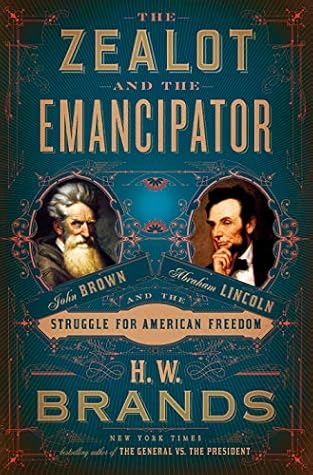
More on this book
Community


Kindle Notes & Highlights

by
H.W. Brands
Read between
December 23 - December 29, 2021

Meanwhile many Northerners were making a hero of Brown, praising him for striking the blow against slavery their consciences told them they should have made.
“To be sent off through the wilderness alone to very considerable distances was particularly his delight;
If the young blacks of our country could once become enlightened, it would most assuredly operate on slavery like firing powder confined in rock, and all slaveholders know it well.
“Here, before God, in the presence of these witnesses, from this time I consecrate my life to the destruction of slavery.”
Thomas Lincoln opposed slavery, partly for what it did to the slaves but also for what it cost non-slaveholding whites like himself. As visitors to the South often remarked, slavery demeaned manual labor, discouraging poor whites from improving their lot through their own toil.
duty. With care and enterprise he thought he could soon gather a force of one hundred hardy men, men who would be content to lead the free and adventurous life to which he proposed to train them; when these were properly drilled, and each man had found the place for which he was best suited, they would begin work in earnest; they would run off the slaves in large numbers, retain the brave and strong ones in the mountains, and send the weak and timid to the North by the underground railroad; his operations would be enlarged with increasing numbers, and would not be confined to one locality.”
From this night spent with John Brown in Springfield, Mass., 1847, while I continued to write and speak against slavery, I became all the same less hopeful of its peaceful abolition. My utterances became more and more tinged by the color of this man’s strong impressions.”
“It is sometimes called the City of Magnificent Distances,” he wrote of Washington. “But it might with greater propriety be termed the City of Magnificent Intentions.”
“He ever was, on principle and in feeling, opposed to slavery,” Lincoln said. Clay had long worked for emancipation in Kentucky, and hoped to see it in the country at large. “And yet Mr. Clay was the owner of slaves.” Clay appreciated that emancipation was a practical issue as well as a moral one, and practical matters had to be acknowledged. “Cast into life where slavery was already widely spread and deeply seated, he did not perceive, as I think no wise man has perceived, how it could be at once eradicated, without producing a greater evil, even to the cause of human liberty itself.”
“Popular sovereignty” was what Douglas called the concept of allowing settlers to determine the fate of the territories with respect to slavery. When the Nebraska bill became law as the Kansas-Nebraska Act, the measure killed the Missouri Compromise and replaced it with popular sovereignty.
The settling of Kansas provided the closest thing America had witnessed to a national referendum on slavery.
Must the fertile prairies of Kansas, through a struggle at arms, be first secured to freedom before free men can sow and reap? If so, how poorly we were prepared for such work will be seen when I say that, for arms, five of us brothers had only two small squirrel rifles and one revolver.”
He insisted that the social and political difference between slavery and freedom was becoming more marked; that one must overcome the other; and that postponing the struggle between them would only make it the more deadly in the end.”
“Free them all and keep them among us as underlings? Is it quite certain that this benefits their condition?” Lincoln couldn’t say it would. “What next? Free them, and make them politically and socially our equals? My own feelings will not admit of this; and if mine would, we well know that those of the great mass of white people will not. Whether this feeling accords with justice and sound judgment is not the sole question, if indeed, it is any part of it. A universal feeling, whether well or ill-founded, cannot be safely disregarded. We cannot, then, make them equals.”
Our progress in degeneracy appears to me to be pretty rapid. As a nation, we began by declaring that ‘all men are created equal.’ We now practically read it ‘all men are created equal, except negroes.’ When the Know-Nothings get control, it will read ‘all men are created equal, except negroes, and foreigners, and Catholics.’ When it comes to this I should prefer emigrating to some country where they make no pretense of loving liberty—to Russia, for instance, where despotism can be taken pure, and without the base alloy of hypocrisy.”
But caution was itself risky at a time when American politics was careening toward danger. On each side of the slavery debate, emotions were being deliberately inflamed to mobilize supporters against the other side.
“But if our ears are poisoned by the advice of men who never rebuke violence on the side of power, and never fail to inveigh against the self-defense of wronged liberty, we shall invite aggression and civil war.”
The latter had no religion worth the name. “There is nothing but an annual uproarious camp-meeting where they get just enough religion to enable them to find out that the Bible justifies all the immeasurable vices and wrongs of slavery.”
“The slave state men come without books—without enough education to read, if they had them—without schools or a wish for them. They come with statutes framed for making free thought a sin, free speech a penitentiary offence, a free press punishable with death if it in the least loosens the bonds of oppression.”
“The senator from South Carolina has read many books of chivalry, and believes himself a chivalrous knight,” Sumner sneered. “Of course he has chosen a mistress to whom he has made his vows, and who, though ugly to others, is always lovely to him; though polluted in the sight of the world, is chaste in his sight—I mean the harlot Slavery. For her his tongue is always profuse with words. Let her be impeached in character, or any proposition made to shut her out from the extension of her wantonness, and no extravagance of manner or hardihood of assertion is then too great for this senator.”
“The question of slavery, at the present day, should be not only the greatest question, but very nearly the sole question,”
“I protest against that counterfeit logic which concludes that, because I do not want a black woman for a slave I must necessarily want her for a wife. I need not have her for either, I can just leave her alone. In some respects she certainly is not my equal; but in her natural right to eat the bread she earns with her own hands without asking leave of anyone else, she is my equal, and the equal of all others.”
I have no purpose to introduce political and social equality between the white and the black races. There is a physical difference between the two which, in my judgment, will probably forever forbid their living together upon the footing of perfect equality;
“There is no reason in the world why the negro is not entitled to all the natural rights enumerated in the Declaration of Independence—the right to life, liberty, and the pursuit of happiness,” Lincoln said. “I hold that he is as much entitled to these as the white man. I agree with Judge Douglas he is not my equal in many respects—certainly not in color, perhaps not in moral or intellectual endowment. But in the right to eat the bread, without the leave of anybody else, which his own hand earns, he is my equal, and the equal of Judge Douglas, and the equal of every living man.”
“It was an amazing proposition—desperate in its character, wholly inadequate in its provision of means, and of most uncertain result. Such as it was, Brown had set his heart on it as the shortest way to restore our slave-cursed republic to the principles of the Declaration of Independence; and he was ready to die in its execution.”
I felt for a number of years, in earlier life, a steady, strong desire to die; but since I saw any prospect of becoming a ‘reaper’ in the great harvest, I have not only felt quite willing to live, but have enjoyed life much, and am now rather anxious to live for a few years more.”
“Whereas slavery, throughout its entire existence in the United States, is none other than a most barbarous, unprovoked, and unjustifiable war of one portion of its citizens upon another portion—the only conditions of which are perpetual imprisonment and hopeless servitude or absolute extermination—in utter disregard and violation of those eternal and self-evident truths set forth in our Declaration of Independence; therefore we, citizens of the United States, and the oppressed people who, by a recent decision of the Supreme Court, are declared to have no rights which the white man is bound to
...more
“All persons of mature age, whether proscribed, oppressed, and enslaved citizens, or of the proscribed and oppressed races of the United States, who shall agree to sustain and enforce the Provisional Constitution and Ordinances of this organization, together with all minor children of such persons, shall be held to be fully entitled to protection under the same.”
One story related afterward told of an intemperate pro-slavery fellow haranguing a crowd about what he would do to that murdering, man-stealing abolitionist Brown if he ever laid eyes on him. He would shoot him on the spot, he vowed. A bearded gentleman in the back of the crowd responded in a mild voice. “My friend, you talk very brave,” he said. “And as you will never have a better opportunity to shoot Old Brown than right here and now, you can have a chance.” He produced two revolvers from under his coat and offered one to the brave orator, telling him to fire at will. The boaster grew pale
...more
“He did not at all object to rousing the nation,” Douglass said. “It seemed to him that something startling was just what the nation needed.
“No man sent me here; it was my own prompting and that of my Maker, or that of the devil, whichever you choose to ascribe it to. I acknowledge no man in human form.”
James Mason retook control of the questioning. “How do you justify your acts?” “I think, my friend, you are guilty of a great wrong against God and humanity. I say that without wishing to be offensive. And it would be perfectly right in anyone to interfere with you so far as to free those you willfully and wickedly hold in bondage. I do not say this insultingly.”
wish to say, furthermore, that you had better—all you people at the South—prepare yourselves for a settlement of that question that must come up for settlement sooner than you are prepared for. The sooner you are prepared the better. You may dispose of me very easily; I am nearly disposed of now; but this question is still to be settled—this negro question I mean—the end of that is not yet. These wounds were inflicted upon me—both saber cuts on my head and bayonet stabs in different parts of my body—some minutes after I had ceased firing and had consented to surrender, for the benefit of
...more
“And I think you are fanatical,” Brown rejoined. “Whom the gods would destroy they first make mad—and you are mad.”
“I was much impressed with the thought that before me stood a man, in the full vigor of health, who must in a few minutes be in eternity. I sent up a petition that he might be saved. Awful was the thought that he might in a few minutes receive the sentence ‘Depart ye wicked into everlasting fire.’ I hope that he was prepared to die, but I am very doubtful—he wouldn’t have a minister with him.”
John Brown, am now quite certain that the crimes of this guilty land will never be purged away but with blood,” he declared.
“He did not value his bodily life in comparison with ideal things. He did not recognize unjust human laws, but resisted them as he was bid.”
“He could not have been tried by a jury of his peers, because his peers did not exist.”
“By and by, when men look back and see without prejudice that whole scene, they will not be able to avoid saying: ‘What must be the measure of manhood in a scene where a crazed old man stood head and shoulders above those who had their whole reason? What is average citizenship when a lunatic is a hero?’ ”
“You consider yourselves a reasonable and a just people; and I consider that in the general qualities of reason and justice you are not inferior to any other people. Still, when you speak of us Republicans, you do so only to denounce us as reptiles, or, at the best, as no better than outlaws. You will grant a hearing to pirates or murderers, but nothing like it to ‘Black Republicans.’ ” Such language poisoned political discourse, Lincoln said, and jeopardized the interests of the South as well as the North. He made a modest request: “Bring forward your charges and specifications, and then be
...more
A rush was made for the hero that sat on his heels. He was seized, and jerked to his feet. An effort was made to jam him through the crowd to his place of honor on the stage; but the crowd was too dense, and it failed. Then he was boosted—lifted up bodily—and lay for a few seconds sprawling and kicking upon the heads and shoulders of the great throng. In this manner he was gradually pushed toward the stand, and finally reached it, doubtless to his great relief, in the arms of some half-dozen gentlemen, who set him down in full view of his clamorous admirers.” The commotion grew louder.
“Let the world distinctly understand why they go—to save slavery,” he said of the secessionists, “and why we rejoice in their departure—because we know their declaration of independence is the jubilee of the slave.”
“When men come under the influence of fanaticism, there is no telling where their impulses or passions may drive them.
“We have just carried an election on principles fairly stated to the people. Now we are told in advance the government shall be broken up unless we surrender to those we have beaten, before we take the offices. In this they are either attempting to play upon us, or they are in dead earnest. Either way, if we surrender, it is the end of us, and of the government. They will repeat the experiment upon us ad libitum.
And finally, in 1787, one of the declared objects for ordaining and establishing the Constitution was ‘to form a more perfect Union.’ But if destruction of the Union by one or by a part only of the states be lawfully possible, the Union is less perfect than before the Constitution, having lost the vital element of perpetuity.”
“We are not enemies, but friends. We must not be enemies. Though passion may have strained, it must not break, our bonds of affection. The mystic chords of memory, stretching from every battlefield and patriot grave to every living heart and hearthstone all over this broad land, will yet swell the chorus of the Union, when again touched, as surely they will be, by the better angels of our nature.”
“Overlooking the whole field of disturbing elements, he should have boldly rebuked them. He saw seven states in open rebellion, the Constitution set at naught, the national flag insulted, and his own life murderously sought by slave-holding assassins. Does he expose and rebuke the enemies of his country, the men who are bent upon ruling or ruining the country? Not a bit of it.”
Douglass wanted the conflict between the secessionists and the Union to be about slavery; Lincoln wanted it to be about states’ rights—which, in his view, included the right to permit slavery but not the right to secede. Douglass saw the struggle as essentially moral; Lincoln saw it as political. Douglass was an idealist; Lincoln, a pragmatist.
Lincoln could assert that the war was about the Union, not about slavery, and for him it was. But everyone, including Lincoln, knew that slavery was the underlying cause of the sectional division that had produced secession and the war.
“You and we are different races. We have between us a broader difference than exists between almost any other two races. Whether it is right or wrong I need not discuss, but this physical difference is a great disadvantage to us both, as I think your race suffer very greatly, many of them by living among us, while ours suffer from your presence. In a word, we suffer on each side. If this is admitted, it affords a reason at least why we should be separated.”
