
More on this book
Community


Kindle Notes & Highlights

by
H.W. Brands
Read between
December 20, 2020 - January 6, 2021

Another son, Jason, later remarked, “It is a Brown trait to be migratory, sanguine about what they think they can do; to speculate; to go into debt; and to make a good many failures.”
Truth was malleable to Douglas. “He would, with utter unscrupulousness, malign his opponents’ motives, distort their sayings, and attribute to them all sorts of iniquitous deeds or purposes of which he must have known them to be guiltless. Indeed, Douglas’s style of attack was sometimes so exasperatingly offensive that it required, on the part of the anti-slavery men in the Senate, a very high degree of self-control to abstain from retaliating.”
Douglas stopped his pacing. “Yes, Gowdy, I am troubled over the progress and outcome of this debate,” he said. He had watched and measured Lincoln, and he knew what he was getting into. “I regard him as the most difficult and dangerous opponent that I have ever met.”
Our progress in degeneracy appears to me to be pretty rapid. As a nation, we began by declaring that ‘all men are created equal.’ We now practically read it ‘all men are created equal, except negroes.’ When the Know-Nothings get control, it will read ‘all men are created equal, except negroes, and foreigners, and Catholics.’ When it comes to this I should prefer emigrating to some country where they make no pretense of loving liberty—to Russia, for instance, where despotism can be taken pure, and without the base alloy of hypocrisy.”
The free-state men brought books, newspapers, schools, open minds. “The slave state men come without books—without enough education to read, if they had them—without schools or a wish for them. They come with statutes framed for making free thought a sin, free speech a penitentiary offence, a free press punishable with death if it in the least loosens the bonds of oppression.”
Slavery was wrong for what it did to blacks; it was also wrong for what it did to whites. And because whites voted, while blacks did not, Lincoln took pains to stress what whites lost from slavery. Lincoln, with other Republicans, advanced an ideology of free labor, which decried slave labor but also stressed the dignity of the white working man.
you who have come from Virginia or Kentucky, to get rid of this thing of slavery—let me ask you what headway would you have made in getting rid of it, if by popular sovereignty you found slavery on that soil which you looked for to be free when you got there?” He knew the answer. “You would not have made much headway if you had already found slavery here, if you had to sit down to your labor by the side of the unpaid workman.” Lincoln reiterated that opposition to slavery, and in particular to its spread, was not mere philanthropy for blacks. It was crucial to the betterment of whites. “It is
...more
William Seward and Salmon Chase were strong figures who had held public office during the period since the slavery crisis had sharpened in 1850; each had left a trail of decisions for which he might be criticized. Lincoln’s advantage was his lack of a trail; having held no office, he had no such record to defend. The longer he kept his head down, the better his chances when he finally stood up.
Less than twenty-four hours after launching his long-planned war of liberation, Brown had effectively made himself and his surviving men prisoners. Perhaps he was deluded into thinking the people of Virginia were like those of Kansas, where his audacity had more than once made up for his deficiency in numbers. But in Kansas he fought Missourians, for whom Kansas was a political cause, not their home. Nor in Kansas was he threatening to start a slave rebellion, the hoary nightmare of white Southerners. In Kansas his irregular forces fought irregulars; at Harpers Ferry he faced organized
...more
His conscience was clear and his soul at rest. “Under all these terrible calamities, I feel quite cheerful in the assurance that God reigns; will overrule all for his glory; and the best possible good. I feel no consciousness of guilt in the matter: or even mortification on account of my imprisonment; and irons; & I feel perfectly assured that very soon no member of my family will feel any possible disposition to blush on my account. Already dear friends at a distance with kindest sympathy are cheering me with the assurance that posterity, at least, will do me justice.”
had I so interfered on behalf of the rich, the powerful, the intelligent, the so-called great, or in behalf of any of their friends, either father, mother, brother, sister, wife, or children, or any of that class, and suffered and sacrificed what I have in this interference, it would have been all right, and every man in this court would have deemed it an act worthy of reward rather than punishment.”
A majority held in restraint by constitutional checks and limitations, and always changing easily with deliberate changes of popular opinions and sentiments, is the only true sovereign of a free people.
The rule of a minority, as a permanent arrangement, is wholly inadmissible; so that, rejecting the majority principle, anarchy or despotism in some form is all that is left.”
A husband and wife may be divorced and go out of the presence and beyond the reach of each other, but the different parts of our country cannot do this. They cannot but remain face to face, and intercourse, either amicable or hostile, must continue between them.
Lincoln spoke directly to the secessionists. “In your hands, my dissatisfied fellow-countrymen, and not in mine, is the momentous issue of civil war. The government will not assail you. You can have no conflict without being yourselves the aggressors. You have no oath registered in heaven to destroy the government, while I shall have the most solemn one to preserve, protect and defend it.”
“We are not enemies, but friends. We must not be enemies. Though passion may have strained, it must not break, our bonds of affection. The mystic chords of memory, stretching from every battlefield and patriot grave to every living heart and hearthstone all over this broad land, will yet swell the chorus of the Union, when again touched, as surely they will be, by the better angels of our nature.”
Douglass saw the struggle as essentially moral; Lincoln saw it as political. Douglass was an idealist; Lincoln, a pragmatist.
The Democrats didn’t understand, or wouldn’t admit, how fully the fortunes of the Union now depended on the military service of the former slaves. “Abandon all the posts now possessed by black men, surrender all these advantages to the enemy, and we would be compelled to abandon the war in three weeks.”
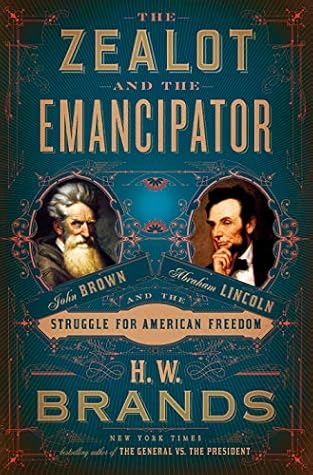
THE QUESTION HAD BEEN: What does a good man do when his country commits a great evil? John Brown chose the path of violence, Lincoln of politics. Yet the two paths wound up leading to the same place: the most terrible war in American history. Brown aimed at slavery and shattered the Union; Lincoln defended the Union and destroyed slavery.
“While Abraham Lincoln saved for you a country, he delivered us from a bondage, according to Jefferson, one hour of which was worse than ages of the oppression your fathers rose in rebellion to oppose.” Without Lincoln’s first accomplishment, the second couldn’t have come. God worked in mysterious ways; Lincoln wasn’t perfect, but he was perfectly suited to his task.
