
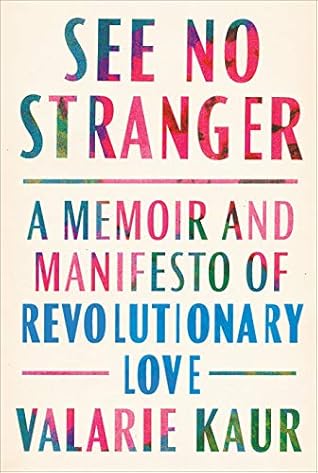
More on this book
Community


Kindle Notes & Highlights

by
Valarie Kaur
Read between
August 25 - August 31, 2022

I thought my breathlessness was a sign of my weakness, until a wise friend told me what I wish to tell you: Your breathlessness is a sign of your bravery. It means you are awake to what’s happening right now: The world is in transition.
Some days are so deadly, I can taste the ash in my mouth. Other days, I see glimpses of the nation, the world, that is wanting to be born: a society awakened to the truth of our interdependence. I choose to labor for that world. Sound government is necessary but not sufficient to take us across the threshold. We need a shift in consciousness and culture. A revolution of the heart. A new way of being and seeing that leaves no one outside our circle of care. A love without limit. Revolutionary love.
Love is a form of sweet labor: fierce, bloody, imperfect, and life-giving—a choice we make over and over again. Love as labor can be taught, modeled, and practiced. This labor engages all our emotions. Joy is the gift of love. Grief is the price of love. Anger protects that which is loved. And when we think we have reached our limit, wonder is the act that returns us to love. “Revolutionary love” is the choice to labor for others, for our opponents, and for ourselves in order to transform the world around us. It begins with wonder: You are a part of me I do not yet know. It is not a formal
...more
“I see no stranger,” said Guru Nanak, “I see no enemy.” Guru Nanak taught that all of us could see the world in this way. There is a voice inside each of us called haumai, the I that names itself as separate from You. It resides in the bowl that holds our individual consciousness. But separateness is an illusion. When we quiet the chatter in our heads through music or meditation or recitation or song, the boundaries begin to disappear. The bowl breaks. For a moment, we taste the truth, sweet as nectar—we are part of one another. Joy rushes in. Long after the moment passes, we can choose to
...more
What has been an ancient spiritual truth is now increasingly verified by science: We are all indivisibly part of one another. We share a common ancestry with everyone and everything alive on earth. The air we breathe contains atoms that have passed through the lungs of ancestors long dead. Our bodies are composed of the same elements created deep inside the furnaces of long-dead stars. We can look upon the face of anyone or anything around us and say—as a moral declaration and a spiritual, cosmological, and biological fact: You are a part of me I do not yet know.
Wonder is where love begins, but the failure to wonder is the beginning of violence. Once people stop wondering about others, once they no longer see others as part of them, they disable their instinct for empathy. And once they lose empathy, they can do anything to them, or allow anything to be done to them.
Love is dangerous business, Papa Ji explained. If you choose to see no stranger, then you must love people, even when they do not love you. You must wonder about them even when they refuse to wonder about you. You must even protect them when they are in harm’s way.
In 1699, the tenth Sikh teacher, Guru Gobind Singh, formed the Sikh community into the Khalsa, which means “pure and free,” a kind of beloved community. He gave the community new last names that signified a sense of sovereignty—“Singh” for men and boys, meaning “lion” or “warrior-prince”; “Kaur” for women and girls, meaning “warrior-princess” or “sovereign woman warrior.” He adorned us with five articles of faith, the five “K’s”—a steel bracelet called a karra, a comb called a kangee, an undergarment called a kach, a dagger called a kirpan, and long uncut hair called kesh. “Sikhs do not hide,”
...more
“What is higher than truth?” Papa Ji would ask me. “Living the truth,” I answered. “Changa,” he said. “Good.” “Truth is high, but higher still is truthful living,” says Guru Nanak. “Sachahu orai sabh ko upar sach aachaar.”
The Sikh ideal was the sant-sipahi, the warrior-sage. The warrior fights. The sage loves. It was a path of revolutionary love.
The most powerful force shaping who we see as us and them is the dominant stories in our social landscape. They are produced by ideologies and theologies that divide the world into good or bad, saved or unsaved, with us or against us. Stereotypes are the most reductive kind of story: They reduce others to single, crude images.
Any theology that teaches that God will torture the people in front of you in the afterlife creates the imaginative space for you to do so yourself on earth.
Sometimes I imagine: What if first contact in the Americas had been marked not by violence but by wonder? If the first Europeans who arrived here had looked into the faces of the indigenous people they met and thought not savage but sister and brother, it would have been difficult, perhaps impossible, to mount operations of enslavement, theft, rape, and domination. Such operations depend on the lie that some people are subhuman. If they saw them as equals instead, might they have sat down and negotiated a shared future? Imagine institutions on this soil built on the premise of equality rather
...more
Seeing no stranger is an act of will. In brain-imaging studies, when people are shown a picture of a person of a different race long enough for comprehension, it is possible for them to dampen their unconscious fear response. We can change how we see. We shouldn’t confuse this with suppressing our biased thoughts. Saying to yourself Don’t be racist, don’t be racist doesn’t work. It actually increases the frequency and power of the original biased thought! Instead you have to choose to think of the face in front of you as belonging to a person. In these studies, it was as simple as wondering
...more
I started a simple practice. As I move through my day and come across faces on the street or subway or on a screen, I say in my mind, Sister. Brother. Sibling. Aunt. Uncle. I start to wonder about each of them as a person. When I do this, I am retraining my mind to see more and more kinds of people as part of us rather than them. I practice this with animals and parts of the earth, too. I say in my mind: You are a part of me I do not yet know. I practice orienting to the world with wonder, preparing myself for the possibility of connection.
Human beings cannot remain in this silence and survive, and so we have to learn to say what is unsayable. We tell a story about violence to make sense of it, and the story returns us to the public realm where grieving is possible. The act of naming the violence and grieving loss in community is how the hole turns into a wound that can heal.
Grief is the price of love. Loving someone means that one day, there will be grieving. They will leave you, or you will leave them. The more you love, the more you grieve. Loving someone also means grieving with them. It means letting their pain and loss bleed into your own heart. When you see that pain coming, you may want to throw up the guardrails, sound the alarm, raise the flag, but you must keep the borders of your heart porous in order to love well. Grieving is an act of surrender.
The journey is often painful, but suppressing grief is what causes the real damage—depression, loneliness, isolation, addiction, and violence. When we are brave enough to sit with our pain, it deepens our ability to sit with the pain of others. It shows us how to love them.
In the wake of trauma, when it feels like we’re thrown into a hole, we need to be able to tell the story of what happened in order to return to a sense of community. We must be able to say: This was wrong and must not happen again. Telling the story is the prerequisite to justice. But for the story to matter, someone we trust must be listening. It is not easy to listen.
Grieving together, bearing the unbearable, is an act of transformation: It brings survivors into the healing process, creates new relationships, and energizes the demand for justice. We come to know people when we grieve with them through stories and rituals. It is how we build real solidarity, the kind that shows us the world we want to live in—and our role in fighting for it.
All this time, as we were struggling to understand and grieve the loss of our bodies, the nation barely noticed. Instead the nation was marshaling its energies for war, telling itself a story about its goodness and greatness and power to deliver justice to enemies of freedom. The fact of white supremacist hate contradicted this story, so the scope and extent of the violence, and our pain, never entered mainstream consciousness. America did not grieve with us. America did not find our lives worthy of grief or our stories believable. We were left to grieve in the dark, but with this consolation:
...more
I could not help asking myself: Would people have shown up if Balbir Uncle had been less virtuous? Did people of color have to be perfect in order for our lives to be grievable? I marveled at the labor it took to prove our humanity—it seemed like we had to be superhuman in order to be seen as human. But looking back at history, even that has not been enough.
New horrors keep arising from old impulses. The past keeps bleeding into the present. No civilization in the world is exempt. But what is particular to America is that many who suffered enormous loss and destruction have had to do so alone, had to marshal language to tell the story, only to find that there was no one to hear it because their suffering contradicts the story that the nation keeps telling itself—the story of American exceptionalism. America is a beacon of light, the singular enforcer of truth. Our story of exceptionalism doesn’t allow us to confront our past with open eyes. A
...more
America’s greatest social movements—for civil rights, immigrants’ rights, women’s rights, union organizing, queer and trans rights, farmworkers’ rights, indigenous sovereignty, and black lives—were rooted in the solidarity that came from shared grieving. First people grieved together. Then they organized together. Often, they sang and celebrated together.
Mother Teresa once said, “If I look at the mass, I will never act. If I look at the one, I will.” And so, begin with one. Can you choose one person to practice wondering about? Can you listen to the story they have to tell? If your fists tighten, or your heart beats fast, or if shame rises to your face, it’s okay. Breathe through it. Trust that you can. The heart is a muscle: The more you use it, the stronger it becomes. Then the next time a black boy in your city is killed by a police officer, or a turbaned Sikh father is beaten, or a Jewish person is stabbed, or a trans woman is murdered, or
...more
There is something called “empathy fatigue” that happens when we get overloaded by other people’s pain. The good news is that you don’t need to feel empathy all the time. Love is not a rush of feeling: Love is sweet labor. What matters is the work your hands do. So, breathe and rest and, when you are ready, see if you can wonder about the world just a little, just enough to show up to the labor one more day. Let wonder surprise you.
I realized that, after fifteen years, I had never been given the chance to grieve 9/11. Not even a day. Not even an hour. This was the case for so many of us who jumped into crisis-response mode to protect our own families and communities from hate. We were robbed of the space to breathe, let alone the right to grieve with our country.
On the very night of the attacks, President Bush declared a “war against terrorism” and divided the world into us and them: “You are either with us or against us.” Grieving is a process that takes time and stillness and presence. It is impossible to grieve and prepare to kill at the same time. So, despite all the performances of national mourning, we as a nation had little time and space to be present to our pain and all that it had to teach us. Unresolved grief inside a person is tragic; unresolved grief inside a nation is catastrophic: It releases enormous aggression. In the name of the
...more
We could have grieved with all of our fellow Americans, not just the ones who looked like us, but also the ones who looked like the people we feared. We could have grieved with people around the world and drawn connections between their suffering and ours. The mass killing of three thousand people and the trauma of a world that watched could have sustained a kind of public grieving that expanded our sense of who counts as “us” beyond what anyone had previously experienced. It could have made us safer. Today we might have remembered 9/11 as the tragedy that initiated an era of global
...more
The question therefore is not whether or not we will fight in our lives but how we choose to fight.
Any act to change the world around us begins within us. It starts with a sense of agency, a sense that we have the power to effect change. The Latin root of the word “power” means “to be able.”
The Brazilian educator Paulo Freire calls this internal shift “critical consciousness,” the moment we tap into our own power to change the world around us. It feels like waking up.
Today Americans are seven times more likely to be killed by a white right-wing extremist than a terrorist who kills in the name of Islam. And Muslim and Sikh Americans specifically are five times more likely to be targets of hate than we were before 9/11.
When you love someone, you fight to protect them when they are in harm’s way. If you “see no stranger” and choose to love all people, then you must fight for anyone who is suffering from the harm of injustice. This was the path of the warrior-sage: The warrior fights, the sage loves. Revolutionary love.
Nonviolence is often seen as passive and soft. But warrior metaphors show nonviolent action for what it is—fierce, strategic, demanding, and disciplined. Nonviolent movements around the globe have ushered in more durable democracies that are less likely to regress into civil war. There are some situations where force is necessary to defend oneself and resist state violence. But force should be a last resort.
First, what is your sword, your kirpan? What can you use to fight on behalf of others—your
Second, what is your shield, your dhal? What can you use to protect yourself and others when the fight is dangerous—your
Third, what is your instrument, your dilruba?
a string instrument small enough for soldiers to carry on their backs into the battlefield, so that they could lift their spirits in music, song, and poetry ...
This highlight has been truncated due to consecutive passage length restrictions.
