
More on this book
Community


Kindle Notes & Highlights

Read between
November 25 - November 26, 2019

His stern visage had fallen away momentarily, he was so happy to see her alive.
“No, the Dancer’s not a sadist. He can’t afford to be. His only urge is to complete the job, and he’s got enough willpower to keep his other lusts under control. Why’d he suffocate her when he could have used a knife or rope? . . . I’m not exactly sure but it could be good for us.”
“Maybe there was something about her that he hated and he wanted to kill her in the most unpleasant way he could.”
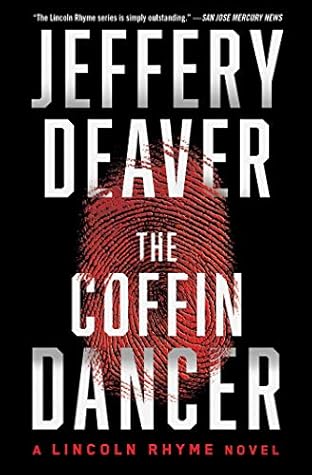
Yet it seemed to Rhyme that if anyone could disprove Locard’s Principle, it was the ghost they called the Coffin Dancer.
At times it’s easy to neglect the body, to forget we even have bodies—times like these, when lives are at stake and we have to step out of our physical beings and keep working, working, working.
The lights were dim. Rhyme was rubbing his head against the pillow like a bear scratching his back on a tree. The Clinitron was the most comfortable bed in the world. Weighing a half ton, it was a massive slab containing glass beads through which flowed heated air.
“You all right, Sachs? Tell me true?” “I’m okay.” She returned to the chair, sipped more of the smokey liquor. “You want to stay tonight?” he asked.
She’d ante up far more personal information than he. But that was all right. She loved listening to him say whatever he wanted to. His mind was astonishing.
It was as if that restlessness had moved from his useless legs into his mind, which roamed the city—in his imagination—well into the night.
“Come on, Sachs. We’ve got secrets, you and me? I don’t think so.”
He offered a casual smile and Sachs felt the pain course through her—actual pain like the blow that left the bruise in the shape of the Show Me State. Because what he was saying was a lie. Oh, he’d been thinking about this woman. Sachs didn’t believe in woman’s intuition but she did believe in cop’s intuition; she’d walked a beat for far too long to discount insights like these. She knew Rhyme’d been thinking about Ms. Trilling.
She’d talked about him to her mother many times. And the cagey old woman would usually say something like “It’s good to be nice to a cripple like that.” Which just about summed up all that their relationship should be. All that it could be. It was more than ridiculous. But jealous she was. And it wasn’t of Claire. It was of Percey Clay.
Percey wasn’t an attractive woman, but that meant nothing; it had taken Sachs all of one week at Chantelle, the modeling agency on Madison Avenue where she’d worked for several years, to understand the fallacy of the beautiful. Men love to look at gorgeous women, but nothing intimidates them more.
Rhyme couldn’t, of course, pull her to his chest and slip his arm around her. But the comparable gesture was his tilting his head to hers.
But Sachs knew it was just the opposite. The turn-on was that he was a man who had complete control, despite the fact he couldn’t move.
Then suddenly he shook his head, so violently that she thought he might have been having an attack of dysreflexia. “No!” he whispered. She’d expected playful, she’d expected passionate, at worst a flirtatious Oh-oh, not a good idea . . . But he sounded weak. The hollow sound of his voice cut into her soul.
So this was all that she was to him, she understood at last. A partner. A colleague. A capital F Friend.
“Uh-huh,” he said, though what he might be seeing was a mystery to Rhyme since the stage light was off.
It was the way a senior pilot might study her before their first flight together. Checking her authority, her demeanor, her quickness of thought. Her courage.
He’d cocked an eyebrow. “Worm on a hook,” she’d said.
Well, there’s a phrase we use in flying jets. The ‘coffin corner.’ ” “What’s that?” “It’s the margin between the speed your plane stalls at and the speed it starts to break apart from Mach turbulence—when
Any planes that fly that high have to have autopilots to keep the speed inside the margin. Well, I’ll just say that I fly that high all the time and I hardly ever use an autopilot.
And what does a rusty gun tell us, Soldier? Plenty, sir. Stephen Kall lifted his hands.
Somehow Lincoln the Fucking Worm had known that Stephen wouldn’t buy the setup about the Twentieth Precinct. They’d been expecting him here all along. Lincoln had even figured out his strategy—that Stephen would try to get through the alley from this very building.
It was two years since Stephen had worked with a partner. Sometimes he wished he hadn’t killed the man.
They’re green-lighted to kill! Stephen thought. No surrender pitch. They see me, they shoot. Armed or not.
“Blood spatter’s very revealing. But it’s meaningless unless the surface it’s on is uniform.
“Forget the little ones. They’re ‘overcast’ drops, satellites of the others. Describe the biggest ones.
“I don’t think he left a bomb. He hardly had time. But whatever shape the agent’s in, and it won’t be good, ignore him for a minute and look for any traps first.”
There was a large hole in the right shoe and through it you could see a lattice of skin wrinkles. “No socks. Could be his friend’s homeless.”
Sachs said, “All those doctors’ offices there . . . This guy must’ve been boosting pills.”
That’s my Amelia, he thought. For an instant his thoughts returned to last night—the two of them lying in bed together. He pushed the thought away.
It meant that the antipersonnel satchel had gone off in Sheila’s apartment. And that meant they’d found out he’d been there. How the hell had they done that?
They’ll never find you, never tie you down. The worms won’t get you . . .
The can looked dirty. Maybe worms had crawled on it. Maybe crawled inside. You could drink a worm and never know it . . .
“The fact is I’ve been in a situation lately where I haven’t really . . . where I haven’t been as interested in women as most men are. But it’s just a temporary condition.”
“I don’t know. I’ll tell you I’ve never killed anybody because he’s a homosexual. That would make no sense.”
Jodie sipped his orange juice. There were dozens of empty orange juice cans piled in the corner. It seemed to be all he lived on. “You know,” he said, wiping his mouth on his sleeve, “you think professional killers’d be crazy. But you don’t seem crazy.”
He said don’t think about the hard part as a problem, just think about it as a factor. Like something to consider. He’d look me in the eye and say, ‘It’s not a problem, it’s just a factor.’
Stephen put his hand on Jodie’s leg to prove that he really did like it.
From his voice he sounded fit and athletic, but then Rhyme supposed he himself might seem like an Olympian to someone who couldn’t see his destroyed body.
Beside him was the Bear Man—so named because he wheeled around a shopping cart filled with dozens of stuffed animals, supposedly for sale, though only the most psychotic of parents would buy one of the tattered, licey little toys for their child.
The paint balls came in every color but Lou insisted on loading with red. Like blood.
Then Lou would go inside to inspect the plates and bowls and make sure they were lined up on the checkered tablecloth, four squares from the edge, and sometimes when they were only three and a half squares from the edge or there was still a dot of grease on the rim of a melamine plate Stephen would listen to the slaps and the whimpers from inside the house as he lay on his back beside the fire and watched the sparks fly toward the dead moon.
Stephen, who never had any trouble looking any man in the eye, glanced at Jodie once then down immediately. And from somewhere, totally weird, this image came to mind. Jodie and Stephen living together in the cabin, going hunting and fishing. Cooking dinner over a campfire.
He felt cringey again. He slid his hand down Jodie’s back. It rested at the base of his spine. The bad feeling went away.
“The best snipers don’t work alone. They always have a spotter with them. He locates the target and figures out how far away it is, looks for defensive troops, things like that.” “You want me to do that for you?” “Yep.
Stephen blurted suddenly, “It’s good I met you.” “I’m glad I met you too.” Jodie hesitated for a minute. “Partner.” He stuck his hand out. “Partner,” Stephen echoed. He had a fierce urge to take his glove off, so he could feel Jodie’s skin on his. But he didn’t.
But the criminalist—a scientist foremost—refused to give voice to his hopes. Afraid he might jinx the operation—well, jinx Sachs, he was thinking.
Oh, man, Rhyme, blew it bad. Wish we’d had a better farewell night . . . I’m sorry . . . I’m sorry . . .
