
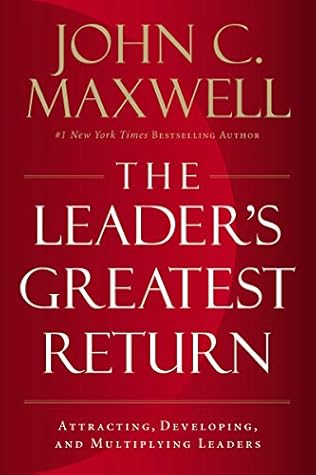
More on this book
Community


Kindle Notes & Highlights
Read between
July 22 - November 29, 2022

But everything worthwhile is uphill. If the purpose of life was ease and comfort, no sensible person would ever take on the demands of leadership. Developing leaders is even harder. It’s like herding cats. That is why so many people who lead let themselves become comfortable attracting and leading followers instead of seeking out and developing leaders. Followers usually follow. Leaders, not so much.

Elsewhere, Maxwell has talked about everything good in life being uphill but we have downhill habitats. Great teaching.
Just as individuals never arrive, neither do organizations. In all my years helping organizations find, raise up, and develop leaders—and I’ve helped more than I can count—not once has a company spokesperson said, “Don’t help us. We have too many good leaders.” There is always a leadership shortage.
My companies and nonprofits all focus on leadership development, and for several years I’ve been called a leadership expert.3 Yet what do all of my organizations need? More good leaders. The organizations have leadership cultures, leadership vision, and leadership mentoring, yet we still need more and better leaders. Why? Because everything rises and falls on leadership. When an organization stops growing leaders, it stops growing.
I've seen this in companies before. Their strong executive team leads to success and growth. But that growth will be limited if they don't grow mid-level (and future high-level) leaders.
The executive team has to spend more time managing a growing number of direct reports and putting out fires caused (or contributed to) by a lack of effective leaders between them and the rest of the organization.
It gets even worse if any members of the executive team get fed up with the worsening conditions and leave for employment somewhere else.
Now, you're scrambling to fill an important gap on the leadership team with no one on the bench.
The only way to prevent this is to have a system for developing leaders. It's not a quick fix. It's a long term commitment to constant development, but it's the only way to keep this lack of leadership from limiting your growth.
Grow a leader—grow the organization.
I am often amazed at the amount of money and energy organizations spend on activities that will not produce growth. They pour money into marketing, yet they don’t train their employees in how to treat customers when they show up. You can say customers are your priority, but they know the difference between good service and hollow promises.
A lack of leadership is always eventually felt by the customers in worse service and a lackluster experience.
how well you lead determines how well you succeed.
People too often overvalue their dream and undervalue their team. They think, If I believe it, I can achieve it. But that’s simply not true. Belief alone is not enough to achieve anything. It takes more than that. Your team will determine the reality of your dream. A big dream with a bad team is a nightmare.
1. Define it—Forge a consensus regarding our organization’s working definition of leadership. 2. Teach it—Ensure everyone knows our leadership point of view and leaders have the skills required to succeed. 3. Practice it—Create opportunities for leaders and emerging leaders to lead; stretch assignments prove and improve leaders. 4. Measure it—Track the progress of our leadership development efforts, adjusting strategies and tactics accordingly. 5. Model it—Walk the talk and lead by example—people always watch the leader.7
1. IDENTIFYING LEADERS: Find Them So You Can Develop Them 2. ATTRACTING LEADERS: Invite Them to the Leadership Table 3. UNDERSTANDING LEADERS: Connect with Them Before You Lead Them 4. MOTIVATING LEADERS: Encourage Them to Give Their Best 5. EQUIPPING LEADERS: Train Them to Be Great at Their Job 6. EMPOWERING LEADERS: Release Them to Reach Their Potential 7. POSITIONING LEADERS: Team Them Up to Multiply Their Impact 8. MENTORING LEADERS: Coach Them to the Next Level 9. REPRODUCING LEADERS: Show Them How to Develop Leaders
...more
Every person you bring onto your team will make you either better or worse. And every leader you develop will do the same. Maybe that’s why Amazon founder Jeff Bezos remarked, “I’d rather interview 50 people and not hire anyone than hire the wrong person.”
If the mission of your organization were to climb trees, which would you rather do: hire a squirrel or train a horse to do the job?
Do you know what you’re going after? That will tell you what kind of leaders you need to find to improve your organization.
before you start identifying potential leaders. Answer these questions: • What is your vision? • What is your mission? • Who do you need on your team to accomplish your vision and mission? • What resources will you need to accomplish your vision and mission?
If you start bringing in and developing leaders without clearly communicating your better vision of the future, you're setting yourself (and your leaders) up for failure.
My friend speaker and author Mark Sanborn said, “Great leaders help people have a larger vision of themselves.”
Encouragement is oxygen to the soul for the leader, and if you’re a leader who wants to develop other leaders, you need to encourage them and help them breathe.
People need a place where they can rise up and practice leadership.
But bringing in outsiders can create challenges because of the unknowns. I think the greatest challenge is cultural compatibility.
“At Delta, we hire for attitude but train for aptitude.
Attitude is a choice, and at the heart of a good attitude is willingness—willingness to learn, to improve, to serve, to think of others, to add value, to do the right thing, and to make sacrifices for the team.
Good leaders want more for the people they lead than they want from them.
Builders are producers.
Builders don’t get comfortable. They live the Law of the Rubber Band, which I taught in The 15 Invaluable Laws of Growth.23 It says growth stops when you lose the tension between where you are and where you could be. Builders like to be stretched.
My friend Chris Hodges says that the vision gap is the space between what we are doing and what we could do. Builders are impatient to close that gap.
Builders are passionate about what they are doing and where they are going. And their passion inspires others to join them.
How did Bob do it? First, he started by knowing exactly who he was looking for. And he followed the same pattern I outlined in this chapter: 1. ASSESSMENT OF NEEDS: “What is needed?” 2. ASSETS ON HAND: “Who has leadership potential within the organization?” 3. ASSETS NOT ON HAND: “Who has leadership potential outside of the organization?” 4. ATTITUDE OF THE POTENTIAL LEADERS: “Are they willing?” 5. ABILITY OF THE POTENTIAL LEADERS: “Are they able?” 6. ACCOMPLISHMENTS OF THE POTENTIAL LEADERS: “Have they produced results?”
If you’re not identifying the leaders of tomorrow whom you will train up, your potential and your future will always be limited.
People with leadership potential want to spend time with leaders.
A leadership table shouldn’t be an elite invitation to exclusivity; it should be an open invitation to opportunity.
Instead of putting all their eggs in one basket of early-anointed high potentials, companies should expand their chances of producing future leaders by giving everyone a similar development diet and letting the cream rise to the top on its own.
In an article in Harvard Business Review, Bryan Walker and Sarah A. Soule said, “Culture is like the wind. It is invisible, yet its effect can be seen and felt. When it is blowing in your direction, it makes for smooth sailing. When it is blowing against you, everything is more difficult.”
Organizations with a strong leadership culture depend on people for guidance and direction, not rules and policies.
Because most are not in the people development business. They are in the fast food business. CFA develops people that serve other people. Therefore, they attract people that value developing and serving other people.
It’s been my observation that many organizations are in the “profit” business. They operate much differently than those in the people development business. Ironically, those in the people development business tend to make a lot more profit because, in the end, the people are responsible for the profit.
why not create a leadership roundtable? Here’s how you can do it:
establish expectations. Here’s what you need to tell them: • The format of the group is honest discussion, not teaching. • The environment is one of encouragement. • Everyone in the group must participate. • There are no bad questions. • Everyone’s aim should be to add value to what’s shared. • The purpose of the roundtable is application, not information. • We hold each other accountable for following through with our commitments.
As the leader of a roundtable, you are not to teach anything. Your goal is to ask questions and facilitate discussion.
Knowledge isn’t the key to success. Applying knowledge is. That’s how people grow.
For many years, I’ve taught something I call ACT, which stands for apply, change, teach.
At the end of every session, ask people, based on what was discussed: • “What can you apply to your life?” • “What can you change about yourself?” • “What can you teach to someone else to help them?”
The best leaders separate themselves. The leadership roundtable will help everyone who participates, but you’ll find the best leaders if you pay attention and don’t try to dominate the discussion. You need to give people room to rise up, and when they do, tag them for more personalized development.
Learners that will transfer a new skill into their practice as a result of theory, demonstration, practice, feedback during training and in situation coaching or mentoring = 90%8 As a learner, there’s no substitute for participating and having access to people who know what they’re doing, can direct you, and can give you feedback.
Leadership is more caught than taught.
Before I bring potential leaders into a meeting, I ask myself: • “Do I have questions to ask? And do they have questions to ask?” • “Do I have experiences to share? And do they have experiences to share?” • “Do I have lessons to teach? And do they have lessons to teach?” • “Is there application to give them? Do they have applications to give me?”
I should always be adding value to someone or learning from someone.
It’s good to remember that if someone is always at the head of the class, he or she is in the wrong class.
Who luck is about constantly expanding the pool of people you’re connected with. One of the best ways to expand that pool is to ask the people you already know to introduce you to people they know. I’ve done this for years by asking, “Who do you know that I should know?”
In the end, the only way for any person to learn leadership is to lead. Leading isn’t a theoretical exercise. Lead is a verb, and to get better at leadership, people have to lead,
“Purposeful practice was the only factor distinguishing the best from the rest.”
Before you lead and develop people, you need to connect with them. You need to find common ground with potential leaders, which is less about ability and more a function of attitude.
people don’t automatically commit to you and follow you when they understand you. They commit to you and follow when they feel understood.
