
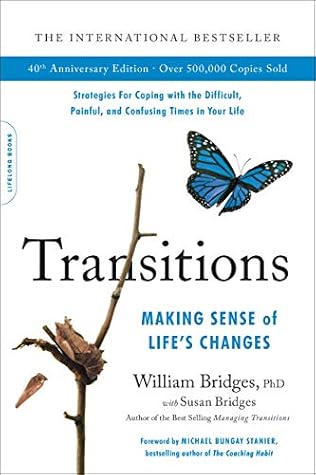
More on this book
Community


Kindle Notes & Highlights


disidentification process is usually the inner side of the disengagement process.
In the ceremony for entry into the healing cult of the Ndembu of southern Africa, initiates were brought before a strange shape in the jungle; they were told this was Davula, or the cult’s spirit. Then unexpectedly they were told to beat on the spirit-shape with sticks and kill it.
We did not have to unlearn the first grade to go on to the second,
which way is up and which way is down; it is a sense of which way is forward and which way is back.
(in the words of Robert Frost) “lost enough to find yourself.”
The guy who is fired (disengagement) or bypassed for promotion one last time (disenchantment) is likely to find himself losing interest in old goals and plans.
vitiate
Disorientation is meaningful, but it isn’t enjoyable. It is a time of confusion and emptiness when ordinary things assume an unreal quality. Things that used to be important don’t seem to matter much now.
Disorientation affects not only our sense of space but also our sense of time.
The problem is not that we don’t want to give up a job or a relationship, or that we can’t let go of our identity or our reality. The problem is that before we can find a new something, we must deal with a time of nothingness.
Oedipus is right at the second great transition point in life, the time when he must leave his involvement and identification with the social roles and self-images that have been successful.
The story of Oedipus illuminates the process of life transition. It shows that after a certain point the very ways of being that brought forth and sustained a life phase begin to destroy it.
Shortly after he was born, and long before the play began, Oedipus was sent away because of a prophecy that he would one day kill his father. Later, when he learned of the prophecy, he left his foster parents’ house. At each step, the attempt to perpetuate something is the act that initiates its downfall. Our endings, we must discover, are often brought about by the very acts and words that we believed would keep things the way they have always been.
The goal of one phase of life becomes the burden of the next. That is why rites of passage begin with a symbolic death.
One of the most important differences between a change and a transition is that changes are driven to reach a goal, but transitions start with letting go of what no longer fits or is adequate to the life stage you are in.
whatever it is, it is internal. Although it might be true that you emerge from a time of transition with the clear sense that it is time for you to end a relationship or leave a job, that simply represents the change that your transition has prepared you to make.
“disengagement” refers exclusively to external things. “Dismantling” can be either an internal or an external process, and “disidentification,” “disenchantment,” and “disorientation” all refer to internal things.
It is the internal things that really hold us to the past, and people who try to deal only with externals are people who walk out of relationships, leave jobs, move across the country, but who don’t end up significantly different from what and who they were before.
the inner ending is what initiates the transition.
a friend was talking about the breakup of his marriage. “But, you know, it really ended quite a while before she left,” he said.
Mircea Eliade,
“In no rite or myth do we find the initiatory death as something final, but always as the condition sine qua non of a transition to another mode of being, a trial indispensable to regeneration; that is, to the beginning of a new life.”
I do my utmost to attain emptiness; I hold firmly to stillness. (XVI) Do that which consists in taking no action; pursue that which is not meddlesome; savour that which has no flavor. (LXIII) —Lao Tzu, Tao Te Ching1
Without quite knowing why, people in the middle of transition tend to find ways of being alone and away from all the familiar distractions.
backpacking alone in the mountains. “Where can we reach you?” her husband asked with concern. The woman, who had never before gone anywhere by herself, replied simply, “You can’t. But I’ll be back.”
Only in the apparently aimless activity of your time alone can you do the important inner business of self-transformation.
But you don’t do it as you do ordinary things, for it is in the walking, watching, making coffee, counting the birds on the phone wire, studying the cracks in the plaster ceiling over the bed, dreaming, and waiting for God knows what to happen
which is attentive inactivity and ritua...
This highlight has been truncated due to consecutive passage length restrictions.
A modern account of such instruction is given in Carlos Castaneda’s books about Don Juan and his Yaqui teachings.
“I didn’t want to lose that job,” he said one night, “but once it was gone, I realized that I didn’t want another like it.
suggest that the old consciousness-altering techniques used in rites of passage did not create a different reality but amplified or enhanced the natural tendency to see and understand the world differently in the gap between one life phase and the next.
In taking the initiate into the wilderness and enervating him or her with fasting and fatigue, in suppressing the initiate’s old consciousness with chanting and rhythmical movements, in enlivening the imagination with mythic tales and symbolic procedures of various sorts—in all these ways, traditional societies opened the person to the transformative experiences of the neutral zone.
For many people, the experience of the neutral zone is essentially one of emptiness in which the old reality looks transparent and nothing feels solid anymore.
These tools were once provided by the tribal elders in the form of instruction and ritual, but today we must fashion our own tools.
The first of the neutral-zone activities or functions is surrender: one must give in to the emptiness and stop struggling to escape it.
three main reasons for the emptiness between the old life and the new. First, the process of transformation is essentially a death and rebirth process rather than one of mechanical modification.
The second reason
the process of disintegration and reintegration is the source of renewal.
As Ralph Waldo Emerson put it, “Every man’s condition is a solution in hieroglyphic to those in inquiries he would put. He acts it as life, before he apprehends it as truth.”
We need to translate the hieroglyphic and in so doing to make sense out of what we are experiencing. When you record your experience, you slow down and force yourself to put things into words. And out of the blur of your experience, shapes start to emerge.
the neutral zone’s gift to you is a ringside seat where you can watch your own mind making up realities.
One of George Orwell’s slogans in 1984 was “Who controls the present controls the past; who controls the past controls the future.”
“What do I really want to eat or drink right now?” (Take one or two minutes to think about that before you read any further.) What did you do with that question? Forget the answer that you did or did not come up with, and think instead about the answer-getting process. How did you go about it?
Some people seem to know instinctively what they want, and they usually get their signals from their mouths or their stomachs. However, most people use some strategy to “come up with an answer.”
Think of what would be unlived in your life if it ended today.
Because endings are dyings in one sense, the obituary is an appropriate statement about your past.
Take a few days to go on your own version of a passage journey.
go a little further with the natural tendency to withdraw for a time during the neutral-zone phase of transition. I am suggesting that you spend a few days alone during which you reflect consciously on the present transition process in your own life. The place should be an unfamiliar one and free of the ordinary influences from your daily situation,
The simpler and quieter the setting, the more chance you will have to attend to your inner business. Your food should be simple, and your meals should be small. Leave at home the wonderful novel you’ve been meaning to read, and don’t distract yourself with other entertainment. Take along a notebook to jot in, but don’t feel that you have to write anything substantial while you are there.
This retreat is a journey into emptiness and a time to cultivate receptivity. The more you leave behind, the more roo...
This highlight has been truncated due to consecutive passage length restrictions.
