
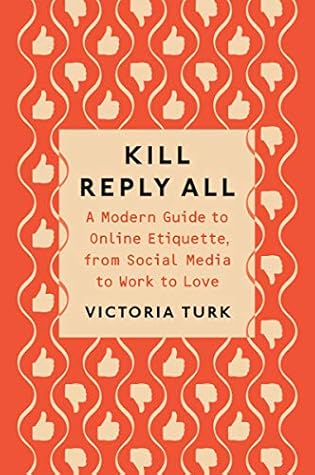
More on this book

Kindle Notes & Highlights


Stop people emailing you in the first place by making your email address hard to find. Says Mann, “Only an animal has their raw email address sitting out in public anymore.”
YOUR EXPERIENCE ON social media will largely be shaped by the people you connect with, so choose wisely. There are two main types of connection across platforms: friends and followers. Friendship is mutual; you can only be friends with someone if they also want to be friends with you. Following, however, is often one-sided. You’ll never be Beyoncé’s friend (sorry), but there’s no excuse not to be her follower.
If you do decide to do a bit of a friend spring-clean, just go about it quietly. Posting one of those obnoxious “Just did a friend cull so congrats if you’re reading this, you made the cut” statuses is the height of poor taste.
A like can mean much more than just “I like this.” It can say “I agree with you,” or “I think you look fit,” or “I’m sorry your dog died.” Context is crucial, so if there’s any ambiguity over why you’re liking your friend’s post about their cat’s funeral, be sure to write a comment, too. (Human deaths require a private message.)
Finally, don’t like your own posts—this is a bit sad, like trying to high-five yourself.
And never like someone’s breakup, even if you did think they weren’t right for each other. It’s awkward when they then get back together.
Be careful what you share, and never share links to stories you haven’t actually read. If you do want to retweet something that you don’t endorse—for example, in order to critique it—then you need to quote-tweet and add a note explaining your position.
The concept of The Ratio took hold on Twitter around 2017. It’s a simple rule: if the number of replies to a tweet vastly outweighs the number of likes or shares, then said tweet must be bad, wrong, and/or morally repugnant.
Similarly, in 2014 the New York Police Department envisioned the public using its #MyNYPD hashtag to share warm-and-fuzzy photos of themselves with police officers, but it was soon hijacked by people sharing stories of police brutality instead.
Another purpose of hashtags is to add semantic context to a post. Like emoji, a hashtag can add an emotional inflection or give the reader a clue as to how a post is meant to be read.
A final word of warning: if you are inventing your own hashtag, be mindful of how it parses. Never forget that mirthful day in 2012 when singer Susan Boyle celebrated her album launch with the Twitter hashtag #Susanalbumparty. It was meant to read “Susan album party,” but many saw four words instead of three.
Dance like no one’s watching, sing like no one’s listening, but post online like everything you write could one day be read by your boss, your mother, or a court of law.
Over the past decade, images have become much more important on social media, and our approach to posting photos has also evolved. The emphasis is now firmly on quality over quantity.
Selfies get a lot of flak—they’re narcissistic, they’re vain, they’re self-indulgent—but we all love them really.
the “follow me” pose—a picture of you from behind, with one hand stretched back toward the photographer. It’s just a totally natural and not-at-all-awkward way to hold hands.
If you’re single and too mortified to ask someone else to take two thousand shots of you in your bikini until you get one that flatters all of your wobbly bits, then you can take a plandid with the help of your phone’s timer. Pro tip: use your camera’s burst mode.
Getting that perfect ’gram is a n...
This highlight has been truncated due to consecutive passage length restrictions.
Food photography on social media was never that noticeable until Instagram came along, and something about that square-shaped frame apparently brainwashed us all into thinking we were restaurant critics.
And please don’t post pictures of healthy foods, like salads or those abominable green smoothies—we want to see food porn, not sanctimonious reminders of how disgustingly healthy you are.
Shifman says that the reason we love memes so much is because they allow us to express ourselves both as an individual and as part of a collective.
Memes can also help form a kind of in-group language, with specific online communities adopting memes that outsiders don’t understand, to help establish a group identity.
Social media is made for showing off, but you should at least try to be subtle about it.
All of this boasting contributes to the feeling of FOMO, or “fear of missing out”—the assumption we all make that everyone else is living a much more interesting, exciting life than we are, because all we see are their carefully curated social media posts. Just remember that, in reality, they probably have just as many lonely evenings, disappointing meals, and bad hair days as you do. Probably.
The phenomenon is epitomized in Rebecca Solnit’s 2008 essay “Men Explain Things to Me,” which opens with the author recounting the time a man at a party tried to explain one of her own books to her. Solnit didn’t actually coin the term “mansplaining,” but the word soon caught on to describe a practice that resonated with many women.
Mansplaining is a dude who once read A Brief History of Time trying to explain black holes to an astrophysicist, or someone who watched last night’s MasterChef outlining the finer points of chocolate tempering to a professional pastry chef.
And I’d bet my last Rolo that the Venn diagram between habitual mansplainers and tweetstormers is essentially a circle.
Social media’s role as a news source has been linked to the spread of fake news, with Facebook in particular coming in for criticism after it was uncovered that accounts linked to Russia had attempted to use the platform to influence U.S. voters ahead of the 2016 presidential election.
Sites like Snopes and FactCheck.org regularly debunk fake news and conspiracy theories. Check if this story is a known hoax. If it’s a bombshell of a story and no mainstream outlets are running it, that’s usually a sign that it doesn’t meet general reporting standards.
If you do accidentally share a story you later learn is fake, don’t leave it up, as this may only cause it to propagate further. Your best option is transparency. Delete the post and let any friends or followers know that you have removed it after learning it was not true.
If an image seems unlikely to be real, you can try doing a reverse image search using Google or TinEye to see if the picture has appeared elsewhere previously.
