
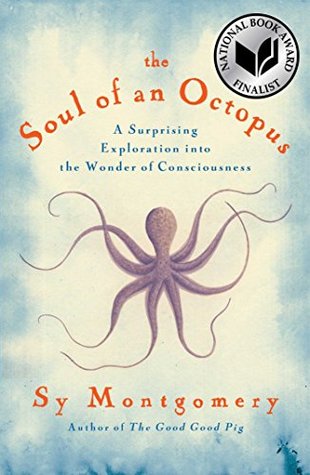
More on this book
Community


Kindle Notes & Highlights

Read between
October 7 - October 20, 2024

I wanted to explore a different kind of consciousness, if such a thing exists. What is it like to be an octopus? Is it anything like being a human? Is it even possible to know?
what I began to discover that day was my own sweet blue planet—a world breathtakingly alien, startling, and wondrous; a place
to me, Athena was more than an octopus. She was an individual—who I liked very much—and also, possibly, a portal. She was leading me to a new way of thinking about thinking, of imagining what other minds might be like.
Three fifths of octopuses’ neurons are not in the brain but in the arms.
“I’ve always liked toddlers and kids,” he says. “I can relate to them. This is . . . similar.” As with a child, to commune with Athena demands a level of openness and intuition greater than that used in the usual discourse between adult humans of a common culture.
Athena is, in the words of the late, great Canadian storyteller Farley Mowat, “more-than-human,” a being who doesn’t need us to bring her to completion. The wonder is that she will allow us to be part of her world.
we entered what we called Octopus Time. Feelings of awe are known to expand the human experience of time availability. So does “flow,” the state of being fully immersed in focus, involvement, and enjoyment. Meditation and prayer, too, alter time perception.
there is another way we alter our experience of time. We as well as other animals can mimic another’s emotional state. This involves mirror neurons—a type of brain cell that responds equally whether we’re watching another perform an action, or whether we’re performing that action ourselves. If you are with, for example, a calm, deliberate person, your own perception of time may begin to match his. Perhaps, as we stroked her in the water, we entered into Athena’s experience of time—liquid, slippery, and ancient, flowing at a different pace than any clock. I could stay here forever, filling my
...more
In our dreams, we humans experience our most isolated and mysterious existence: “All men,” wrote Plutarch, “while they are awake, are in one common world; but each of them, when he is asleep, is in a world of his own.” How much more inaccessible, then, are the dreams of animals?
Octopuses and their relatives put chameleons to shame. Most animals gifted with the ability to camouflage can assume only a tiny handful of fixed patterns. The cephalopods have a command of thirty to fifty different patterns per individual animal. They can change color, pattern, and texture in seven tenths of a second.
Assessing the mind of a creature this alien demands that we be extraordinarily flexible in our own thinking.
“Only intelligent animals play,”
“Just about every animal,” Scott says—not just mammals and birds—“can learn, recognize individuals, and respond to empathy.”
Once you find the right way to work with an animal, be it an octopus or an anaconda, together, you can accomplish what even Saint Francis might have considered a miracle.
“You learn to project empathy.
You have to meet them halfway. You have to be willing to listen.”
learned to slip quietly between cultures.
used to being misunderstood. In a world that demands conformity, in a culture that values animals little, and aquatic animals least of all, we all were.
Belonging to a group is one of humankind’s deepest desires. We’re a social species, like our primate ancestors. Evolutionary biologists suggest that keeping track of our many social relationships over our long lives was one of the factors driving the evolution of the human brain.
Octopus and human intelligence evolved separately and for different reasons. She believes the event driving the octopus toward intelligence was the loss of the ancestral shell. Losing the shell freed the animal for mobility.
the octopus can hunt like a tiger. And while most octopuses love crab best, a single octopus may hunt many dozens of different prey species, each of which demands a different hunting strategy, a different skill set, a different set of decisions to make and modify.
From building shelters to shooting ink to changing color, the vulnerable octopus must be ready to outwit dozens of species of animals, some of which it pursues, others it must escape. How do you plan for so many possibilities? Doing so demands, to some degree, anticipating the actions—in other words, imagining the minds—of other individuals.
The ability to ascribe thoughts to others, thoughts that might differ from our own, is a sophisticated cognitive skill, known as “theory of mind.”
Theory of mind is considered an important component of consciousness, because it implies self-awareness.
Is Octavia thinking anything at all, and if so, could I understand her thoughts? What is going on in the separate, holy, mysterious, private theater of these minds? Can we ever know the inner experiences of another? Learning, attention, memory, perception—these are all measurable, relatively accessible, amenable to study. But consciousness, says Australian philosopher David Chalmers, is “the hard problem,” precisely because it is so private to each inner self. Other philosophers suggest that the self is an idea without basis. “Science does not need an inner self,” writes psychologist Susan
...more
Hormones and neurotransmitters, the chemicals associated with human desire, fear, love, joy, and sadness, “are highly conserved across taxa,” Jennifer said. This means that whether you’re a person or a monkey, a bird or a turtle, an octopus or a clam, the physiological changes that accompany our deepest-felt emotions appear to be the same. Even a brainless scallop’s little heart beats faster when the mollusk is approached by a predator, just like yours or mine would do were we to be accosted by a mugger.
Yet the assembly still seemed to me—a person who had managed to make it through not just one, but two high schools without mastering the combination to my locker—an impenetrable mystery.
“Oh God, Thy sea is so great and my boat is so small. . . .”
At last, in the warm embrace of the sea, breathing underwater, surrounded by the octopus’s liquid world, my breath rising in silver bubbles like a song of praise, here I am.
what Plato called the animus mundi, the all-extensive world soul shared by all of life.
In my scuba-induced altered state, I’m not in the grip of a drug: I am lucid in my immersion, voluntarily becoming part of what feels like the ocean’s own dream.
We enter the ocean by walking overboard, shuffling on our big fins, an entry method called “performing the giant stride.” It sounds stately and accomplished, but doing it, even Jacques Cousteau looked like he’d just left Monty Python’s Ministry of Silly Walks. To see my friends, seasoned, graceful divers, looking so pathetically awkward and helpless, so willing and vulnerable, is a shock. In a heartbeat, the diver is reborn, swallowed into another reality, transformed from a shambling monster into a being of weightless grace. Is this what happens to the spirit at death when it flies up to
...more
Even without touching her neighbors, Kali can taste them. Her chemoreceptors can pick up chemical information from a distance of at least 30 yards. One researcher found that octopus suckers were 100 times more sensitive tasting chemicals dissolved in seawater than a human tongue tasting flavors dissolved in distilled water.
He describes these encounters as “like meeting an intelligent alien.” Like humans, the cephs he met were intelligent and aware. “But look at all those neurons in the arms!” he said. “They may have a radically different style of psychological organization from us. Perhaps in octopus we see intelligence without a centralized self.
If not, that involves imagining something so different from us it might be impossible to think of.” If there is no central consciousness, does an octopus have a “collaborative, cooperative, but distributed mind,”
Does it have a sense of multiple selves? Does each arm literally have a mind of its own? It’s even possible that octopuses have some shy arms and some bold arms.
This could simply be an instance of handedness. Tank-bound octopuses, at least, are known to have a dominant eye, and Byrne thinks this dominance might be transferred to the front limb nearest the favored eye.
some of its arms may walk toward the food—while some of its other arms seem to cower in a corner, seeking safety. Each octopus arm enjoys a great deal of autonomy.
“there is a lot of processing of information in the arms that never makes it to the brain.”
Most octopuses die as paralarvae. Only two in 100,000 hatchlings survive to sexual maturity—otherwise the sea would be overrun with octopuses.
In its short life, the animal in this bag has already survived unimaginable adventures, made death-defying escapes, and overcome heroic odds. Had it once hidden, in its youth, inside a discarded wine bottle? Had it lost an arm to a shark and regrown it? Had it ever played with human divers, amassed a crab ranch, slipped from fishermen’s gear, explored a shipwreck? And how had its experiences shaped its character? I stare into the water and ask: Who are you?
How does he feel about capturing animals in the wild and sending them to a life in captivity? He has no regrets. “They’re ambassadors from the wild,” he said. “Unless people know about and see these animals, there will be no stewardship for octopuses in the wild. So knowing they are going to accredited institutions, where they are going to be loved, where people will see the animal in its glory—that’s good, and it makes me happy. She’ll live a long, good life—longer than in the wild.”
Most of the time, fish observe you and notice you. But they don’t look at you like this, like they are watching and learning.
I am also aware that in animals, as well as people, there is an inborn temperament, a way of seeing the world, that interacts with the environment, and that shapes personality.
“humans are not unique in possessing the neurological substrates that generate consciousness”
here is no different, really, from the one I have sought in my interactions with Athena and Kali, Karma and Octavia. It is no different from the mystery we pursue in all our relationships, in all our deepest wonderings. We seek to fathom the soul. But what is the soul? Some say it is the self, the “I” that inhabits the body; without the soul, the body is like a lightbulb with no electricity. But it is more than the engine of life, say others; it is what gives life meaning and purpose. Soul is the fingerprint of God. Others say that soul is our innermost being, the thing that gives us our
...more
How tired she must be, I thought, after her rich, full life—a life lived between worlds. She had known the sea’s wild embrace; she had mastered the art of camouflage; she had learned the taste of our skin and the shapes of our faces; she had instinctively remembered how her ancestors wove eggs into chains. She had served as an ambassador for her kind to tens of thousands of aquarium visitors, even transforming disgust to admiration. What an odyssey she had lived. I leaned over the barrel and stared at her in awe and gratitude.
What does sadness feel like for an octopus—or for anyone else, for that matter?
