
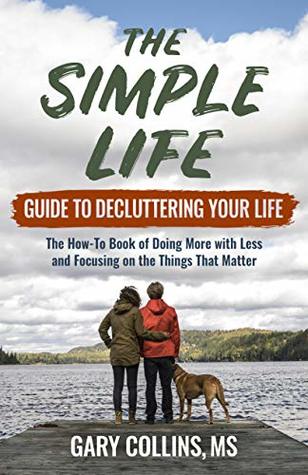
Kindle Notes & Highlights

by
Gary Collins
Read between
May 29 - June 23, 2022

true genius is not the mastery of complexity, but of simplicity.
I rekindled my dream and put my plan into action. I knew I had to start, not only with freeing myself from the consumer lifestyle, but also freeing up my mind to focus on what matters.
This life is as simple as coming up with a plan and putting it into action, instead of waiting for a miracle.
great things come with time and perseverance.
The bottom line is, if you are truly interested in decluttering and simplifying, you are going to have to downsize. More than likely, you will have to downsize big time! It will probably be scary, and even sad to “give up” so much of your stuff. But don’t get Gridlocked by the need for instant gratification. Don’t be one of those people with a convoy of moving trucks lined up outside your house. Don’t try to move immediately from the city to the country or rent multiple storage units to hide your clutter and pretend you got rid of it.
Instead, focus first on where the habit of clutter collection starts. It starts in your mind, and it begins with the simple assumption that owning and keeping things will make you happy. Yes, I know, we all think we’re the exception to this rule. Decluttering starts with being honest with yourself—clutter collection is like overeating. It doesn’t happen on accident, and there’s no way you’d be reading this book if you hadn’t, at some level, bought into the Cult of Clutter dogma.
If we’re honest with ourselves, these are just excuses to hold onto things that we believe are linked to our happiness, whether we’re consciously aware of it or not. In today’s society, having stuff is assumed to equal happiness. Trust me, I followed this mantra with gusto. I bought all kinds of junk I didn’t need—so have many of us. If this sounds familiar, you’re not alone. In fact, you’re probably more normal than you think. You’ve just bought (literally) into the dogma of the Gridmasters. We’ve all done it.
In fact, if you take any young, sane kid and spend the next twenty to thirty years telling them they must do irrational things to make themselves happy, most likely, they’ll do exactly that. Not because they’re abnormal, but because normal people learn habits and beliefs from their environment. By the time those peer-enforced beliefs and behaviors become habits, the person doing them starts to feel like there’s something wrong with them because they can’t make themselves happy like “everyone else” can. So, how do you escape this socially reinforced cycle?
the starting point is realizing that your life, freedom, and happiness means more than your stuff. The idea that stuff will make you happy is one of the “Commandments” of The Cult of Clutter. People who live by this rule become slaves to The Grid. People who leverage this rule by marketing stuff to the rest of us, well, they’re the Gridmasters. Wouldn’t you be more fulfilled by creating experiences, as opposed to acquiring more toys? Stuff-based happiness lasts a very short time. Once it’s over, you need more, and bigger toys to recreate the feeling. The Gridmasters understand this and use it
...more
For me, I just had to realize that less was more. Of course, as is with my health philosophy, the interpretation of less will be different for each individual. But I’d relate it to the second principle of my Simple Life Principles,
material clutter creates mental clutter. More stuff means more responsibility, and not all responsibilities lead to freedom. Some responsibilities become chains around our souls.
Most of us don’t maintain; we upgrade.
we ALL have the capability of being millionaires if we adjust our lifestyle choices.
Did you know that if you’re making a little over $30,000 a year, you’re in the top one percent of income earners in the world? According to the Global Rich List, a website that brings awareness to worldwide income disparities, an income of $32,400 a year will allow you to make the cut. Did you know that if you live in a place where the minimum wage is fifteen dollars an hour, you could make $31,200 a year just by working forty hours every week? By the world’s standards, the poorest people in the United States are considered some of the richest people on the planet!
Change is always painful in the beginning. There is no getting around this. You have to realize you are making a significant life change, and it will be uncomfortable. But all great things in life come with some scrapes and bruises. Remember that you’re making more than a change in your living space. You’re taking what society has told you and turning it upside down. This is going to force a lot of rethinking about what makes you happy. You’ll experience some self-doubt. You’ll get criticism and puzzlement from those around you. The only way to avoid these things is to never make this change
...more
it is easier to solve all your problems when you’re not trapped by your living arrangements, and the mental and emotional clutter created by them. Again, you’ll see what I mean as you start your own journey.
For me, the bottom line was that modern home ownership costs more than money. It forces us into a situation where we can get stuck—sometimes for years, or decades. This is a massive drain on our time and our mental and emotional bandwidth—you can’t put a price on those.
clutter clinging is more about what’s in your mind than it is about what’s in your house.
I have a simple philosophy when it comes to anything in life: Knowledge is power. Positive change is far simpler to accomplish and maintain when you’re armed with correct, in-depth knowledge.
I’ve found that people tend to cling to such information, and even defend it, without ever questioning how they came to believe in it. I’ll show you some examples of such dogma when we talk about how we form emotional attachments to stuff.
this life is more about subtraction than addition,
Small actions repeated over time become habits, and habits shape our lives.
Happy, successful people take action, today and every day. Their lives are an answer to this question . . . “What’s it going to take to stay on track and make progress today?”
Get in the habit of saying, “I want to change (X) in my life. Where do I start, and how do I do it?” I like to call the above “positive change imprinting” I know it sounds really simple, but trust me it works.
Decluttering isn’t a set of practical action steps—it’s a lifestyle. A lifestyle is an expression of what you consistently believe and value.
First, you should remember that your memories will still be there when the thing is gone. Second, you should be focused on creating new happy memories based on experiences and the people you share them with, not based on objects.
I know some of these objects might be things like your childhood teddy bear. Maybe you feel that if you get rid of it you are getting rid of a piece of yourself. I get it. I have been there. But the very fact that you’ve invested that much of your self-image into an object is probably why you were prone to clutter collecting in the first place. This is a habit you’ll want to break.
we have been programmed to be focused on the search and purchasing of items, which do nothing for our overall happiness.
Folks, we don’t just have an obesity problem. We have a full-blown public health epidemic on our hands! If you think this sounds mean or uncompassionate, consider how you’d feel if we were pointing out the amount of people who had another life-threatening condition, like cancer. What if the objective was to draw attention to this devastating disease so people could make better choices and avoid dying young because of it? Well, the National Institutes of Health tells us that obesity (and being overweight) are the second most common cause of preventable death in the United States. Tobacco
...more
Your poor diet and expanding waistline can cause disease. But eating poorly and neglecting exercise is not a disease any more than refusing to file your taxes is a “disease”. We’ve greatly confused cause and effect when it comes to our health and disease.
when considering longevity, we’re not even amongst the top ten countries worldwide. We barely make the top fifty; we’re in fact, ranked a miserable forty-third in the world. The estimated life expectancy of an American is eighty years, which is over nine years less than the country with the longest-living residents: Monaco. When compared to Americans, it’s the citizens of Bermuda, Malta, South Korea, and Jordan (to name only a few examples) who may anticipate a longer life. It’s amazing that we give large sums of financial and military support to a country such as South Korea, yet its citizens
...more
How is it possible that the citizens of countries who are literally decades behind us in terms of technological development live longer than most Americans? Simply put, they take their health far more seriously than we do.
Resistance is a force you’ll definitely encounter when trying to change anything difficult in life. As a matter of fact, it’s likely the most prevalent obstacle you’ll encounter. It would be nice if you could breeze right through life, but that’s not reality. You’re going to have to make some difficult decisions and make some sacrifices. In fact, in his Essay “Compensation” Ralph Waldo Emerson says that most of our problems are caused by our need to separate causes from their effects. And when you set a cause in motion to get healthy, you can bet there will be internal AND external
...more
Here’s a checklist I use every time I want to buy something on impulse: Do I NEED to have this? What problem will this solve for me? How will it improve or make my life easier? Do I need it right now? Can I afford it? Can I live without it? Will it just sit and take up space?
We have five primary senses: touch, smell, taste, hearing, and sight. These are critical survival senses and are used in many different ways. A critical function of these senses is deciphering whether someone is friend or foe. But social media only allows for two of these senses—hearing and sight—and in a very limited manner when compared to a person-to-person setting. In other words, when trying to find a social circle or new friends on social media, you never know what you’re going to get. You’re pretty much flying blind.
Not to mention that there’s a very good, scientific reason people are more likely to act dishonest, or like assholes, over social media. The human brain is fit with a network of neurons called “mirror neurons”. These neurons cause you to, at some level, feel an emotional connection to another person’s suffering or pleasure. It’s as if your mirror neurons are reflecting that person’s experience inside your own mind and nervous system. This is why it’s harder to be cruel to someone in person. Your mirror neurons pick up the hurt in their eyes or on their face, and you literally feel a connection
...more
Now equate that to multitasking and its impact on your mental health. Your brain likes the “sugar-high” of switching between tasks. By the end of the day, or the week, you’re stuck in a traffic jam of half-finished tasks, scattered thoughts, and lingering worries about what you still have to do or might have forgotten to do.
according to Daniel Levitin, McGill University psychology professor and author of The Organized Mind: Thinking Straight in the Age of Information Overload: “We’ve created more information in the last ten years than in all of human history before that.”
America poet T.S. Eliot said, long before we even had computers: “Where is the Life we have lost in living? Where is the wisdom we have lost in knowledge? Where is the knowledge we have lost in information?”
With all the information now available at our fingertips, it’s easy to get distracted and stressed over things that have nothing to do with our freedom or happiness. Why do I care that Kim Kardashian got another butt-enhancing procedure, or that another shady politician just got prosecuted, or in many cases escaped prosecution for crimes you and I would certainly go to prison for? The next thing you know, you’re in the comments section, wasting time and getting spun up emotionally in something that has no bearing on your life.
Consumer-driven holidays are just crazy land to me: We stress ourselves out and spend money most of us don’t have. For what? Who wins during the holidays? The big stores, and companies who could care less whether we enjoy our Christmas. The Holiday shopping season is based on one thing and one thing only . . . to get you to spend money on stuff you and other people don’t even need. It has absolutely nothing to do with happiness. If you can’t be happy sitting down to a nice dinner with your family and friends, exchanging a bunch of stuff isn’t going to change that.
most Americans have no idea how our government works these days. They just pick the side, which they assume aligns with their beliefs and values. What most of them don’t know is that the people they’re voting for probably don’t believe most (or all) of what they claim to believe. I have a saying that I’ve used during interviews when discussing picking sides in politics: How do you want your shit sandwich? Chunky or smooth?
Politicians WANT You to Pick a Side When it comes to staying in power, politicians are smart and devious. By separating us and pitting us against each other, they have greater influence upon us and have a better chance of staying in office.
When it comes to purpose, it’s not about collecting items (as we’re often taught today), it’s about action. Positive action.
Life purpose is found in the greater good—making a difference, no matter how small that difference may be.
