
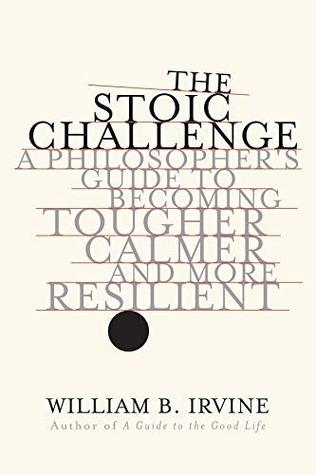
More on this book
Community


Kindle Notes & Highlights

Read between
June 10 - June 22, 2021

Stoic test strategy: when faced with a setback, we should treat it as a test of our resilience and resourcefulness, devised and administered, as I have said, by imaginary Stoic gods.
framing effect: how we mentally characterize a situation has a profound impact on how we respond to it emotionally.
by thinking of setbacks as tests of our character, we can dramatically alter our emotional response to them. We can, in particular, develop our ability to stay calm, even in the face of very significant setbacks, and this in turn can have a dramatic impact on our quality of life.
Their goal was not to remain calm while suffering a setback but rather to experience a setback without thereby suffering. It is an important difference.
One sign of maturity is a realization of the extent to which you, either intentionally or unintentionally, make life difficult for those around you. Consequently, you should keep in mind the words of Seneca: “we are bad men living among bad men; and only one thing can calm us—we must agree to go easy on one another.”
Thoughtful people, by contrast, minimize the number of setbacks they experience by learning how the world works and using this knowledge to plan their activities.
“We cannot always control what happens in our life . . . , but we can always control what we do with what happens.”
Theodore Roosevelt offered this bit of Stoic-inspired advice: “Do what you can, with what you’ve got, where you are.”
When the number of options available is limited, it is foolish to fuss and fret. We should instead simply choose the best of them and get on with life. To behave otherwise is to waste precious time and energy.
This process, now known as negative visualization, is one of the most remarkable psychological instruments in the Stoic tool kit. It is important to realize that in advising us to negatively visualize, the Stoics weren’t advocating that we dwell on how things could be worse; that would indeed be a recipe for misery. Instead, what we should do is periodically have flickering thoughts about how our lives and circumstances could be worse.
Seneca shared this view—“It is not how the wrong is done that matters, but how it is taken”4—as did Marcus Aurelius: “If you are distressed by anything external, the pain is not due to the thing itself, but to your estimate of it; and this you have the power to revoke at any moment.”
Conclusion: if you can bring yourself to laugh at the things that make most people cry, you have a powerful weapon to use against life’s adversities.
In particular, by framing the setback as a test of our resilience and ingenuity, we could not only prevent the onset of negative emotions but transform the setback into a challenge that we might enjoy undertaking.
familiarity breeds comfort: do something scary often enough, and it not only ceases to be scary, it becomes automatic.
Stoics engage in toughness training so they can have a better life.
Since his primary goal in life is to attain and then maintain tranquility, he would spend the time that remained experiencing as few negative emotions as he can, with as little anxiety, fear, anger, and regret as possible. He would do his best to embrace the sources of delight that his life still had to offer. In more general terms, he would regard his dying days as an opportunity to top a good life with a beautiful and fitting capstone.
