
More on this book
Community


Kindle Notes & Highlights


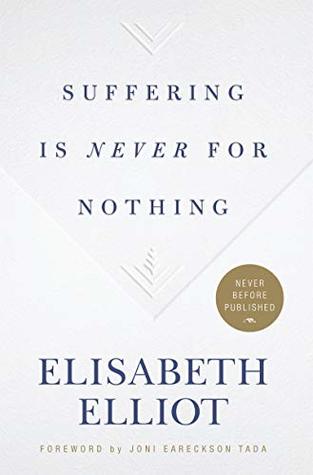
One evening, she came to my hotel room. As Elisabeth sat on the edge of my bed, we opened our hearts and shared how God had remained so faithful to us through so much suffering. We agreed that no one participates in God’s joy without first tasting the afflictions of His Son. And before she left, she smiled and said, “Suffering is never for nothing, Joni.” It was so Elisabethan, and I thought I understood what she meant. After all, nine years of quadriplegia had made me take seriously the lordship of Christ in my life, refining my faith, and giving me a deeper interest in prayer and the Word.
And I’ve come to see that it’s through the deepest suffering that God has taught me the deepest lessons. And if we’ll trust Him for it, we can come through to the unshakable assurance that He’s in charge. He has a loving purpose. And He can transform something terrible into something wonderful. Suffering is never for nothing.
I’m convinced that there are a good many things in this life that we really can’t do anything about, but that God wants us to do something with.
“Suffering is having what you don’t want or wanting what you don’t have.”
Malcolm Muggeridge said, “Supposing you eliminated suffering, what a dreadful place the world would be because everything that corrects the tendency of man to feel over-important and over-pleased with himself would disappear. He’s bad enough now, but he would be absolutely intolerable if he never suffered.”
The deepest things that I have learned in my own life have come from the deepest suffering. And out of the deepest waters and the hottest fires have come the deepest things that I know about God.
if we don’t ever want to suffer, we must be very careful never to love anything or anybody. The gifts of love have been the gifts of suffering. Those two things are inseparable.
And it has been out of that very measure of pain that has come the unshakable conviction that God is love.
And so, we come back again to the terrible truth that there is suffering. The question remains, is God paying attention? If so, why doesn’t He do something? I say He has, He did, He is doing something, and He will do something. The subject can only be approached by the cross. That old, rugged cross so despised by the world. The very worst thing that ever happened in human history turns out to be the very best thing because it saved me. It saves the world. And so God’s love, which was represented, demonstrated to us in His giving His Son Jesus to die on the cross, has been brought together in
...more
Janet Erskine Stuart said, “Joy is not the absence of suffering but the presence of God.”
Suffering is an irreplaceable medium through which I learned an indispensable truth.
fact, C. S. Lewis said, “God whispers to us in our pleasures, speaks in our conscience, but shouts in our pain: it is His megaphone to rouse a deaf world.”
You see Job here dialoguing with God. There is no question in Job’s mind throughout this entire book of the existence of God. He knows that it is God with whom he has to reconcile his circumstances. Somebody is behind all this, he’s saying. And the question “why” presupposes that there is reason, that there is a mind behind all that may appear to be mindless suffering. We would never ask the question why if we really believed that the whole of the universe was an accident and that you and I are completely at the mercy of chance. The very question why, even if it is flung at us by one who calls
...more
We would never ask the question why if we really believed that the whole of the universe was an accident and that you and I are completely at the mercy of chance.
And C. S. Lewis says in his book, The Problem of Pain, “Man is now a horror to God and to himself and a creature ill-adapted to the universe not because God made him so but because he has made himself so by the abuse of his free will.”7 And Lewis goes on to state this knotty problem in its simplest form. “If God were good, He would wish to make His creatures perfectly happy, and if God were almighty He would be able to do what He wished. But the creatures are not happy. Therefore, God lacks either goodness, or power, or both.”
So, answering the question depends upon our definition of good. An ancient man thought of goodness in moral terms. Modern man equates good with happiness. If it ain’t fun, it ain’t good. The two things almost seem to be mutually exclusive. They put it the other way around, if it’s good, it ain’t fun. There’s a commercial I’ve seen recently for some kind of cereal with two little kids who have heard that it’s natural and it’s good for you. So they said, “Well let’s get him to try it. He’ll eat anything. He doesn’t know it’s good for you.” So the little kid eats it because he doesn’t know any
...more
I love that old hymn by Richard Baxter, “Christ leads me through no darker rooms than He went through before.”
But I’ve read the wonderful letters of Samuel Rutherford, that Scottish preacher from the seventeenth century who seems to have been through just about every imaginable human mill, and he had lost at least one child and I had his letter in my study. And so I looked up one of his letters to a woman who had lost a child. And this is what he wrote to her, so I quoted these words to Phil and Janet after saying to them that I didn’t know what you’re going through but I know the One who knows, and then I sent them Samuel Rutherford’s words. This is what he said after losing two daughters: “Grace
...more
Back when I was a college student, I was dabbling around in poetry, as I suppose most teenage girls do at some point. I wrote some words that later on seemed to me to be almost prophetic. I wrote these words and I really don’t remember exactly whether there was any particular reason why I wrote them at the time, but something had given me a clue that there could be some loneliness ahead for me. So these were the words that I wrote, Perhaps some future day, Lord, Thy strong hand will lead me to the place where I must stand utterly alone. Alone, O gracious lover, but for Thee. I shall be
...more
There’s an old legend, I’m told, inscribed in a parsonage in England somewhere on the sea coast, a Saxon legend that said, “Do the next thing.” I don’t know any simpler formula for peace, for relief from stress and anxiety than that very practical, very down-to-earth word of wisdom. Do the next thing. That has gotten me through more agonies than anything else I could recommend. And when I found out that my husband was dead, I had gone out to the missionary aviation base in a place called Shell Mera, the edge of the jungle, to be with the other four wives as we waited for word about our
...more
This highlight has been truncated due to consecutive passage length restrictions.
You either believe God knows what He’s doing or you believe He doesn’t. You either believe He’s worth trusting or you say He’s not. And then, where are you? You’re at the mercy of chaos not cosmos. Chaos is the Greek word for disorder. Cosmos is the word for order. We either live in an ordered universe or we are trying to create our own reality.
Amy Carmichael, missionary to India who’s biography I wrote called A Chance to Die, told how when she was growing up in a little village in Northern Ireland, they not only immediately stretch forth their hand for the spanking which was given by a small paddle called a pandy, but they had to say thank you, mother.
gratitude and acceptance should distinguish the Christian.
How to deal with suffering of any kind. Number one, I wrote, “Recognize it.” Number two, “Accept it.” Number three, “Offer it to God as a sacrifice.” And number four, “Offer yourself with it.”
Now there are a good many circuitous routes to learning to know God. But there are some shortcuts. And I’m here to suggest that gratitude is one of those shortcuts. Just start thanking God in advance because no matter what is about to happen, you already know that God is in charge. You are not adrift in a sea of chaos.
So, what is your place of need today? Has the wine run out? Are you hungry? Is it something more desperate like the man who had been crippled for thirty-eight years or the child who had died or the widow who had lost her only son or the baby born blind or the storm that came up when the disciples thought they were perishing? What is your place of need? Where is Jesus putting His finger in your life today? Maybe there is an unanswered prayer that you have been battering away at God’s door for years about, and it just seems as though He’s not paying attention. Maybe there’s some deep resentment
...more
Forgiveness is for real offenses. It’s not like saying, “excuse me” when you step on somebody’s toe by accident. “Excuse me” is one thing. But “forgive me” is for real offenses. And Jesus comes into our lives in these places of need. And if we recognize Him because of our need, then we can receive whatever it is that He is prepared to offer us whether it’s the grace of forgiveness or the patience to wait for the answer to that prayer or healing or serenity in the midst of the worst times of your life. Whatever it is, you can receive it and say, “Thank You, Lord.”
I have never thanked God for cancer. I have never thanked God specifically that certain Indians murdered my husband. I don’t think I need to thank God for the cancer or for the murder. But I do need to thank God that in the midst of that very situation the world was still in His hands. The One who keeps all those galaxies wheeling in space is the very hand that holds me. The hands that were wounded on the cross are the same hands that hold the seven stars. The hands that were laid on old John when he was the...
This highlight has been truncated due to consecutive passage length restrictions.
At the beginning of this chapter, I referenced that I was going to tell you three things relevant to gratitude in the midst of suffering, and I don’t think I’ve specified what that third thing is, but I’ve already said it. The first thing was that gratitude and acceptance distinguish the Christian. The second was that gratitude honors God. And the third principle relevant to gratitude in the face of suffering comes from the second half of the same verse I referenced earlier, Psalm 50, verse 23. “He who brings thanksgiving as his sacrifice honors me; to him who orders his way aright I will show
...more
This highlight has been truncated due to consecutive passage length restrictions.
I close this chapter with one more verse from the Psalms, specifically, Psalm 55:22, “Cast your burden on the Lord and He shall sustain you” (nkjv). To my amazement and delight I discovered that that word burden in the Hebrew is the same word as the word for gift. This is a transforming truth to me. If I thank God for this very thing which is killing me, I can begin dimly and faintly to see it as a gift. I can realize that it is through that very thing which is so far from being the thing I would have chosen, that God wants to teach me His way of salvation. I will take the cup of salvation and
...more
You’re familiar with Paul’s word from Romans 12:1, “I beseech you, therefore, brethren, by the mercies of God, that ye present your bodies a living sacrifice, holy, acceptable unto God, which is your reasonable service” (kjv). I particularly like the KJV translation as it translates that last phrase as “an act of intelligent worship.” Now if I present to God my body as a living sacrifice then that includes everything that the body contains—my brains, my personality, my heart, my emotions, my will, my temperament, my prejudices, my failings, all the rest of it—is presented to God as a living
...more
I remember when I was a little girl wanting to buy Christmas presents for my parents and I had no way at all of earning money. My brothers had paper routes and earned maybe twenty-five cents a week or something like that back in the Depression days. But I had to depend on an allowance. So I would have had absolutely nothing to give to my mother for Christmas if my mother hadn’t given something to me first. That’s the way it is with us with God, isn’t it? We are totally destitute. Everything that we have comes from Him and we have nothing to offer except what He has given us.
This lesson became a powerful, life-changing, transforming lesson during the time of my husband’s illness. I would awaken in those wee small hours of the night—which Amy Carmichael calls the hours when all life’s molehills become mountains—my mind would be filled with vivid imaginings of the horrible things that were going to happen to my husband between then and death.
Amy Carmichael, a single woman, became the mother of thousands of Indian children. There was a time when the family that she founded as a Dohnavur Fellowship—little children, rescued from temple prostitution—that family numbered over 900 people at one time. And she worked there for fifty-three years. And she wrote these words in one of her poems, “If Thy dear home be fuller, Lord, for that a little emptier my house on earth, what rich reward that guerdon20 were.” You and I have no idea what God has in mind when we make the offering. But everything is potential material for sacrifice.
I have never forgotten what a missionary speaker said in chapel when I was a student. We had compulsory chapel five days a week at Wheaton College. So we heard hundreds of speakers and remembered practically nothing of most of them. But I have never forgotten what this woman said. She spoke about the little boy bringing his lunch to Jesus. And she said, “If my life is broken when given to Jesus, it may be because pieces will feed a multitude when a loaf would satisfy only a little boy.”
When my brother, Tom, was a little boy about three years old, one of his favorite forms of play was to take all the paper bags out of the drawer in the kitchen where my mother kept them and spread them all over the floor. Well, my mother permitted that with Tom. He was number five. I was number two. And I don’t think I would have gotten away with it. But she’d learned a lot of things by that time and I’m sure she was tired. She told him that he could do that on one condition, that he put the bags back in the drawer before he left the kitchen. Well, he understood that perfectly well. Children
...more
Let me ask you, who are the people who have most profoundly influenced your life? Those who have most profoundly influenced my life are without exception people who have suffered because it has been in that very suffering that God has refined the gold, tempered the steel, molded the pot, broken the bread and made that person into something that feeds a multitude—of whom I have been one of the beneficiaries.
I once received a wonderful letter from a woman, an older woman who told me back when she was a little girl in the Depression that her father had died. None of his friends came to the funeral. She had to wear a borrowed dress. The house was mortgaged. Her mother was left a widow with seven children. And the lawyer who was supposed to be handling her financial affairs stole the inheritance. And the lady said this, when we went back to the house after the funeral, my mother picked up a broom and began to sweep the kitchen. And she said I look back on that now and I realize that it was the soft
...more
Back in 1820 there was a little six-week-old baby who had an inflammation of the eyes. And the doctor applied hot poultices and burned the corneas so that the child was blind for life. When she was nine years old she wrote these words, “O what a happy soul am I although I cannot see. I’m resolved that in this world contented I shall be. So many blessings I enjoy that other people don’t. To weep and sigh because I’m blind, I cannot nor I won’t.”22 And that little girl grew up to write 8,000 hymns—among them, “To God Be the Glory,” “Blessed Assurance,” “Rescue the Perishing,” “Face to Face.” Her
...more
Isaiah 58:10–11, “If you pour yourself out for the hungry and satisfy the desire of the afflicted, then shall your light rise in the darkness and your gloom be as the noonday. And the Lord will guide you continually, and satisfy your desire with good things, and make your bones strong; and you shall be like a watered garden, like a spring of water, whose waters fail not” (rsv).
In closing, I want to give you a poem written by Grant Colfax Tuller. “My life is but a weaving between my Lord and me; I do not choose the colors, He worketh steadily. Oft times He weaveth sorrow and I, in foolish pride, forget He sees the upper, and I the under side. Not till the loom is silent and the shuttles cease to fly, shall God unroll the canvas and explain the reason why. The dark threads are as needful in the Weaver’s skillful hand, as the threads of gold and silver in the pattern He has planned.”24
