
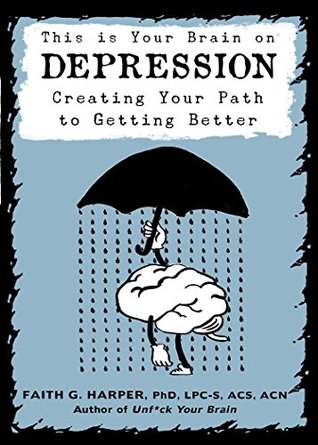
More on this book

Kindle Notes & Highlights

Read between
July 28 - August 8, 2022

What is depression? Depression is a biochemical learned helplessness response to stress.
Robert Sapolsky, the brilliant stress researcher who wrote Why Zebras Don’t Get Ulcers, defines depression as “a genetic-neurochemical disorder requiring a strong environmental trigger whose characteristic manifestation is an inability to appreciate sunsets.”
Many, many, many diseases, however, are lurking in our DNA and can be turned on by the right conditions. The super fancy term for this is epigenetics.
And when we start to feel like shit, we spiral down even more, which reinforces the disconnect in the neuron convos. So our brains start to think that nothing is controllable, fixable, or ever gonna be good again. I’m gonna refer to this tendency as the depression funnel.
The slide down happens when we get busy and we give up the things we deem nonessential, like healthy food and body movement, even though those are the things that nourish us the most.
The problem is, the optional things are the things that most nourish us. So, we funnel into a narrower and narrower way of living as we are depleted more and more. Eventually the only things left are the stressful things we should attend to, rather than the things that give us joy.
But, I so want you to know that you are not your diagnosis.
Remember all the stuff about depression being a biochemical learned helplessness response? This means that depression by its very definition is a piece of shit who is going to try to gaslight you into thinking that (1) everything is hopeless and (2) treatment is a waste of time because nothing will work.
Depression can be tamed, leashed, and trained to not dominate every waking moment of your existence. Just like any other chronic disease.
The World Health Organization confirmed a long-term study showing that in third world countries where antipsychotic medications are not even available, recovery rates were actually higher. Because if the medications weren’t available, they couldn’t be the focus of treatment. So the causes were treated, giving people a sense of meaning and community. And then they got better.
Medications help adjust brain chemistry and manage the symptoms that we are struggling with. They give us the life jacket we need to stay in the game and build other coping skills and mechanisms of healing.
having your out-breath be longer than your in-breath, which calms your vagus nerve.
You simply breathe in for five, hold for eight, and blow out for nine.
But the research of depression recurrence shows that there are two certain things that we do have control over that can really impact our ability to manage depression and keep really bad depressive episodes from recurring, coming back as frequently, or being as severe as they could be. These two things are what the National Institute of Health calls cognitive vulnerability and neuroticism.
Cognitive vulnerability means that you attribute negative shit happening (clinical term: “Stressful Life Events” [SLEs]) as somehow indicative of who you are as a person.
Neuroticism is more general. It means, essentially, that your default mode is negative.
But in a clinical sense, people who lean toward the nervous and sensitive end of the scale are the people who are just more raw and vulnerable to the world.
Pay attention to the number of spoons you have. Look at what costs you spoons and what helps you build more spoons. This will help you make your best self-care decisions.
I will try to identify what is specifically upsetting me.
I will review the thoughts and conclusions I have made to see if I am being plagued by any distorted thinking styles.
I will do something that I enjoy and that helps me feel better for 30 minutes.
When we start becoming mindful of when we start funneling down by noticing when our self-care lapses and our symptoms start getting worse, we are far more successful at heading off another depressive episode.
Once you have a good idea of what your personal funnel behaviors look like, create a new list with tools to battle each of them.
You are not defined by your depression. You are not weak, and you didn’t do anything wrong. You didn’t deserve this. You are not being punished. You hit the perfect storm of genetics + trigger and are now dodging and weaving while running your ass off toward the right end zone.
They are survivors, fighting back against brain chemistry that is entirely at odds with all the things that make life worth living.
Other Supportive Supplements: Tryptophan (helps depression and sleeplessness), B12 (helps increase energy), GABA (helps manage anxiety), and trace minerals (helps manage irritability).
