
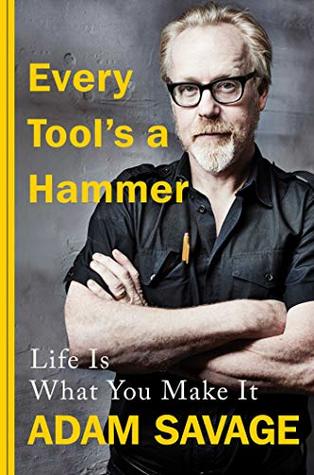
More on this book
Community


Kindle Notes & Highlights


Whenever we’re driven to reach out and create something from nothing, whether it’s something physical like a chair, or more temporal and ethereal, like a poem, we’re contributing something of ourselves to the world. We’re taking our experience and filtering it through our words or our hands, or our voices or our bodies, and we’re putting something in the culture that didn’t exist before.
Putting something in the world that didn’t exist before is the broadest definition of making, which means all of us can be makers. Creators.
nothing we make ever turns out exactly as we imagined; that this is a feature not a bug; and that this is why we do any of it. The trip down any path of creation is not A to B. That would be so boring. Or even A to Z. That’s too predictable. It’s A to way beyond zebra. That’s where the interesting stuff happens. The stuff that confounds our expectations. The stuff that changes us.
When we say we need to teach kids how to “fail,” we aren’t really telling the full truth. What we mean when we say that is simply that creation is iteration and that we need to give ourselves the room to try things that might not work in the pursuit of something that will. Wrong turns are part of every journey. They are, as Kurt Vonnegut was fond of saying, “dancing lessons from God,” and the last thing we want to do is give our kids two left feet.
the first law of thermodynamics: an object at rest tends to stay at rest unless acted upon by an outside force. Which is to say, to get started you need to become the outside force that starts the (mental and physical) ball rolling, which overcomes the inertia of inaction and indecision, and begins the development of real creative momentum.
Obsession is the gravity of making. It moves things, it binds them together, and gives them structure. Passion (the good side of obsession) can create great things (like ideas), but if it becomes too singular a fixation (the bad side of obsession), it can be a destructive force.
There is a belief among many of these types, that to jump with both feet into something like that is to play hooky from the tangible, important details of life. But I would argue—and have—that these pursuits are the important parts of life. They are so much more than hobbies. They are passions. They have purpose. And I have learned to pay genuine respect to putting our energy in places like that, places that can serve us, and give us joy.
A screenwriter’s way of seeing is a special thing. They have a unique type of brain, one that filters the world it experiences entirely through narrative and has, over time, become a highly tuned machine in the service of character construction, world building, and plot layering. Screenwriters are basically human 3-D printers for story.
“To believe your own thought, to believe that what is true for you in your private heart is true for all men—that is genius.”
But what does that mean, to go deep? As a maker, it means interrogating your interest in something and deconstructing the thrill it gives you. It means understanding why this thing that has captured your attention has not let go, and what about it keeps bringing you back. It means giving yourself over to your obsession.
I think Kubrick wants us to understand that the tragedy of war is that it’s often envisioned by idiots and executed by professionals.
If impatience is my biggest sin as a maker, its primary manifestation has been in my continual struggle with addressing my work. In this context, addressing your work means orienting yourself, physically and mentally, in the optimal position to execute the task, despite the fact that it might take a little longer. It means taking the time you need to do the job right the first time. Taking the time to organize your thoughts; to organize your work space; to organize your tools. It’s time, when taken, that you might feel is slowing you down in the moment, but in fact is saving you time in the
...more
Kurt Vonnegut was fond of saying, “Travel plans gone astray are dancing lessons from God.”
Isaac Newton once said, “If I have seen further it is by standing on the shoulders of giants.”
