
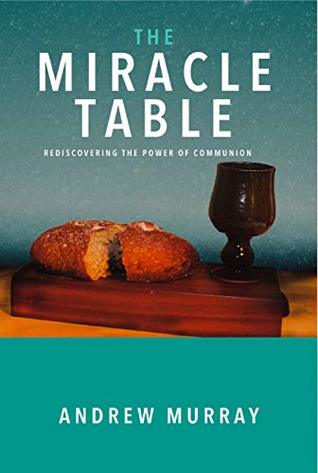
More on this book


Kindle Notes & Highlights

Read between
November 11 - November 26, 2025

Is there something that we are missing when we break bread? Are there some things that we need to re-discover?
I believe that joy around the Communion Table is undoubtedly something that we need a revival of. As I read Scripture I always see the Bread and Wine associated with joy. I read of a joyful Saviour who invited people to a Kingdom centred around a joyful wedding banquet. I see an early Church that broke bread with joy. I see a call to remember the joy of our salvation and an invitation to fellowship with the One in whose presence there is fullness of joy.
“Christ held Himself in His hands when He gave His Body to His disciples saying: “this is My Body.” No one partakes of this Flesh before he has first adored it.” - St. Augustine
Thanksgiving is the starting point of communion. We will only go as deep into the presence of God as much as we have first given thanks.
The word Eucharist has been used by some denominations to refer to the act of the giving and receiving of the sacraments themselves, but Eucharist comes from the Greek noun which means thanksgiving. Eucharist is not meant to be the act of eating and drinking, but rather the attitude in which we eat and drink. We are meant to approach the Communion Table with a heart bursting with thankfulness and praise.
Twice John refers to Jesus giving thanks as He broke bread. Why would he mention this twice? Is he showing us a principle: this is how you break bread. You do so with a heart of thankfulness.
He gave thanks for the bread. He gave thanks for the wine.
In all of these scriptures the Greek word Eucharisteo is used, which is where we get our word Eucharist from. It effectively means three things - to be thankful, to feel grateful, and to give thanks. Just pause for a moment and think about that. To be. To feel. To give. To be - we are grateful. This is who I am, my identity as I approach the Table. I am thankful, I am grateful for all that Jesus has done, all that the Father gave, all that is available through the Spirit. To feel - this is not just a cold, religious ceremony. I feel something. My heart has been set on fire with this love
...more
This highlight has been truncated due to consecutive passage length restrictions.
Communion was not just meant to be a private act of devotion, but a public demonstration of praise.
The highpoint of our praise should be the Lord’s Table. It should be the most passionate, and powerful time of praise in our church services.
In our public gatherings the act of Communion is meant to be a game changer. As the saints gather around the Lord’s Table the atmosphere in the service should change. Things should feel different, even smell different (spiritually speaking), as there has been a shift, heavenly perfume has been released. Something has filled the house that wasn’t there before.
Communion is meant to be about praise! It is meant to be about thanksgiving. It should be the highlight of every public gathering
Those who truly get the Lord’s Table may even be accused of being too excessive and over the top by those who don’t understand the value God places on communion. After all, Mary’s act of worship was considered a waste by others. But to Jesus it was a beautiful thing. May we all provide the Lord with beautiful moments of worship at His Table.
According to Paul, true worship is more than just singing songs, it is living a life of consecration in surrender to God.
It is important to note that it is the “Lord’s” Table. At the Table, He is the Friend of Sinners who welcomes all, but He is also the Lord. He is the One who demands my allegiance, my worship, and my very life.
One of the greatest examples is found in Acts 27. In this chapter, Paul is on a ship that goes through a powerful hurricane. The Bible tells us that they took a ‘violent battering.’ They go on to throw their cargo overboard. All is in darkness as they see neither sun or stars for many days. They reach the point of giving up all hope of being saved. (v20) I wonder if Paul’s situation can sometimes describe our lives? Do you ever feel like you are being tossed about by the circumstances of life? Do you ever feel like you are losing everything of value? Do you ever feel like you are going
...more
This highlight has been truncated due to consecutive passage length restrictions.
“I hunger for the bread of God, the flesh of Jesus Christ. I long to drink of His blood, the gift of unending love.” - St. Ignatius of Antioch
the Lord’s Table is a looking back to the death of Jesus and the covenant made in His blood. The Lord’s Table is also about encountering the risen Saviour in the here and now. However, the Lord’s Table is also a looking forward – ahead, to the return of the King of King’s and the Lord of Lord’s.
As J. Todd Billings puts it, ‘The Lord’s Supper, as a foretaste of the Wedding Banquet of the Lamb and His Bride, gives us a taste of God’s new world.’
Every time we approach the Lord’s Table we should do so with a ravenous appetite and a desperate thirst; hungry for a taste of Him and thirsty for His presence, longing to meet and commune with our God. We come hungry and thirsty, trusting the promises of the Bible that those who hunger and thirst for righteousness shall be filled, (Matthew 5:6) and that He satisfies the thirsty and fills the hungry with good things. (Psalm 107:9)
