
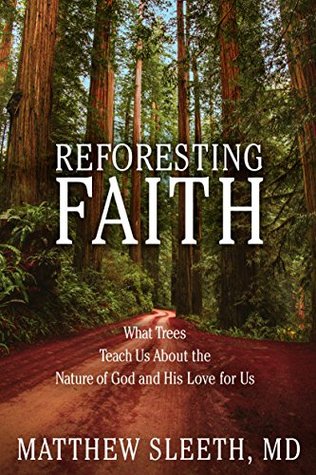
More on this book
Community


Kindle Notes & Highlights

Read between
January 16 - June 19, 2022

Christianity is the only religion that weaves trees from one end of its sacred text to the other. Every important character and every major event has a tree marking the spot. There is a tree in the first and last chapter of the Bible, in the first psalm, and in the first gospel.
This year will we see the trees? Will we heed the call to protect them? Will we plant the small tree today that the next generation will climb and the following one will find shade under? Will we plant in faith? Will we be called “oaks of righteousness” (Isaiah 61:3)?
The land produced vegetation—all sorts of seed-bearing plants, and trees with seed-bearing fruit. Their seeds produced plants and trees of the same kind. And God saw that it was good. —GENESIS 1:12, NLT
Science, as powerful as it is, can’t even define evil, much less distinguish between right and wrong.
Right away I recognized that Jesus was unlike any person I’d ever met. He was both more human and more godly than anyone I’d known.
Other than God and people, the Bible mentions trees more than any other living thing. There is a tree on the first page of Genesis, in the first psalm, on the first page of the New Testament, and on the last page of Revelation.
Jesus said, “I am the true vine, and my Father is the vinedresser” (John 15:1). The wisdom of the Bible is a tree of life (Proverbs 3:18). We are told to be “like trees planted by streams of water, which yield their fruit in its season” (Psalm 1:3, NRSV).
Noah received the olive leaf (Genesis 8:11), Abraham sat under “the oaks of Mamre” (18:1), and Moses stood barefoot in front of the burning bush (Exodus 3:2–5). At first glance Joseph might appear to be an exception, but the Bible tells us that Joseph simply is a tree (Genesis 49:22).
Zacchaeus climbing the sycamore fig (Luke 19:1–4), the blind man seeing people as if they were trees walking (Mark 8:24), and the disciples gathering on the Mount of Olives (Luke 22:39). The apostle Paul asserted that if we have gone for a walk in the woods, we are without excuse for knowing God (Romans 1:20). Paul also wrote that Christians are like branches grafted into Israel’s tree trunk, with roots that help us stand fast and firm no matter what troubles come our way (11:17–18).
Jesus himself declared that the kingdom of heaven is like a tree (Matthew 13:31–32). The only thing that Jesus ever harmed was a tree (Mark 11:12–14, 20–21), and the only thing that could harm him was a tree. After Jesus was resurrected, he was mistaken for a gardener (John 20:15).
Jesus is the new Adam who has come to redeem all of creation. Heaven is a place where the leaves of a tree heal all the nations (Revelation 22:1–2).
Jesus’s last “I am” statement is “I am the root and the descendant of Dav...
This highlight has been truncated due to consecutive passage length restrictions.
In the 1611 King James Version of the Bible, the words tree, leaf, branch, root, fruit, and seed occur 967 times.
The tally is 230 fewer times in the English Standard Version (ESV); 267 fewer times in the New International Version (NIV); and 274 fewer times in the New Living Translation (NLT).
glance at a few of Charles Spurgeon’s sermon titles indicates what people were hearing from the pulpit during the mid- to late 1800s. His sermons included “Christ the Tree of Life,” “The Trees in God’s Court,” “The Cedars of Lebanon,” “The Apple Tree in the Woods,” “The Beauty of the Olive Tree,” “The Sound in the Mulberry Trees,” and “The Leafless Tree.”
The logical conclusion of dualism is that God made himself corrupt simply by taking on the form of matter—human flesh.
One does not have to be a systematic theologian to ask this: “If the spiritual is superior to the material, why did God love the earth so much that he sent his only Son to save it?” The most dangerous consequence of this heresy is that it prevents us from hearing God speak to us through our everyday interactions with his creation.
In our solar system alone, the odds of being an atom in a living thing are incalculably small—something on the order of one in 3,500 trillion. As we push beyond our solar system deeper into space, the odds drop dramatically.
God chose a tree as his symbol of life. The largest and longest-lived form of life on the earth is a tree. Whether dead or alive, trees are always supporting life. It is not surprising then that the author of life would put a tree at the beginning, middle, and end of his message to us, the Bible.
Nonetheless, we need to establish parameters around Bible passages we consider metaphor and content we take literally. When Jesus promised that if we have the faith of a mustard seed we could move mountains (Matthew 17:20), he was not saying people could levitate Mount Sinai.
“God,” they reasoned, “doesn’t experience time as we do.” As proof they pointed to lines of Scripture such as, “With the Lord one day is as a thousand years, and a thousand years as one day” (2 Peter 3:8). “God,” they postulated, “lives outside of time.”
God said, Let the earth bring forth grass, the herb yielding seed, and the fruit tree yielding fruit after his kind, whose seed is in itself, upon the earth: and it was so. And the earth brought forth grass, and herb yielding seed after his kind, and the tree yielding fruit, whose seed was in itself, after his kind: and God saw that it was good. (Genesis 1:11–12, KJV)
God said, Behold, I have given you every herb bearing seed, which is upon the face of all the earth, and every tree, in the which is the fruit of a tree yielding seed; to you it shall be for meat. And to every beast of the earth, and to every fowl of the air, and to every thing that creepeth upon the earth, wherein there is life, I have given every green herb for meat: and it was so. And God saw every thing that he had made, and, behold, it was very good. And the evening and the morning were the sixth day. (1:29–31, KJV)
The LORD God formed man of the dust of the ground, and breathed into his nostrils the breath of life; and man became a living soul. And the LORD God planted a garden eastward in Eden; and there he put the man whom he had formed. And out of the ground made the LORD God to grow every tree that is pleasant to the sight, and good for food; the tree of life also in the midst of the garden, and the tree of knowledge of good and evil. (2:7–9, KJV)
The LORD God took the man, and put him into the garden of Eden to dress it and to keep it. And the LORD God commanded the man, saying, Of every tree of the garden thou mayest freely eat: But of the tree of the knowledge of good and evil, thou shalt not eat of it: f...
This highlight has been truncated due to consecutive passage length restrictions.
Trees/chlorophyll provide all the energy for animals (1:29–30). God planted a garden filled with trees as a place in which humans could live (2:8). Trees are “pleasant to the sight” (2:9). The tree of life is a symbol of human access to God (2:9). Humanity’s first job was to dress (take care of) and keep (preserve) the trees (2:15). Humanity is given moral agency through the tree of the knowledge of good and evil (2:16). Without humans, trees would manage just fine. Without trees, people would perish.
If you’ve ever seen mist rising off a sunlit cliff face in the morning, you’ll understand where this theory originated. Not until the 1770s was the link between trees and breathing discovered. Scientists found that a mouse in a sealed jar with plants inside and placed in the sunlight was a happy mouse. They also found that the mouse died if either the sun or the plants were taken away. The sun-plant-animal oxygen connection was discovered.
God blew the breath of life into Adam’s nostrils and in the next motion pivoted and planted trees. At the level of respiration, humans and trees share an eerily similar architecture. This similarity wasn’t established until the age of plastics, which allowed anatomists to make a cast of the tubes leading into a human lung. A bronchogram, or a cast, of our respiratory “tree” is indistinguishable from the shape of a bare oak tree.
Genesis 2:7 states, “The LORD God formed man of the dust of the ground” (KJV). It’s estimated that all the carbon, iron, calcium, and other elements necessary to make a human would cost $4.50 if ordered from a chemical supply house. The image of God’s forming Adam from the dust is not only poetic but also accurate: humans are dirt cheap. The value of a human, however, is not derived from the elements we’re made of. We are jars of clay containing something priceless. It’s the initial breath from God that makes the difference.
Trees have a way of bridging generations, connecting us with the past and inviting us to dream of the future. When we plant and tend trees, we imitate God.
“good.” It is a tree of justice, beauty, truth, love, light, and righteousness. While in the garden, Adam and Eve ate freely from the tree of life. To eat from, be grafted into, or take hold of this tree is to obtain everlasting life. Thus, by definition, the tree of life stands for Christ. The rest of the Bible—and this book—centers on the tree of life.
God put the poisonous tree in the middle of the garden, where Adam and Eve couldn’t mistake it. “This tree will kill you the minute you eat from it,” God warned. He then offered some helpful advice: “The tree of life is always here right beside temptation—just to remind you.” Beside every bad decision in life, there is a good alternative.
Before the Fall, God, Adam, and Eve met up on a regular basis. But not on the day of the Fall. That’s the day they stood him up. For the first time, we no longer sought God; God had to come looking for us (Romans 3:11).
In one sense, mortality was a blessing rather than a curse. Can you imagine being born on a planet where fallen humanity lived forever? Today, the eight wealthiest people on the earth have more money than the least wealthy 3.6 billion put together.
When sin entered the world, it affected all of creation, not just humanity. Every time we clear-cut a forest or destroy a species, we continue the legacy of the Fall.
After you’ve had dozens of questions answered, you begin to realize that the Bible is all about seeking truth, finding the answers, and having the truths change the course of your life. Proverbs 3:18 says the Bible’s wisdom is a tree of life: “Happy are those who hold her tightly” (NLT). The first psalm says those who pursue the Bible’s wisdom eventually become like fruit-bearing trees, growing leaves that never wither (verse 3).
When you spot a tree in the Bible, you can be confident that heaven is on the way—even though the character in Scripture may have no idea. When you see a tree, branch, bush, root, or fruit on the page, look for God.
In one sense anything we give to God is like offering the owner of the beach a grain of sand. God’s approval is based on the spirit in which a gift is given. One of God’s all-time favorite gifts was the offering of two coins given by a poor widow (Mark 12:41–44).
If we examine our own histories, we’ll find that the apple has not rolled far from the tree. Have you ever caught a glimpse of Cain in the mirror when you are brushing your teeth, shaving, or putting on makeup? How about when a friend gets an award or promotion and you don’t? Do you rejoice for your friend, or do you feel jealous? Any sibling rivalry?
“God saw that the wickedness of man was great in the earth, and that every imagination of the thoughts of his heart was only evil continually” (Genesis 6:5, KJV).
If you see a dove in a religious painting, the artist is likely representing the presence of the Holy Spirit.
top of many religious paintings from the Middle Ages through the Renaissance; they are the artist’s shorthand for God.
A rainbow is all the light we can see symbolizing a God we cannot see.
One of the names for Jesus is the Christ, which means “the Anointed One.” Jesus called himself
The dove, rainbow, and olive leaf represent the Trinity: God the Holy Spirit, God the Father, and God the Son.
Genesis 18: Abraham was dozing against the door of his tent pitched in the shade of a spreading oak.
Abraham was brave, except when he cowered. He was honest, except when he told half lies to save his own skin. He obeyed the Lord, except when he went off on his own to do things his own way. But Abraham always came back to the Lord.
God selected Abraham to occupy the place at the root of faith’s tree. I think of the huge oak giving shade to Abraham and Sarah as the tree of hospitality. It’s also called the Oak of Mamre.
Because of his bravery and wisdom, Abraham increasingly held sway over leaders in the area. Eventually, one of the local kings asked Abraham to enter into a peace treaty. Afterward, Abraham planted trees. This is the first record in the Bible that a human planted trees. Abraham paired his tree planting with an act of faith: “Abraham planted a grove in Beersheba, and called there on the name of the LORD, the everlasting God” (Genesis 21:33, KJV).
If you plant trees to celebrate important events—such as the birth of a child, the passing of a loved one, a friend’s coming to faith, or the marriage of a family member—rest assured, you are in good company.
