
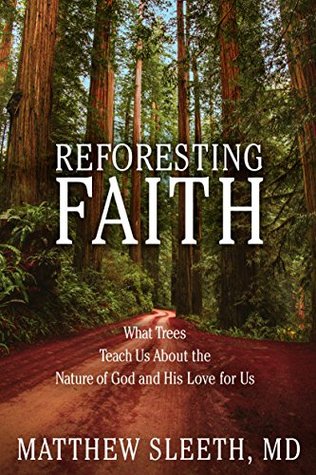
More on this book
Community


Kindle Notes & Highlights

Read between
August 4 - August 5, 2020

Every tree has its enemy, few have an advocate. —J. R. R. TOLKIEN
The smell of a pine forest on a hot day, the sound of palms clattering in a tropical breeze, the sight of yellow maple leaves raining down through an autumn sky—these are all evidence of trees giving praise to their Creator.
Other than God and people, the Bible mentions trees more than any other living thing.
Trees are not randomly placed in Scripture. They mark the most important events, including the Creation, the Fall, the Crucifixion, and the Resurrection. This is not a coincidence. The Bible is one interwoven book, written by one God.
God chose a tree as his symbol of life. The largest and longest-lived form of life on the earth is a tree. Whether dead or alive, trees are always supporting life. It is not surprising then that the author of life would put a tree at the beginning, middle, and end of his message to us, the Bible.
God spoke everything into existence. Whether this happened in a week or over eons I leave up to you. In my discussion of Genesis, I’ll use the language of one week. Feel free to substitute generations or a day as you see fit. The goal of this book is not to identify the age of rocks but to find out why the Rock of Ages planted so many trees in the Bible. We know this much: trees point toward who God is, who we are, how the world works, and why evil exists.
Without humans, trees would manage just fine. Without trees, people would perish.
A bronchogram, or a cast, of our respiratory “tree” is indistinguishable from the shape of a bare oak tree.
Trees have a way of bridging generations, connecting us with the past and inviting us to dream of the future. When we plant and tend trees, we imitate God.
While in the garden, Adam and Eve ate freely from the tree of life. To eat from, be grafted into, or take hold of this tree is to obtain everlasting life. Thus, by definition, the tree of life stands for Christ. The rest of the Bible—and this book—centers on the tree of life.
God put the poisonous tree in the middle of the garden, where Adam and Eve couldn’t mistake it. “This tree will kill you the minute you eat from it,” God warned. He then offered some helpful advice: “The tree of life is always here right beside temptation—just to remind you.” Beside every bad decision in life, there is a good alternative.
Today, the eight wealthiest people on the earth have more money than the least wealthy 3.6 billion put together.1 Human greed knows no limits, so God gave us an inescapable one: death.
Proverbs 3:18 says the Bible’s wisdom is a tree of life: “Happy are those who hold her tightly” (NLT). The first psalm says those who pursue the Bible’s wisdom eventually become like fruit-bearing trees, growing leaves that never wither (verse 3).
When you see a tree, branch, bush, root, or fruit on the page, look for God.
The gopher tree has a lesson for us today: obey the Lord even if you’re the only one doing it.
A rainbow is all the light we can see symbolizing a God we cannot see.
If you plant trees to celebrate important events—such as the birth of a child, the passing of a loved one, a friend’s coming to faith, or the marriage of a family member—rest assured, you are in good company.
God tends to do his most intimate business beside very small trees. If a tree is so small it appears to be a bush, look for God to be doing gigantic things—even the impossible.
the humble wooden walking stick was standard issue for God’s ministers and prophets. In biblical Hebrew the word for “tree” and for “wood” is the same.
Jacob’s ladder represents a connection between the ephemeral and eternal, between fallen and redeemed humanity. The ladder is a symbol of the Messiah. Later in the Bible, Christ will call a disciple from under a tree and explain Jacob’s ladder (John 1:47–51).
Joseph is the Old Testament archetype of the person described in the first psalm: “a tree planted by streams of water, which yields its fruit in season and whose leaf does not wither” (verse 3, NIV).
There are no coincidences in Scripture. God had a plan when he authored the Bible, and from beginning to end, he used trees to mark the trail.
One of the dangers of not pausing to appreciate the glories of creation—including the trees in God’s world and God’s Word—is that we limit our ability to appreciate what God is up to.
The cross is the tree that makes the bitter waters of life sweet.
We don’t need more wonders; we need a greater sense of wonderment.
And God is in the life business. Therefore, we, the crown jewel of God’s creation, are called to be wise stewards of everything that supports life.
We can’t be good stewards of creation unless we open our eyes, our minds, and sometimes our window shades to see things from God’s perspective. We don’t need more wonders; we need a greater sense of wonderment.
the Bible is concerned with a greater good than short-term profit—agricultural or otherwise. Adopting a more godlike perspective is best for trees and for humanity. And a godlike perspective takes a longer view.
Even a field in the fallow season is alive with purpose. In the fall migrating flocks land in the fields to rest and glean corn missed by the combine. A bit of snow on a harvested field is a masterpiece. No color combination is as subtle as flaxen-gold cornstalks against a background of snow with the sun setting. Outline such a field with trees and you’re working on perfection.
Having a proper regard for trees is no more the slippery slope to idolatry than giving a bowl of rice to a starving child is a slippery slope to gluttony.
The human body runs on oxygen and the energy stored in carbon bonds. That’s how our bodies work. The human soul was built to run on communion with God. That’s how our souls work.
Without trees life on the earth would be impossible.
Trees are always trying to come back to life.
It seems that trees will even share sap and chlorophyll with fallen neighbors. Whether through seed, scion, stump, or fence post, trees tenaciously cling to life. Moreover, trees challenge the human model of what is alive and what is dead. As Job exclaimed, there is hope for a tree even if it is cut down.
God was not asking Job and his friends about all the bunny trails that academia has traveled down over the last three thousand years. For example, the book of Job does not mention alchemy, transmutation of metals, or phrenology. The encyclopedias of Aristotle, Cato, Varro, and Pliny, however, failed to avoid these pitfalls. The Bible avoided these mistakes because its author understands every nook and cranny of his creation. After all, the universe is his invention.
trees can come back to life after being chopped down. So can humans who embrace the tree of life and the promises of God’s living Word.
I don’t think it’s an accident that as God is trying to teach short-lived humanity about time on a vaster scale, he uses trees.
Trees live for vast periods of time; indeed, God loves them so much that he even presents them with a ring on their birthdays.
One of the most important reasons God chose trees is because at every stage of their lives, trees give.
We can’t begin to imagine how beautiful heaven is going to be, but there’s one thing we can be sure of: it will be a city filled with trees.
going to be. One thing we do know: the trees in heaven are going to be out of this world.
The quiet we enjoyed was much more profound than even the quiet of a winter day. The reason was the trees. We got to hear what foliage does to urban sound. An average mature shade tree has up to thirty times more square footage in its leafy canopy than it does on the ground under it. The leaves move in the wind and act as acoustical dampeners, softening the sounds of cars and sirens. If you want to get up on your tippy-toes and peek across the divide into heaven, be in a city as it grows still on a cool summer Sunday morning, when no one is rushing off to work.
From a biblical perspective God not only expects us to work with nonbelievers on issues such as water, trees, and the air, but he also models love for nonbelievers and demands that we do the same. When Jesus gave a discourse on love, he reminded his listeners that the Lord cares for all the inhabitants of the world. “I say to you, Love your enemies and pray for those who persecute you, so that you may be sons of your Father who is in heaven. For he makes his sun rise on the evil and on the good, and sends rain on the just and on the unjust” (Matthew 5:44–45).
The Bible enjoins Christians to take the long view and work for the good of the future, even for those who do not believe in God.
Christians are instructed to make this earth look more like heaven. Plant trees, care for trees, and preserve old forests. This is a job for believers.
plenty of trees on the earth a hundred years from now is in everyone’s best interest.
If you just want to fight, take up boxing. If you want to make the world a better place, go plant trees—even along the streets of Nineveh.
It’s one thing to say the Lord is coming quickly and expend all your resources in spreading the gospel. You are on safe biblical ground. But it’s quite another thing to say the world is ending soon as an excuse to hoard wealth. I wonder what God thinks about those who wager their grandchildren’s futures on bad theology but not their 401(k).
Self-serving theology and the hypocrisy that attends it has carried a large number of young people away from the church. They see selfishness and contradictions behind such theology, and they want nothing to do with it. Stewardship of the planet is something God and many young people care deeply about. Respecting God and his creation is something we can all celebrate.
If you think the world is coming to an end, plant a tree. If you think the world will still be here in a hundred years, plant a tree. If you want to fight pollution, plant a tree. By definition, planting a tree is the only thing you can do in your own backyard that makes the whole world better. As Martin Luther is credited with saying, “If I knew the world would end tomorrow, I would still plant a tree.”
