
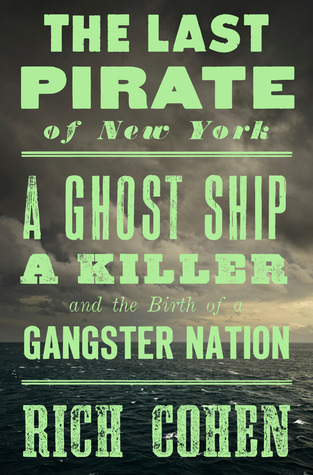
More on this book
Community


Kindle Notes & Highlights

by
Rich Cohen
Read between
July 3 - July 14, 2019

at Stillwell Avenue and the Boardwalk in Coney Island, where Lucky Luciano sat his boss Joe Masseria at a poker table, then stepped aside as a squad of hitmen, including Bugsy Siegel and Joe Adonis, came through the door.
Albert Hicks was a founding father same as them, only he was a founder of New York’s underworld. His story was passed down by word of mouth, told and retold until it became a legend. It was officially recorded just once—in the press, as it unfolded—then shifted from breaking news to tall tale, added to and tarted up as time passed.
All the good and all the bad were already in place in 1860.
Everything that’s happened since has merely been a dreamlike elaboration.
contemporaneous writers knew Albert Hicks was something other than a normal ...
This highlight has been truncated due to consecutive passage length restrictions.
He put his arm around the town and pulled it...
This highlight has been truncated due to consecutive passage length restrictions.
He was Manhattan as it had been when pirates anchored off Fourteenth Street.
His final spree played out like a ghost story, only it happened to be true.
Captain Stevens boarded the ghost, walked the decks, and saw the signs of the slaughter, then shook off whatever unease he might be feeling and got to work.
Trinity Church was the tallest building in Manhattan.
Crowds soon assembled to look at the ghost ship: cold-faced men in hats, street urchins, sailors, and clerks.
The Hudson, turbid and overshadowed by palisades, deepens below Manhattan.
In the old days, every road on the island ended at the water, the sun rose at the foot of every street.
The town grew around the harbor.
In the late 1600s, all housing and commerce were crowded in tight communion on the southern shore. It was a fishing village and a trading post, then a bustling military base, a fort on the edge of an unknown continent, then a small town, then a big town, then a small city, then a metropolis.
A black market in slaves flourished in the shadow of the harbor: pirates, violating the ban on the international slave trade, smuggled human beings from the west coast of Africa to New York, where they were sold, transferred, and carried to Baltimore, Charleston, Savannah, and New Orleans.
There was a booming trade in guns and narcotics. Mott and Pell streets would soon be riddled with opium dens, subbasement cellars with velvet couches where hopheads took the curling white smoke deep into their lungs, their stony eyes filling with clouds and clipper ships.
The toughest worked in the Sixth Ward, which covered a few dozen acres between Broadway and the Bowery.
but the river pirates had an otherworldly ability to fade into the mist. You closed your hand around them, but when you opened it, they were gone.
Detective Nevins was different. He looked like a beaver, short and thick, with rusty hair, a twitchy nose, and sharp eyes, and he worked and behaved like one—persistent and industrious, even dogged.
The fugitive had the feral look of a forest animal that finds itself in town, fascinatingly alive, mesmerizing but scary.
Kids gathered around him, wastrels—ten-, twelve-, fifteen-year-old boys who’d wandered over from the Five Points and adjacent slums, ragamuffins looking for a dollar. They were dark-eyed and ratty in their cast-off clothes, worn till they rotted and fell free. They lived outside in the sun, as natural a part of the environment as the gulls that lit on the rooftops. Hicks eyed the boys warily. A cop can be fooled, but a child sees right through you.
A decade later the city would actually produce a stench map, which people consulted in determining which parts of the city to avoid. Because a bad smell can ruin your day.
The coaches were large and roomy, elegant in the way of old-leather America, brandy, cigar smoke, and brass spittoons.
It was a rickety boardinghouse in the fields. The porch sagged, and the upper windows were like sad eyes in a sad face.
A tremendous beech tree shaded the yard, the trunk as smooth as river stone, its ribbed leaves as green as limes, with pale undersides that quaked in the wind. The tree filled like a sail on a blustery day, bellying out like the main canvas on a clipper ship. For two dollars, the cost of a steak at Delmonico’s in New York, you could engage rooms in such a place for a week.
Even the most hardened man might have a tell, a tic that betrays his guilt. We all want to be found out. If we’re not caught, how can we be forgiven?
it was edited and otherwise finessed by someone at the publishing house.
ornate, high-flown, and Victorian, American literary writing as it was before the simplifying purities of Lincoln and Hemingway—fancy,
spritzed with perfume, ten-cent words and the sort of wraparound sentences that a man like Hicks, a man of barrooms a...
This highlight has been truncated due to consecutive passage length restrictions.
The fall seemed endless, like plunging into a hole, deep and dark, or going through the mouth of a whiskey bottle into another life.
