
More on this book
Community


Kindle Notes & Highlights

Read between
January 26 - April 24, 2022

In 1979, employers provided young workers with an average of 2.5 weeks of training per year. Today, employers want workers they don’t have to train, and that has shifted the burden of upgrading skills onto the workers themselves.
education gospels converge with our articles of faith in individual work ethic, self-sacrifice, and gendered norms about being the head of a household.
Economist W. Norton Grubb and historian Marvin Lazerson call this the education gospel: our faith in education as moral, personally edifying, collectively beneficial, and a worthwhile investment no matter the cost, either individual or societal.
Education is good because a good job is good.
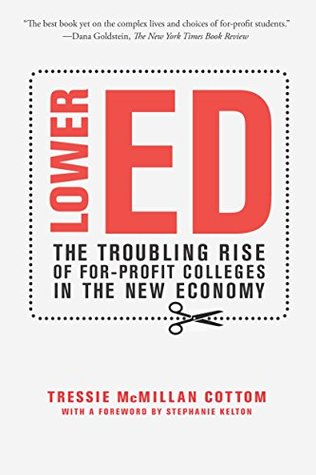
Lower Ed refers to credential expansion created by structural changes in how we work, unequal group access to favorable higher education schemes, and the risk shift of job training, from states and companies to individuals and families, exclusively for profit.
Lower Ed is, first and foremost, a set of institutions organized to commodify social inequalities (see Chapters 3 and 4) and make no social contributions beyond the assumed indirect effect of greater individual human capital.
Lower Ed encompasses all credential expansion that leverages our faith in education without challenging its market imperatives and that preserves the status quo of race, class, and gender inequalities in education and work. When we offer more credentials in lieu of a stronger social contract, it is Lower Ed. When we ask for social insurance and get workforce training, it is Lower Ed. When we ask for justice and get “opportunity,” it is Lower Ed.
The new economy makes one overriding demand of education: constantly and consistently retrain millions of workers, quickly and at little to no expense for the employer. The new economy is marked by four characteristic changes to the relationships that underpin our social contract: people are frequently changing jobs and employers over their working lifetimes (job mobility); firms place greater reliance on contract, term, and temporary labor (labor flexibility); there is less reliance on employers for income growth and career progression (declining internal labor markets); and workers are
...more
The decision to encourage or allow expansion to happen in the private sector instead of in the public sector was a political choice to uphold neoliberal ideas of individualism, markets, and profit taking.
At heart, higher education is a means both of redressing socioeconomic inequality and of perpetuating socioeconomic inequalities in new guises.
I make an explicit claim in this book: for-profit colleges are distinct from traditional not-for-profit colleges in that their long-term viability depends upon acute, sustained socioeconomic inequalities.
What is clear is that poor and minority students are disproportionately enrolled in for-profit colleges.
