
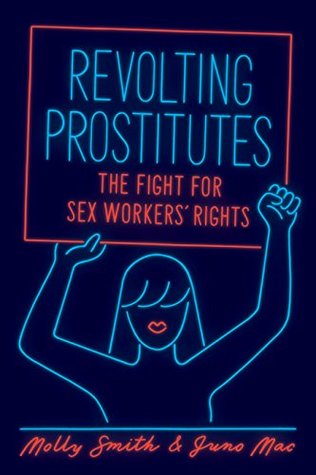
More on this book
Community


Kindle Notes & Highlights

by
Molly Smith
Read between
October 8 - October 30, 2022

The idea of prostitution serves as a lightning rod for questions about work, masculinity, class, bodies; about archetypal villainy and punishment; about who ‘deserves’ what; about what it means to live in a community; and about what it means to push some people outside that community’s boundaries.
Perhaps the most difficult questions raised by prostitution involve what it means to be a woman in a patriarchal society. Feminist writer Kate Millett notes feminist rhetoric suggesting ‘that all women are prostitutes, that marriage is prostitution’.1 Sex workers have long noted with ambivalence the interplay between prostitution as a site of metaphor and as an actual workplace.
Spare Rib)
the women’s movement has ‘used the word prostitute in a really nasty way – about housewives, to sum up their idea of the exploited situation of women’.2 They noted that this interest in the metaphorical uses of prostitute was not accompanied by much practical support for sex workers’ efforts to tackle criminalisation.
More political energy goes to obstructing sex work than to what is really needed, such as helping sex workers avoid prosecution, or ensuring viable alternative livelihoods that are more than respectable drudgery.
the practical and material rather than the symbolic or metaphorical. Approaching sex work from this perspective provokes certain questions. What conditions best enable someone who wants to quit sex work to do so? What conditions lead people to sell sex, or make sex work their only opportunity for survival? What gives a sex worker more power in negotiating with an employer, and what reduces their power?
People of all genders sell sex: transgender and cisgender men, non-binary people, and those with indigenous or non-western genders such as hijra, fa’afafine and two-spirit people.
In medieval Europe, brothel workers formed guilds and occasionally engaged in strikes or street protests in response to crackdowns, workplace closures, or unacceptable working conditions.5 Fifteenth-century prostitutes, arraigned before city councils in Bavaria, asserted that their activities constituted work rather than a sin.
Likewise, watembezi [street based] women in colonial-era Nairobi formed financial ties to one another, paying each other’s fines or bequeathing assets to one another when they died.10
When eight sex workers were murdered in the small city of Thika, Kenya, in 2010, others from around the country flocked to support them.
Europe the modern movement is generally considered to have begun in 1975, when sex workers in France occupied churches to protest criminalisation, poverty, and police violence.
the sex workers’ rights movement became increasingly international. The First and Second Whores’ Congresses took place in Amsterdam and Brussels, and new sex worker led groups began emerging from Australia, Thailand, Brazil, South Africa, and Uruguay, among other places.
In the mid-nineteenth century, as middle-class women emerged into the public sphere of the professions, a new kind of role was invented which married the ideal values and attributes of middle-class femininity to paid employment. In part, this can be thought of as a feminist project, as the alleged moral superiority of these women justified their taking a more public role in society, including working outside the home, the legal right to own property, the vote, and so on.
Even when their interests temporarily aligned, as in their shared struggles against the Contagious Diseases Acts of the 1860s, suffragists and other feminists failed to see sex workers as their equals. (Likening sex workers to animals persists in some feminist anti-prostitution activism, with prostitutes sometimes compared to service dogs, pets, and Pokémon.)29
many sex radicals advanced their arguments from a non–sex worker perspective. Defending porn often meant defending watching it, rather than performing in it.
Stuck in the domain of sex and whether it is ‘good’ or ‘bad’ for women (and adamant that it could only be one or the other) it was all too easy for feminists to think of The Prostitute only in terms of what she represented to them. They claimed ownership of sex worker experiences in order to make sense of their own.
However, as we explore in depth in chapter 2, sex positivity can be a counterproductive point from which to start a conversation about the actual conditions of the sex industry. Working class sex workers and sex workers of colour have long criticised the race and class privilege of these politics; labour rights and safety are not the same as pleasure, and those who do experience sexual gratification at work are likely to be those who already have the most control over their working conditions.
The way that sex workers’ rights is merged with the interests of men in the feminist imagination makes it easy for non-prostitute women to turn away from us.
The relationship between survivor-led, sex positive, radical, liberal, libertarian, Marxist, and carceral responses to prostitution is as fractious as ever. Both
In the southern United States, the first centralised and specialised policing organisations were slave patrols, whose major function was to capture and punish runaway slaves. Historians of the region argue that they ‘should be considered a forerunner of modern American law enforcement.’49
In the early-nineteenth-century northern United States and in the United Kingdom, professionalised police forces were set up in response to a restive urban working class organising against bad working and living conditions.
As historian David Whitehouse explains, the state needed a way to control burgeoning crowds, protests, and strikes without ‘sending in the army’, which risked creating working class mar...
This highlight has been truncated due to consecutive passage length restrictions.
Jewish refugees arriving in Britain in the 1880s and 1890s were met by a surge in anti-Semitism; anti-Semitic tracts claimed at the time that ‘the white slave traffic [is carried out] everywhere … by Jews’.52 This racist panic led to the enactment of the Aliens Act of 1905, which contained the first recognisably modern anti-immigration measures in Britain.
In the US, the first federal immigration restrictions included the Page Act of 1875, the Chinese Exclusion Act of 1882, and the Scott Act of 1888. These targeted Chinese migrants, particularly sex workers, and devoted substantial resources to attempting to discern wives from prostitutes.54
Puta, the Spanish word for prostitute, has links with the English putrid.* Another
Sometimes the connection between these ideas is obvious. For the Victorians, the ‘loss of virginity’ risks ruin and a grim death from syphilis. The ruined woman is reconfigured as an agent of destruction, spreading disease in her wake.
The nineteenth century Contagious Diseases Act gave police the power to subject any suspected prostitute to a forced pelvic exam with a speculum – a device, still in use today, invented by a doctor who found gynaecological contact repellent, and who purchased enslaved Black women to experiment on.6 In
with a cigarette between her red lips, a tight dress, and a wicked smile – above slogans warning that she and other ‘pickups’ were dangerous: traps, loaded guns, ‘juke joint snipers’, Axis agents, enemies of the Allied forces, and friends of Hitler.10
Campaigns for women’s suffrage in the late nineteenth and early twentieth centuries drew on the connection between women’s bodies and honour and the honour and body politic of the nation. These campaigns were intimately linked with efforts to tackle prostitution, with British suffragists engaging in anti-prostitution work ‘on behalf’ of women in colonised India to make the case that British women’s enfranchisement would ‘purify the imperial nation-state’.
Orders of nuns across the world ran workhouses and laundries for ‘fallen women’ – prostitutes, unmarried mothers, and other women whose sexualities made their communities uneasy.20 Conditions in these ‘Magdalene laundries’ were primitive at best and often brutal; even in the twentieth century, women could be confined within them for their whole lives, imprisoned without trial for the ‘moral crime’ of sex outside of marriage. Many women and their children died through neglect or overwork and were buried in unmarked graves. In Tuam, Ireland, 796 dead children were secretly buried in a septic
...more
The Irish nuns who ran the Magdalene laundries did not disappear.22 Instead, they set up an anti-prostitution organisation, Ruhama, which has become a major force in campaigning to criminalise sex work in Ireland, and now couches its work in feminist language.23
Sex, in these discussions, is positioned as something intrinsically too special to be sold – something intimate reserved for meaningful relationships. Implicit in this view is the sense that sex is a volatile substance for women and must be controlled or legitimised by an emotional connection.
In the UK, women ‘rescued from brothels’ are still sent to live with nuns.
Raising the subject of the worker’s needs (for safety, money, or negotiating power) would spoil the illusion that the worker and client are erotically in tune, and that she’s just as sexually invested in their encounter as he is. In this rhetoric, the focus can easily shift to the needs and enjoyment of the client.
This approach reaches its apex in the 2011 documentary Scarlet Road, which follows sex worker Rachel Wotton in her relationships with two disabled clients.
The worker’s interests are not identical to those of the client. Ultimately, the worker is there because they are interested in getting paid, and this economic imperative is materially different from the client’s interest in recreational sex.* Losing sight of that leads to a politics that is inadequate in its approach to workers’ material needs in the workplace.
Being critical about sex positivity in the sex worker movement should not mean pretending sex is incidental. We can explore the sexual experiences of people in the sex trade in a way that respects the diversity of those experiences – whether they are bad or good – and doesn’t overwhelm the conversation about labour rights.
An image of a woman in porn can be seen to stand in for ‘all women’, whereas an actual woman performing in porn is understood as essentially other. So ‘defending women from images of women in porn’ is a project that’s understood (by some feminists) as a broader political project, whereas the labor rights of women who perform in porn are considered marginal.
They, too, think that the question of whether sex work is work should primarily be fought on the terrain of whether sex work is good work.
Work is thus constantly being re-inscribed as something so personally fulfilling you would pursue it for free.
Working in crummy factories for disgusting pay was the most degrading and exploitative work I ever did in my life … I think there should be another word for the kind of work working class people do; something to differentiate it from the work middle class people do; the ones who have careers. All I can think of is drudgery. It’s rotten and hopeless; not even half a life. It’s immoral. Yet as I say, it’s expected of working class women that they deny themselves everything … Why should I have to put up with a middle class feminist asking me why I didn’t ‘do anything – scrub toilets, even?’ than
...more
With commercial sex criminalised, there can be no workers’ rights, whereas with commercial sex decriminalised, people who sell sex can access labour law. The left supports the decriminalisation of sex work because the left supports workers having rights.
Likewise, few sex workers would object if you sought to abolish the sex industry by ensuring that they got the resources they need without having to sell sex.
People are attracted to the concept of a Nordic-style law that criminalises only the sex buyer, and not the prostitute – but any campaign or policy that aims to reduce business for sex workers will force them to absorb the deficit, whether in their wallets or in their working conditions.
In fact, as Wages For Housework articulated in the 1970s, naming something as work is a crucial first step in refusing to do it – on your own terms.
‘to demand wages for housework does not mean to say that if we are paid we will continue to do it. It means precisely the opposite. To say that we want money for housework is the first step towards refusing to do it, because the demand for a wage makes our work visible, which is the most indispensable condition to begin to struggle against it.’36
Naming work as work has been a key feminist strategy beyond Wages For Housework. From sociologist Arlie Hochschild’s term ‘emotional labour’, to journalist Susan Maushart’s term ‘wife-work’, to Sophie Lewis’s theorising around surrogacy and ‘gestational labour’, naming otherwise invisible or ‘natural’ structures of gendered labour i...
This highlight has been truncated due to consecutive passage length restrictions.
When sex workers assert that sex work is work, we are saying that we need rights.
We are not saying that work is good or fun, or even harmless, nor that it has fundamental value. Likewise, situating what we do within a workers’ rights framework does not constitute an unconditional endorsement of work itself.
US law defines sex trafficking as ‘the recruitment, harbouring, transportation, provision, or obtaining of a person for the purpose of a commercial sex act’ – which, reading closely, we note does not necessarily entail the kinds of harms we might associate with the term ‘sex trafficking’.
